Home Blog Page 160

Celebrating Susan Gravely’s “Italy on a Plate”

0
A man in yellow pants and a blue jacket and a woman in a yellow dress cheers their glasses in the entryway of a home.

Susan Gravely and I have travelled parallel paths. Our first trips to Italy happened at about the same time in the 1980s. We both fell deeply in love with the beauty of its towns, the wonder of its food and wine, and the extraordinarily vivid, generous, and talented people we met there. Inevitably, our lives would be shaped around our shared Italophilia. 

Susan once founded Vietri, widely regarded today as America’s top dinnerware company. For 40 years, she has cultivated relationships with skilled ceramic and glass artisans across Italy. Their work, and their friendships with Susan, have brought Vietri to the best stores in our country. Neiman Marcus placed an order at her first trade show. From that early endorsement from a retail authority, Vietri has grown into 2,000 accounts across the US with a fulsome offering of dinnerware, glassware, flatware, home accessories, and more. Glassworks in Shadyside is part of Vietri’s network.

Susan Gravely in a yellow dress speaks to a man and woman seated at the dining table with a fancy light fixture over head.

A Wordless Meeting 

My own Italophilia guided me into a career as a merchandising executive in the home divisions of top US department stores. I saw Susan frequently at trade shows in New York, Milan, Atlanta, and Dallas. Her direct gaze, the interest she took in everyone who came her way, and her inventive knitting together of makers, products, colleagues, and customers, impressed everyone. She seemed able to see at a glance the movement of her products from factory floor to store shelves to kitchen tables, and wisely guided her business with what she saw. 

As Susan tells it, our most important rendezvous involved no exchange of words or glances. In fact, I didn’t even see her. Working hard in a Tuscan factory to pack a very late order of plates, she ducked her sweaty, dusty, T-shirt-wearing self behind a stack of boxes as I strode, in suit and tie, toward a conference room to inquire about the very same late inventory. Her conspirators kept her secret admirably, but I’m truly sorry she hid. I would have thrown my jacket off, loosened my tie, and pitched in. Working side by side, I might have enjoyed some of the stories Susan relays in Italy on Plate

The book Italy on a Plate by Susan Gravely sits on a brown placemat of a dining table.

Bringing Stories to Life Through Literature

We might have enjoyed dinner afterwards at Ristorante La Lanterna, a trattoria in Montelupo Fiorentino whose food and atmosphere draw not just people passing through on business, but generations of locals too. Susan shares several recipes from their menu in Italy on a Plate. I then smiled over her words about this place and its owners, the Pieraccioli family, recalling how often a combination of respect, humility, interest, and humor launched me time and time again into relationships with people who could just as easily brushed me off. Often the first step was to allow myself to be convinced by someone that wine with lunch does not distract from but rather adds to one’s intelligence! To paraphrase an old saying: When in Rome, do as the Romans do. Good things happen.

The book provoked even deeper smiles when describing people who have become her fast friends, and with whom I have also done some very happy buying, laughing, and breaking bread. Mariano Venzo from VBC in Nove then invites Susan into his home for family meals. His jovial countenance accompanies a willingness to experiment with new ceramic techniques and new dinnerware designs. Don Vincenzo Solimene, whose business is located along Italy’s breathtaking Amalfi coast, welcomed her into his 1960s Futurist factory, designed by architect Paolo Soleri. Together, with his children and an amazing crew of artisans, they introduced a collection of hand-painted plates to Americans which are now an instantly recognizable classic. I remember the first time I saw these plates in use–at the famed Orso Restaurant in NYC’s Theater District–and I marveled at their witty motifs. Brava Susan, I thought.

The interior of a darkly painted dining room sits a dining table decorated with brown placemats, lots of wild flowers, and blue plates.

Sharing the Love

I especially enjoyed her sketch of Franco Ammannati from Ceramiche Virginia, located in the countryside not far from Florence. A man of great creativity, he has been a part of some of Vietri’s most successful designs. Take Cucina Fresca, for example. Susan was searching for a collection of durable, high-fired dinnerware that would somehow express the tactile charm of low-fired terra cotta earthenware (pretty, but prone to chipping). Franco realized that by brushing the edges of plates with some beeswax prior to their final firing, he could coax the glaze into the gentle irregularity of terra cotta, with no sacrifice of strength. Franco’s genius is paired with an unforgettable sense of humor. The off-color punchlines of his very best stories prevent me (alas) from repeating any here! 

“These people have become as dear to me as family,” writes Susan. I know the feeling. One of my most cherished friendships was forged in the same mix of Italy, creative business, travel, love of food, sharp humor, and just plain old goodness of heart. I met Lisa Ottanelli in 1996 on a merchandising trip to Italy for Saks Fifth Avenue. As my buying agent then, she was supposed to keep me out of trouble and help me place efficient, easy-to-fill orders. Instead, we managed to get into all sorts of Lucy-and-Ethel trouble on the road, in the name of innovative product development and retail success.

Susan Gravely in a yellow dress holds a red glass in her hand and talks to two people whose backs are towards the camera.

Decades later, Lisa was an absolute integral part of Barberry Handmade, the artisanal store my sister and I ran in Sewickley not long ago. Still joined at the hip almost 30 years later, we’re planning a trip together even as this story goes to press. 

A Celebration for a Passionate Woman

Susan visited Pittsburgh last year to hold a book lecture and signing at TABLE Studios in Shadyside. A full house listened raptly to her stories of people, plates, and repasts. Afterwards, many of our guests shared the ways Vietri has been a part of their lives. The next day, 16 aficionados gathered at my house in Sewickley for lunch with Susan. Chef Kate Romane of Black Radish Kitchen prepared crostini, a green salad, Pesce all’Aqua Pazza and Torta di Mele Classico. These last two recipes, fish in a deliciously flavored tomato broth, and classic apple cake, are found in Italy on a Plate.

A light blue plate holds a dish of tomatoes in a sauce with a fork positioned at the top of the plate. On the placemat sits anotehr small plate and a glass of water.

James Mohn and I, as hosts, along with Justin Matase (who mixed a wonderful mocktail to start us off), set the table. Anne Dickson of Fox and the Fleur came early to create lush florals for the foyer, living room, and table. Susan, her “Gal Friday” Brette Baumhover, and Ilene Levy and Henry Shenk from Glassworks, arrived first. Then the rest of the guests arrived in summery splendor: Vivian Benter, Kanika Capel, Brenda Friday, Tim Komen, Mollie Hanna Lang, Nikol Marks, Kathe Patrinos, and Stacy Weiss. 

Two rectangular plates in blue and light purple hold a scoop of white cream with flower leaves scattered on top.

It All Comes Back to Italy

What did we talk about? After some introductions and some catching up, Susan got us talking about the food, the people, and the sublime talents of Italy, of course. The afternoon flowed gorgeously from dish to dish, and topic to topic. A bit of wine was poured. La dolce vita enveloped us. Which is exactly what Susan had envisioned as the effect of her book.

“My hope for Italy on a Plate,” she told us all, “is that it will encourage you to try new recipes and enjoy them with friends and family. I hope my words do Italy’s wonders justice, and that they inspire you to travel there, soak in its splendor, and bring some of it back with you to share with those you love, around a table, with a full plate and a full heart.” I suspect that the number of Italophiles in the world increased greatly that day.

To buy a copy of Italy on a Plate, and to see the Vietri line, visit Glassworks on Walnut Street in Shadyside.

Story by Keith Recker / Photography by Laura Petrilla / Table Settings by Ilene Levy and Glassworks / Dinnerware, Glassware, and Flatware by Vietri / Placemats, Napkins, and Napkin Rings by Kim Seybert / Food by Kate Romane, Black Radish kitchen

A footer photo with a grey and white marble background, three TABLE Magazines and subscribe info and button

Subscribe to TABLE Magazine’s print edition.

How to Make an Espresso Spritz

0
A cocktail glass is filled with a Espresso Spritz, garnished with an orange and sitting on a blue table surrounded by Nespresso pods.

Espresso Spritz is a summer alternative to the popular espresso martini. This refreshing mixture of espresso and tonic will kickstart your day, and prepare your mind for the challenges ahead.

Using Nespresso

For our Espresso Spritz, we use Nespresso pods for our shot of good energy. Their premium selections range to fit any type of coffee drinker. You can choose from light, velvety blends to strong, dark varieties. Plus, you can recycle each espresso capsule after using the easy brewing feature with the touch of a button.

Two pictures side by side of a glass with tonic water inside and espresso being poured over top to make a spritz. The glass is garnished with an orange slice.
Print
clock clock iconcutlery cutlery iconflag flag iconfolder folder iconinstagram instagram iconpinterest pinterest iconfacebook facebook iconprint print iconsquares squares iconheart heart iconheart solid heart solid icon
A cocktail glass is filled with a Espresso Spritz, garnished with an orange and sitting on a blue table surrounded by Nespresso pods.

How to Make an Espresso Spritz


  • Author: Anna Franklin

Description

No need to run to a bartender for your favorite cocktail.


Ingredients

Scale
  • 4 oz tonic water
  • 1 shot of espresso
  • 3/4 oz Amaro Montenegro
  • Splash of fresh orange juice
  • Garnish with fresh Basil and a brûléed orange slice


Instructions

  1. Pour 4 ounces of tonic water into a glass filled with ice
  2. Add 1 shot of espresso and a squeeze of fresh orange juice
  3. Garnish with basil and a brûléed orange slice

Coffee Spritz Preparation Instructions

A cup of this soothing beverage contains less than 70 calories, with lots of vitamin C from the orange juice.

Note that you can add a bit of simple syrup if you want your coffee spritz to be sweeter.

Also, keep in mind that this recipe has a lot of variations. The only two ingredients that are required are tonic water and espresso.

From thereon, there are a lot of spritzes that use bourbon, vodka or other liquors, flavored ice, lemon juice, etc.

Espresso Spritz: Origins

The spritz was created in the late 1800s, in the Veneto region of Italy (then part of the Austro-Hungarian Empire).

The word spritz means ‘splash’ in German, and comes from the way Austrian soldiers prepared the Italian wine they were drinking. They added a splash (or spritz) of still water into the wine to make the drink lighter.

Over time, the drink evolved from using still water to sparkling water, and eventually liqueurs like Aperol.

The espresso spritz, or the combination of espresso and tonic water, originated in Oslo. It was allegedly created by a barista at Koppi Roasters in 2007.

The drink grew in popularity in the Scandinavian region, and eventually found its way into the rest of Europe, even in the World Barista Championship.

Wrap Up

We hope you enjoyed our espresso spritz recipe. Make sure to try it out in the hot summer months for maximum delight.

For a perfect presentation of the espresso spritz, we recommend using an elegant Harcourt Proost Beer Glass from Baccarat, designed by Marcel Wanders.

Recipe and Styling by Anna Franklin
Photography by Dave Bryce

Subscribe to TABLE Magazine‘s print edition.

Spring Beef Stir Fry

0
Spring Beef Stir Fry in a purple bowl cut in half. Another bowl of rice cut in half, a half-cut spoon, and a smaller bowl with a side dish.

Spring has sprung, and so has your craving for a tasty, satisfying meal. This Spring Beef Stir Fry is a concoction of fresh flavors and colorful ingredients, perfect for those warmer days when you’re craving something light yet fulfilling. Tender strips of skirt steak marinated in a symphony of ginger, garlic, and orange zest are tossed with crisp-tender sugar snap peas, asparagus, and green peas. Get ready for a burst of flavor in every bite that’s as invigorating as the season itself!

What is Stir Fry?

Stir fry is a great way to pair protein and veggie combinations without overthinking the game plan. It’s a fast and flavorful cooking method where you toss ingredients in a wok or pan with a small amount of hot oil. By maintaining movement for the duration of cooking meat and veggies together (or veggies on their own), it thoroughly cooks the ingredients while infusing them with your choice of marinade. With this cooking method, you’ll prepare dinner in no time.

Print

clock clock iconcutlery cutlery iconflag flag iconfolder folder iconinstagram instagram iconpinterest pinterest iconfacebook facebook iconprint print iconsquares squares iconheart heart iconheart solid heart solid icon
Spring Beef Stir Fry in a purple bowl cut in half. Another bowl of rice cut in half, a half-cut spoon, and a smaller bowl with a side dish.

Spring Beef Stir Fry


  • Author: Veda Sankaran

Description

Cook up a pan full of fresh garden flavors with sizzling skirt steak.


Ingredients

Scale
  • 1 ½ lb skirt steak, cut against the grain into thin strips
  • 1 tbsp soy sauce
  • 1 tbsp oyster sauce
  • 1 tbsp sesame oil
  • 1 tbsp cornstarch
  • ¾ lb sugar snap peas, strings removed and cut in half
  • 1 bunch asparagus, trimmed and cut into 2” pieces
  • 1 cup frozen peas or blanched fresh peas
  • Oil for stir frying

For the marinade:

  • 2 tbsp finely chopped garlic
  • 1 tbsp grated ginger
  • 2 tbsp oyster sauce
  • 2 tbsp soy sauce
  • 1 tbsp brown rice vinegar
  • 1 tbsp sesame oil
  • Zest of 1 orange approx 1 tsp
  • 2 tbsp chicken broth
  • 1 tsp dark brown sugar
  • Black pepper to taste


Instructions

  1. First, stir together all the marinade ingredients and set aside.

  2. Prep the meat, making sure to cut your strips thinly and across the grain.

  3. Pour a tablespoon each of soy sauce, oyster sauce, and sesame oil over the meat, using your hands to massage it evenly. Next, pour about a tablespoon of the marinade and repeat to evenly distribute. Finally, sprinkle the cornstarch and stir to coat.

  4. Let sit on the counter for 20-30 minutes as you prep the sugar snap peas, asparagus, and peas.

  5. Begin the stir fry by adding some neutral oil to the bottom of a wok. Add half the marinated/velveted beef and quickly sear on high heat. Remove and repeat with the remaining half of the meat.

  6. If there is too much cornstarch stuck to the bottom of the pan when you are finished searing the meat, give your wok a quick rinse, scraping off the stuck on bits, before stir frying the vegetables.

  7. Make sure the wok is dry before adding more oil to coat the bottom to begin stir frying the vegetables. Once the oil is hot, add your sugar snap peas and asparagus and stir fry for about 3-5 minutes depending on the thickness of your asparagus. Your veggies should be still green, and tender but with a crunch.

  8. At that stage, add the seared steak back into the wok, along with the remaining marinade. Quickly combine everything and cook for a minute before adding the peas. Stir and cook for 30 seconds, before removing from the heat. Serve immediately with Jasmine rice.

Recipe and Food Styling by Veda Sankaran
Photography by Dave Bryce

Subscribe to TABLE Magazine’s print edition.

A Dinner Party in a Newly Remodeled Kitchen

0
A matte blue stove with black embellishments sits below a white stove hood with gold embellishments. Purple wine glasses sit to the right of the stove on a white countertop.

A dinner party in a newly remodeled kitchen is the perfect way to celebrate its completion. What began as a galley kitchen with a breakfast nook is now a spectacular cooking and dining space, brought to life by Ida McConnell, certified kitchen designer and owner of Cuvée Kitchen Designs, Inc.

The luminous redesign is rooted in McConnell’s philosophy of “creat[ing] a welcoming, enticing, pleasing, and functional environment. A space that creates a positive visceral reaction, one in which you want to linger and a place to enjoy while performing the tasks at hand. Where form not only follows function, they are one and the same.”

Two photos sit side by side of two different sinks in an expansive kitchen. On the left is a completely white painted cabinet adn sink while on the right are black cabinets and a teal striped backsplash.

Forming a Gathering Space

An inviting island seats five and is equipped with refrigeration drawers, keeping fruit and vegetables close at hand, making prep a breeze.

The room’s focal point is the incredible stove hood, custom-detailed by a local metalsmith and flanked by arched windows. The view to the backyard invites the outdoors in, and the rounded shapes create continuity with arched architectural details on the home’s front porch. Phillip Wentzel Custom Homes was the contractor for the project.

A white cabinet with a blue oven built into it with gold embellishments.

Another showstopper? The beverage center, featuring a glass-front, built-in True refrigerator, custom painted and detailed to blend into the cabinetry. Its open facade beckons guests to gather and select a tasty, chilled drink. A HydroTap by ZipWater dispenses filtered water, carbonated water, and hot water for easy drink making. The pop of striped wallpaper draws attention without disrupting the flow

The kitchen also features a custom coffee bar with a built-in pot filler. The barista station lives inside a tall cabinet with retractable doors that neatly hide the area when it is not in use.

A man and woman both in black chefs coats and aprons cook side by side at a stainless steel stove.

Rutt HandCrafted Custom Cabinetry, supplied by Cuvée Kitchen Designs, creates seamless transitions between the appliances and storage. For example, the refrigerator and freezer are paneled to appear “more like an armoire piece” says McConnell. Glass-front cabinets throughout are ideal for displaying beautiful dishes.

To craft a refreshing color palette, McConnell combined Benjamin Moore Decorator’s White and Hale Navy paints, Oxford Brown-stained walnut wood cabinetry finishes, and Primo Marble & Granite Quartzite and honed-white Tropicalia countertops.

Hidden Surprises

By expanding the kitchen’s footprint, McConnell was able to add a hidden, walk-in pantry, expertly concealed with French doors that complement the cabinets. A step inside reveals an extensive preparation area outfitted with an ice maker, plenty of counter space, shelving, a second dishwasher, and an abundance of storage. Additionally, McConnell designed a new, functional, walk-through butler’s pantry that is in harmony with the home’s age and details.

Extensive space planning and organizational elements rounded out the project, including dividers for utensils, a knife drawer, and an array of hidden organizational features. Prior to move-in, “We walked through every drawer, every cabinet so [that] everything just flowed beautifully,” she says.

A woman in a black chefs shirt stands at a counter with two white plates in front of her.

What better way to celebrate the finished product than a dinner party? Kimberley Haugh of Kimberley Ashlee Catering created a sumptuous dinner menu, complete with wine pairings selected by her husband, Josh Haugh. The multicourse menu was served on traditional dinnerware in colors that perfectly complement McConnell’s design. Cheers!

The Menu, Kimberly Haugh of Kimberley Ashlee Catering

Shrimp Toast with Chili Aioli

Butter Tarragon-Roasted Monkfish with Carrot Purée, Finished with Watercress

Sautéed Italian Greens & Radicchio with Pecorino

Individual Truffled Chicken Pot Pies

Apple Custard with Spiced Apples & Pecans

Small white plates of salads and parfaits sit on a white table accompanied by light gold silverware and other embellishments.

The Wine Pairings

Waterbrook Sauvignon Blanc 2020

Beautiful and crisp with notes of honeydew and apricot

Schug Pinot Noir 2020

Light and bright with notes of red cherries, raspberries, and spice

Appliances Sourced from Don’s Appliances

BlueStar 48” RNB Series Range with 12” Griddle

Best Built-In Hood PK22 Series

BlueStar 30” Electric Wall Oven with French Doors

True 30” Beverage Column with Stainless Glass Door

Cove Dishwasher DW2450

Sharp Microwave Drawer

U-Line 15” Nugget Ice Machine

XO Beverage Center Refrigerator

Fisher & Paykel Integrated Double DishDrawer Dishwasher

Sub-Zero 30” Designer Over-and-Under Refrigerator and Freezer with Ice Maker

Story by Nicole Barley / Photography by Dave Bryce

A footer photo with a grey and white marble background, three TABLE Magazines and subscribe info and button

Subscribe to TABLE Magazine’s print edition.

5 Delicious Recipes for Ramps

0
A plate of garlic knots sit on a green table top beside a side dish of ramp butter.

Today, we’re talking ramps. And no, we don’t mean the skateboarding kind. We mean those wild, springtime sprigs of green with a small white bulb at the bottom. What may be mistaken for another spring onion or leek, is actually a burst of garlic-flavored goodness. While you may not know how to incorporate these little treats into your own recipes, we have 5 recipes that are an excellent starting point. From these recipes you can learn how ramps interact with other ingredients and even create ramp variations and butters that are perfect add-ons to your everyday meals.

Pickled Ramps

A cocktail table holds three blue cocktails and a plate of potato halves topped with pickled ramps.

The bite of ramps can be a little too much if eaten raw or on their own. However, pickling is a way to cut any bitterness, tone down the garlic-taste, and expand the overall flavor. Try your Pickled Ramps on any salads, sandwiches, or even atop fingerling potatoes like Chef Tom Shuttlesworth recommends.

Garlic Knots

A plate of garlic knots sit on a green table top beside a side dish of ramp butter.

With the garlic power of ramps, it’s no question that they make a great addition to Garlic Knots. A delectable ramp butter coats the tops of these soft, pillowy beds of bread. You can choose to make your knots from scratch or purchase a pack from the grocery store to make things even simpler. Plus, the ramp butter will freeze well for an addition to your next dinner.

Kohlrabi Flan

A blue plate holds Kohlrabi Flan with a salad of greens, mushrooms, ramps, and radishes all on a marble table with dandelions and other flowers around the plate.

If you’re conflicted on trying ramps for the first time, this Kohlrabi Flan recipe is the one for you. Ramps are not the main aspect of this dish but complete the flavor surrounding the Kohlrabi Flan. It combines ramps with dandelions, mushrooms, radishes, and other greens to make a complimentary salad.

Spaghetti with Ramps, Chiles & Two Cheeses from Food & Wine

A white plate holds a spaghetti dish with a pair of forks sitting next to the plate on a blue table.
Photo courtesy of Huge Galdones for Food & Wine

For your next dinner, try Spaghetti with Ramps, Chiles, and Two Cheese from Food & Wine for a hearty meal full of textures and tastes. The heat from the chiles and garlic from the ramps balance each other out so one doesn’t take over the entire flavor. Pecorino Romano cheese and Parmigiano-Reggiano cheese round out the dish for a dinner the whole family will love.

Ramp Chimichurri from A Couple Cooks

A glass jar holds a green ramp chimichurri sauce with a spoon sitcking out of it, all against a white background.
Photo courtesy of A Couple Cooks

Make your chimichurri extra garlicky with a Ramp Chimichurri from A Couple Cooks instead. This green, smooth sauce is usually used in Latin America dishes. This version uses just ramps, olive oil, and red wine vinegar since the ramps supply the leaves/greens you need. You can really serve chimichurri with anything. Spread it on steaks, fish, grilled vegetables, tacos, eggs, whatever your heart desires.

Story by Kylie Thomas

A footer photo with a grey and white marble background, three TABLE Magazines and subscribe info and button

Subscribe to TABLE Magazine’s print edition.

Pickled Ramps

0
A yellow plate holds small potatoes with Pickled Ramps on top, a spritz drink to the left, and flowers behind the plate.

Chef Tom Shuttlesworth shares his recipe for Pickled Ramps, which can be added to a wide range of roasted meats, pilafs, and other dishes for a burst of flavor. With the blooming of spring comes a flourish of wild ramps, with their pungent garlicky aroma and long green stalks. The pickling process tames the ramps’ sharp bite, transforming them into a tangy, savory treat. Add a vibrant pop to everything from charcuterie boards to sandwiches to salads, or even used atop fingerling potatoes like the photo above.

What are Ramps?

Ramps are a type of wild onion or wild leek, that appear during the spring season, particularly in regions like Western Pennsylvania. They have a distinctive appearance with broad, smooth, leaves that emerge from the ground, and also often have a reddish-purple tinge at the base of the stem. Their flavor is a potent and interesting combination of garlic and onion, often described as having a pungent, savory taste that is more intense than most scallions or leeks.

Print
clock clock iconcutlery cutlery iconflag flag iconfolder folder iconinstagram instagram iconpinterest pinterest iconfacebook facebook iconprint print iconsquares squares iconheart heart iconheart solid heart solid icon
A yellow plate holds small potatoes with Pickled Ramps on top, a spritz drink to the left, and flowers behind the plate.

Pickled Ramps


  • Author: Chef Tom Shuttlesworth

Description

Take advantage of this fleeting ingredient.


Ingredients

Scale
  • 8 oz ramps
  • 2 dried red chilies (Korean gochugaru is best)
  • 2 bay leaves
  • 1 tsp black peppercorns
  • 2 tsp fennel seeds
  • 1 cup rice wine vinegar
  • ½ cup sugar
  • 1 tbsp kosher salt


Instructions

  1. Trim greens from ramps; reserve for another use. Pack bulbs into a heatproof 1-pint jar along with dried red chilies, bay leaves, fennel seeds, and black peppercorns.
  2. Bring rice wine vinegar, sugar, salt, and 1 cup water to a boil in a medium saucepan, stirring to dissolve. Pour over ramps to cover. Seal jar. Let cool, then chill.

Do Ahead: Ramps will keep 2 weeks in your refrigerator, or use the boiling water canning method for longer life – I’ve kept over a year when properly canned.

Recipe by Chef Tom Shuttlesworth
Food Styling by Clare Vredevoogd
Photography by Andrew Burkle

Subscribe to TABLE Magazine’s print edition.

Kohlrabi Flan

0
A blue plate holds Kohlrabi Flan with a salad of greens, mushrooms, ramps, and radishes all on a marble table with dandelions and other flowers around the plate.

This special recipe is an answer to the frequently asked question, “How to cook kohlrabi?” Chef Jamilka Borges, co-owner of the restaurant Lilith, turns what is traditionally a less-than-beloved vegetable into a sought-after savory starter served atop fresh greens, ramps, mushrooms, radishes, and dandelions. Delicious!

Kohlrabi Flan Recipe

INGREDIENTS

1 tbsp butter
2 tsp salt
3 cloves garlic, minced
1 medium shallot, minced
2 bulbs of young kohlrabi, peeled and diced
1 qt heavy cream
1 fresh bay leaf
6 eggs
Oiled ramekins
Dandelions
Radishes
Mushrooms
Ramps

INSTRUCTIONS

  1. In a pot, melt the butter, add salt , and sauté the garlic and shallot until translucent.
  2. Add kohlrabi, heavy cream and the bay leaf, cooking on low heat until the kohlrabi is cooked through, about 25 to 30 minutes. The cream should look a little caramelized and the kohlrabi should be extremely tender.
  3. Blend in Vitamix, adding one egg at time, and strain through chinois sieve. Pour mix into 4 oz oiled ramekins.
  4. Place in hotel pan with rack and water, cover with foil. Bake in a 325 degree oven for an hour or until slightly jiggly, rotating every 20 minutes.
  5. Once done transfer to a cooling rack and let cool for at least 3 hours.
  6. Plate with a salad of tender, flavorful greens such as dandelions, radishes, mushrooms, and ramps.

Recipe by Chef Jamilka Borges 

A footer photo with a grey and white marble background, three TABLE Magazines and subscribe info and button

Subscribe to TABLE Magazine’s print edition.

Spring Travel Guide 2024

0
An outside image of The Grand Lodge at Nemacolin, a tan and brown building with terra cotta roofing and a large patio area with lush greenery in the front of the building.

Get out of town with our Spring Travel Guide recommendations.

Short trips are the champion of spring. The days are longer, the air is warmer, and we feel the itch to get out and explore. With this list of getaways and events, it’ll be easy to find the trip – or trips – to get yourself, family, and friends out of Pittsburgh this spring.

Welcome to the TABLE Magazine Spring Travel Guide 2024.


A bottle of red wine with grapes in front of it sitting on a wooden picnic table outside in what looks like a wooded area.

Presque Isle Wine Cellars

“Founded in 1964, Presque Isle Wine Cellars is a family-owned winery located in the heart of the beautiful Lake Erie Wine Growing Region.  We invite you to sample our award-winning wines in our Isle House Tasting Room or visit our beautiful creekside location and enjoy a relaxing picnic and glass of wine by the waterfalls.”


A man and a women standing in front of the Penn Shore Winery Sign with 2 dogs on leashes.

Penn Shore Vineyards

As the oldest winery in Pennsylvania, we strive to continually produce the finest varietals and blends from European and American wine grapes grown nearby. Enjoy a glass of wine while sitting on our back patio surrounded by hundreds of acres of grapes, or simply browse through our large retail & tasting rooms. Be sure to visit our website or Facebook page for more information on our events and what’s going on at the winery.


A close-up of a green grape leaf on a grapevine.
PA Wines

For more than 330 years, Pennsylvania has been creating a deep winemaking legacy. It all began when William Penn planted a vineyard in what is now Fairmount Park in Philadelphia. Today, more than 400 wineries and 14,000+ acres of Pennsylvania vineyards are producing more than 2 million gallons of wine every year.  Pennsylvania ranks fourth in the nation for wine production with growing attention for the exciting diversity of wines grown.

Experience all that Pennsylvania wines have to offer by planning a weekend getaway along one of the wine trails, enjoy a wine tasting at a picturesque vineyard, or join one of the exciting events at a winery.  Along the way, learn more about the impressive variety of wines grown, made, and proudly poured in Pennsylvania. You’re never more than an hour away from a winery in Pennsylvania! To start planning, visit pennsylvaniawine.com.


An outside image of The Grand Lodge at Nemacolin, a tan and brown building with terra cotta roofing and a large patio area with lush greenery in the front of the building.

Nemacolin

Discover Real Life Magic at Nemacolin

Across more than 2,200 majestic acres in the Laurel Highlands of southwestern Pennsylvania, Nemacolin is a four-season playground for adventurers who expect the unexpected. With five luxury hotels, you’ll find the perfect getaway at our mountain hideaway,, whether you prefer the iconic, art deco interiors of Falling Rock, the breathtaking elegance of The Chateau, or the private grandeur of The Homes and The Estates. And just wait until you see The Grand Lodge in all its suite glory.

Nemacolin continually reinvents  luxe offerings and has again earned 22 Forbes Five-Star and Four-Star accolades across the resort. Luxuriate in one-of-a-kind dining and entertainment options, including modern cuisine inspired by the sea at Aqueous, two championship Pete Dye-designed golf courses, and sensational spa and wellness treatments. Our enchanting resort is perfect for curious explorers, offering seasonal and exhilarating outdoor activities like Jeep off-roading, ropes courses, fly fishing, horseback riding, and much, much more. Adventure awaits at Nemacolin.

nemacolin.com


A close up picture of a grapevine with grapes in the process of ripening.

Lake Erie Wine Country

Sip, Savor and See Lake Erie Wine Country!

Lake Erie Wine Country is in the largest grape-growing region east of the Rockies.  It extends nearly 50 miles along the Lake Erie shore in Pennsylvania and New York and is home to over 21 unique wineries.  Head north from Pittsburgh and in two hours you will be in the heart of wine country!  Open year round, we are anxious for you to visit, taste our award-winning wines and experience the beauty of our vineyards.  Visit www.lakeeriewinecountry.org  to explore other things to do and places to stay and eat while you’re here.


Packsaddle Covered Bridge, a red wooden bridge over small waterfalls and a clear stream in a wooded area.

Laurel Highlands

Spring is the best time to take on an outdoor adventure in Pennsylvania’s Laurel Highlands! Go the extra mile on a scenic hike or make family memories biking on the Great Allegheny Passage or one of many trails. River sports kick off in the spring including amazing fly fishing and trout streams. Of course, you can unplug and reconnect with a relaxing spa day. An exciting weekend in a charming Laurel Highlands’ cabin is an excellent way to recharge. Or experience the great outdoors camping or glamping under the stars. GO beyond expectations! Plan your spring getaway at GOLAURELHIGHLANDS.com


A photo of the outside of a building with multicolored stacked stone, wood, and white trim with a statue of a green standing frog on the right of the building.

KingView Meadery

KingView Meadhouse & Winery brings you award winning meads (honeywine), hard ciders and wines. We are located only 6 minutes west from historic downtown North East, or 6 minutes east from Harborcreek shopping district. With vineyard views in our backyard, this unique meadery destination is the perfect setting for your special occasion and can handle large groups with our 35 ft. tasting bar that also serves PA craft beers. Come see why KingView Mead stands out as a preferred mead across the nation, and experience something different.


A grape vine that is just budding.

Johnson Estate Winery

Johnson Estate Winery is NYS’ oldest estate winery. It produces world-class Rieslings and other wines in the Germanic environment along the shores of Lake Erie in Western New York. The winery is proud to produce high quality wines from Estate-grown grapes grown on our 110 acres of vineyards. As an estate winery, vineyard practices are wholly integrated into the production of the wines, and quality, rather than quantity, is our governing principle “from bud to bottle”.


A photo of Fallingwater nestled in a lush green wooded area with the waterfall and stream running through it.

Fallingwater

Fallingwater, part of UNESSCO’s World Heritage List, is open for its 61st tour season! Edgar Kaufmann Jr. called it “a work of art…. set on the waterfall of Bear Run, spouting nature’s endless energy and grace.”

Explore the house’s intimate relationship with nature during a Guided Architectural Tour. Or take a grounds tour, or In-depth or Focus tour or Family Field Trip. Visit the Café to enjoy locally sourced coffee drinks, snacks and lunches inspired by Appalachia’s culinary history and seasonal produce.

Enjoy a unique shopping experience in the Museum Store. Our items, many of which are small-batched and locally crafted, are chosen by a team drawing inspiration from the Kaufmann family’s collection.

Stop in the Speyer Gallery for the 2024 exhibition “Frank Lloyd Wright’s Southwestern Pennsylvania—The Fallingwater Projects,” unrealized projects Wright designed for the Fallingwater site from the 1930s through the 1950s.

Deepen your understanding of Wright’s organic architecture by exploring Fallingwater Institute’s education programs. Attend discussions by the Living Room fireplace with director Justin Gunther and a special guest.

Discover why Fallingwater is a place the Kaufmanns believed would enrich lives, inspire generations and connect people to nature. Visit Fallingwater.org for information about education programs, reservations and more.


A vast picturesque look at the lake in Crawford County with several canoes in the water.

Crawford County

Whether it’s your first time or your 20th, when you visit Crawford County, expect to immediately find yourself among family. Away from the buzz and the busy, Crawford County is home to people and places that encourage exploration and relaxation. Our passionate community is full of warm, welcoming residents who are ready to show you what we have to offer.

Around every corner, expect to find a new friend eager to share the comfort and creativity of the area. Adventure is abundant in Crawford County no matter the weather. When the snow settles in, you can warm up with local beer and wine. You can also unpack the history and culture of Northwest Pennsylvania. Explore the intimate, innovative collection of downtown areas where unique, small businesses are thriving. When the temperatures heat up, don’t miss the stunning scenery or outdoor experiences. Nowhere quite encapsulates the great vastness of nature like Crawford County.

Come alive in our great outdoors! There’s fishing, angling, boating, and kayaking in some of the most beautiful glacier lakes in the country. There’s hiking through acres of lush forest paths.

Crawford County also knows good food. That’s why we have over 100 restaurants, breweries, cideries, wineries, diners, sweet shops and more to choose from! Craft Beer to Ciders to Coffee shops, come visit Crawford County, PA and see what we have to offer! You’ll be pleasantly surprised! With all the quaint B&B’s, Hotels, Cabins, Campsites, and Cottages, you should stay for the whole weekend!

Visit our website at visitcrawford.org for more information, suggested itineraries, events listings, and to download our mobile app. ”


Light tan colored wine barrels from 21 Brix stacked sideways on metal racks.

21 Brix

At 21 Brix Winery, our name is inspired by the measure of sweetness in grapes. But what we think is even more important is the sweetness of the experiences created by bringing people together. Come visit our spacious tasting room, sample our wines, and browse our gift shop. We offer local craft beer and cider on tap in addition to a variety of small-plate food options. Conveniently located on Route 20 between Brocton and Westfield – look for the pink elephant! Open daily 10-6. 21 Brix Winery – where life (and wine) is #sweetshared.

Content and Photography provided by locations.

A footer photo with a black background and subscribe info and button

Subscribe to TABLE Magazine‘s print edition.

 

Bringing Sustainability to Chautauqua Lake Houses

0
The outside of a Chautauqua Lake house surrounded by tall green grass and trees.

Situated near stunning Lake Chautauqua on the grounds of the Chautauqua Institution, Jeff and Suzanne Watters’ summer lake house benefits greatly from its beautiful, historic location. Following a sustainable renovation, the relationship works both ways, bringing the home into complete harmony with nature and place.   

As co-creator of Sustainable Sewickley, an organization dedicated to promoting, sharing, and adopting sustainability efforts in the community, “I think about sustainability in whatever I do,” says Suzanne. “Every day, every decision I make. [Choices] may seem small but you have to think what kind of impact it’s going to have over the years.”  

Living sustainably is one thing; building it is another. Taking the leap into making a LEED-certified home involved a steep, and important, learning curve. 

The outside of a wooden Chautauqua lake house with a fire pit outside and two people sitting on the porch,.

Creating a Green Home 

The couple worked with Cincinnati-based Green Building Consulting to align on scope, objectives, and budget before diving into design. The Watters recommend that homeowners interested in gaining LEED certification (which stands for Leadership in Environmental and Energy Design) to do the same. “We were far from fluent or comprehensive in the initial framing of our desired scope. We also learned that the path to LEED can be a bit circuitous and the rating criteria a bit opaque, even for the experts!” says Jeff.  

With the help of a talented team, including Serena Sturm Architects to lead sustainability design and Chautauqua’s Chris Keefe Builders, the home is now Platinum LEED-certified. 

The side of a Chautauqua Lake House with a stone path under a tree leading down to the lake.

Meeting the Standard

Qualifications for this rating, the highest available, include water and energy efficiency, and smart material management and landscaping, all verified by rigorous third-party performance testing and inspections. Platinum LEED status was granted 18 months after the project’s completion.   

Every step of the way, the couple led with a sustainability-focused mindset, hosting estate sales for items they no longer needed, donating to construction reuse centers during demolition, and repurposing as many materials as they possibly could during the rebuild. 

Construction maintained as much of the legacy structure as possible, including a portion of the foundation and framing. One of the big projects was installing the roof-to-foundation insulation wrap. This is a critical element in ensuring a tight seal and long-term energy efficiency in sustainable homes. Plus it adds extra insulation and high-efficiency windows and doors.

The living room of a Chautauqua lake house with a wood coffee table, modern couch and beige walls.

Using Clean Energy

The house doesn’t use fossil fuels for energy. Instead, it has a PV array, or solar panels, and runs on a multiunit electric heat pump powered by renewable wind and solar energy sourced through their local energy supplier. A multiunit heat pump, ENERGY STAR appliances, insulated plumbing, LED lightbulbs, and an electric vehicle charging station in the garage also contribute to the home’s low-carbon footprint. According to the US Green Building Council, LEED-certified homes use 30 to 50 percent less energy than typical homes. 

They called on Sewickley-based dsjDESIGN for the home’s layout and general architecture, and simplicity guided the aesthetic. “We wanted the focus to be on the connection to the land,” says Suzanne. 

Reclaimed stone steps and low-maintenance exterior siding from reSawn Timber Co. complete the exterior, which is visually in the style of other clean-lined, wood-clad homes in the surrounding area. 

A white and brown dog sits on a small daybed in the living room of a Chautauqua Lake House with the lake in the background outside the sliding glass doors.

Handcrafted Not Factory Made

Artisan-made textiles and fixtures, locally made where possible, bring the interior to life. “What couldn’t be sourced locally was sourced as intentionally and sustainably as possible,” says Suzanne.  

Those elements include FSC-certified oak floors from Allegheny Mountain Hardwood Flooring; locally sourced limestone counters; handmade tile made with a percentage of recycled material from Limelight Tile & Ceramics; and metal railings, lighting, towel bars, and stove hood made by local metalsmith, Emerson James Inc. Wool carpeting from ProSource replaces typical carpet made with plastic-based fibers; floor tile from Architectural Clay Products includes a percentage of recycled content; and select light fixtures are made with recycled paper. Local furniture store, Room, helped source dining chairs with recycled upholstery and light fixtures.  

The kitchen of a Chautauqua Lake House with a dark counter top with brown lights over top.

Sustainability Beyond the Construction

Suzanne, an artist, is also “on a mission to make my art practice as sustainable as possible.” This includes everything from reusable materials to eschewing acrylic paint (which contains plastic) and making her own from organic materials like cabbage, blackberries, carrot leaves, and black walnuts and ashes from her fire pit.   

Her nature-inspired art bedecks the home, along with a variety of accessories, wares, and handmade furniture from local makers. 

Wherever possible, finishes are nontoxic, including zero-VOC paint and Rubio Monocoat, a zero-VOC hardwax oil wood finish, on the floors.   

The air filtration HVAC system brings filtered outdoor air inside and low-flow faucets and fixtures promote reduced water use. 

The kitchen counter of a Chautauqua lake house holds bottles of wine, paintings, and bowls beside a stove and stove hood.

Fueling the Earth

Native grasses, wildflowers for pollinators, a composting station, and raised beds for growing food fill the biodiverse garden, designed by Joseph Rollman. One thing you won’t find is monoculture, the typical American expanse of green lawn that needs to be cut weekly. In its place is permeable hardscape, including walking paths, courtyard patio, and driveway, which supports water management. This is supported through bioswales that redirect stormwater runoff. Plus, rain gardens that returns water into the ground, rather than sewers help too.  

If it all sounds a bit complex, well, it was. But Suzanne and Jeff agree that their efforts were worth it. They encourage others to implement green building practices in any way that is manageable for their lifestyle or budget. “Every step counts,” says Suzanne. 

Summers in their home feel like a retreat. “A more sustainably built house is so quiet,” says Suzanne. “The air is really clean, and it feels so well built, natural, and beautiful. We love being there.”  

“We hope that our role as ‘first mover’ in the community will serve as inspiration for other Chautauqua Institution homeowners and homeowners everywhere to emulate,” says Jeff. 

The back outside of a wooden Chautauqua lake house surrounded by high grass and trees,

Story by Nicole Barley / Styling by Keith Recker and Justin Matase / Photography by Laura Petrilla

A footer photo with a grey and white marble background, three TABLE Magazines and subscribe info and button

Subscribe to TABLE Magazine’s print edition.
A Family-Friendly Contemporary Kitchen Remodel

0
The silver stove, oven, hood, and sink sit against the wall of a remolded kitchen, a wooden table sits in the middle of the room with orange flowers on it.

When Nathan and Kathy Anderson were in the market for a new house, they found a well-preserved, circa-1900 home that was ideal for their family. Well, almost. The small, split-up kitchen was nearly a dealbreaker. But with the expert help of Jan and David Horner of Drury Cabinetry, they were able to create something they loved. 

A kitchen remodel with ladles hanging above the stove range, a wooden table in the middle, white counter tops, and black cabinets.

From Small to Expansive

The kitchen in the Anderson’s old home had been typically modern—large, with an island and plenty of cabinet and counter space. The new home featured a small cook’s kitchen with little of either of those. “When we first came to look at the house, I just didn’t understand. It was way in the back of the house and the butler’s pantry was in a different area than the main kitchen. And then there was another pantry in the back,“ says Nathan. 

From census records, Nathan and Kathy discovered the original home had had a housekeeper and two or three other servants living there. It was, of course, not meant for use by the family who originally owned the house. “We are not living the 1900s luxury lifestyle, we are cooking for ourselves and our five daughters. We don’t have any servants!” 

Black kitchen cabinets above and below a white counter top with black cutting boards leaning against the white backsplash.

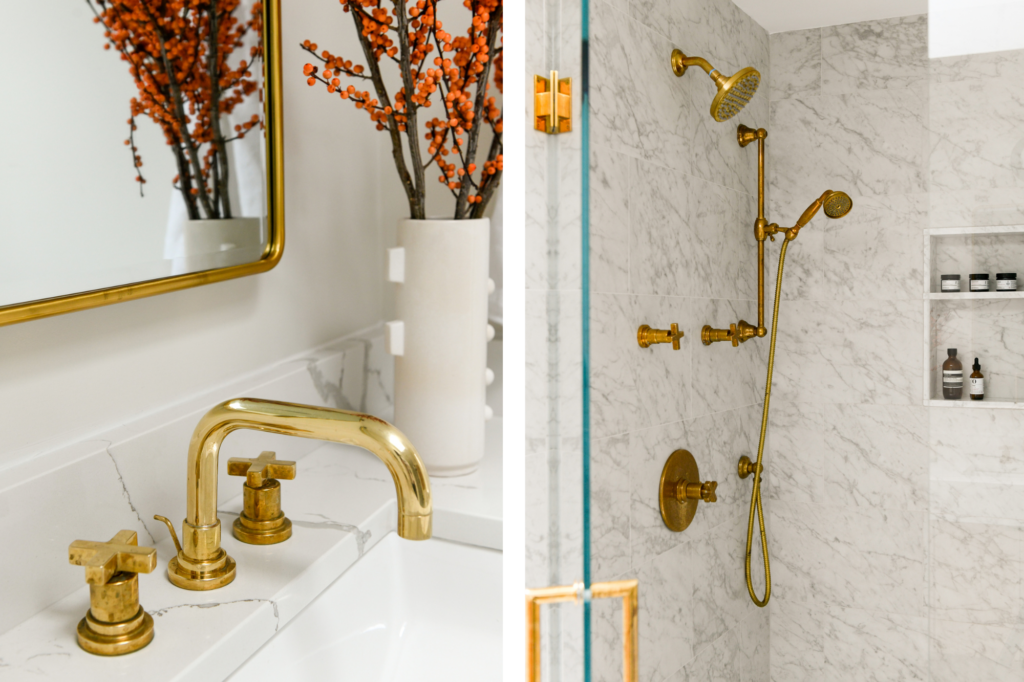
The Andersons are only the third family to occupy the house, but over the years the kitchen had accumulated a few unfortunate “updates,” including bright fluorescent lighting. It required a lot of work, and the couple wanted to retain and restore the mood of the original, a process which included using materials and colors appropriate to the time of its construction. (It also meant eschewing modern creations like engineered countertops.) “I wanted raw brass,” says Kathy. “I also wanted real marble, even though people tried to talk me out of it because of wear issues. But, to me, the scratches and the discolorations that inevitably happen are just part of the age of the house and the stories of the family that lives there.”  

Tying Moments into Design

Many elements of the kitchen reference other parts of the house, or experiences the couple has had. The black of the cabinetry, for instance, is tied to several elements found elsewhere. “The shutters are black. And, also two of the fireplaces, including the one in the dining room. It’s also a historical color. So that was why we picked it,” says Nathan. Drury had to figure out the best way to install cabinets into a space that would have only contained freestanding pieces. He devised elegant, hutch-like cabinets that feel as if they’ve always been there. The style and molding seamlessly blends with that found in the butler’s pantry, including a bit of gingerbread molding to connect the top cabinets with the counters.  

Two photos side by side. On the left is a picture of a wooden door from the view of the wooden dining table. On the right is an entryway between two cabinets to the kitchen, the black stove in the background.

In place of a center island, the Andersons opted for a more traditional table that was executed by Drury. It is also a reference, this time to St. Simon Island, where the couple spent their 10th anniversary. The leg shape is what’s known as St. Simon posts. (The island was known for its lumber.) The table also allows easy access to one of their daughters who has special needs and uses a unique highchair. Where an island would have made it difficult for her to participate, the open table affords her to be a full part of the goings on. 

One set of cabinets has glass fronts that allow supplies for the baking corner to be displayed. Even quotidian things such as flour and baking powder are in full view. The daughters love to bake, Kathy makes bread, and Nathan is known for his chocolate chip cookies—so the area gets a lot of use. Near the second pantry—which contains the family-sized refrigerator—Drury installed a radiator cover with additional counter space. It makes a trip to get milk and eggs and other supplies easier because there’s somewhere to rest them without having to repeatedly cross the room with each item. 

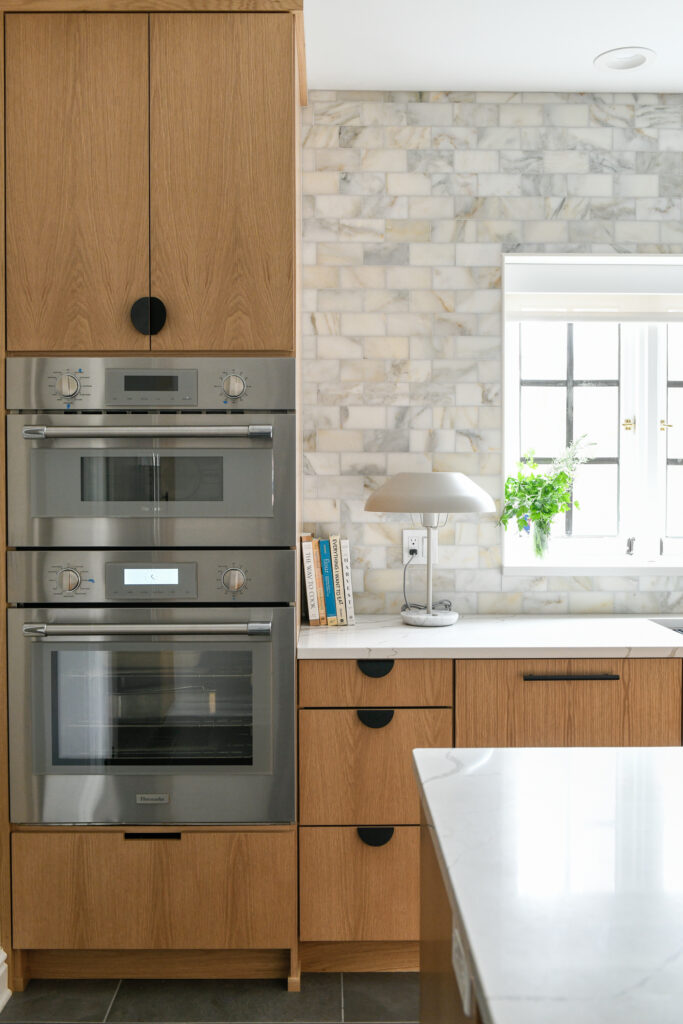
A sink with wooden cabinets sits between two taler wooden cabinets with a small window above the white sink and lamp.

Making Work What You Can’t Change

The Andersons have grown to appreciate the layout for its efficiency and division of labor. Plates and silverware live in the butler’s pantry along with the dishwasher, cleverly concealed in new matching cabinetry that David conceived. “There’s not that perfect triangle, but it does function really well for us. We end up having a lot of people in here because it’s a warm and welcoming spot. Even though we have a very large dining room and living room, people still want to be in this cozy kitchen.”  

And that marble countertop? “It does have scratches after a year of having the kitchen, some little marks from where I knead the dough—but I love it,” says Kathy. “That’s what I was hoping for, that it would age with the house. We wanted everything in the kitchen to feel like a part of the home. So, everything reflects something else in the rest of the house. And so that makes me really happy.” 

Two photos side by side. On the left is cabinetry lit up by sunlight, filled with kitchen glasses and plates. On the right is a wood piano surrounded by green plants and pictures on the wall.

Appliances List

Custom Range Hood 

Bosch 300 Series 24” Panel Ready Built In Dishwasher 

Sharp 1.2 Cu. Ft. Stainless Steel Microwave Drawer 

The Grind 3/4 Horse Power Garbage Disposal 

Monogram 48″ All Gas Professional Range with 6 Burners and Griddle 

Story by Stephen Treffinger / Photography by Erin Kelly / Kitchen Design by Drury Cabinetry

A footer photo with a grey and white marble background, three TABLE Magazines and subscribe info and button

Subscribe to TABLE Magazine’s print edition.
Create a free account, or log in.

Gain access to read this content, plus limited free content.

Yes! I would like to receive new content and updates.

Table Magazine wants to know your location.

TABLE Magazine operates regional sites - Knowing your location helps us route you to the appropriate site for the best experience.