Home Blog Page 159

Erin Kelly Turns a Broken Countertop into Design Brilliance

0
In Erin Kelly's white kitchen sits a small table with two chairs and a slab of broken stone countertop on top of the regular counter.

When a stone countertop arrived broken, photographer Erin Kelly turned the bad news into design brilliance for her kitchen.

On top of Erin Kelly's white countertop against the back wall sits a broken stone countertop surrounded by plants, candles, and other knickknacks.

We have all been there. A long-awaited element arrives to complete a renovation… and it’s broken. Not to mention, beyond repair. In spite of their disappointment, photographer Erin Kelly and her illustrator husband found a silver lining in this broken stone countertop. They picked up the pieces and eventually installed them as sculptural elements in their sensuously neutral kitchen. The fragments subtly reflect light. They cast delicious shadows. And they suggest an embrace of imperfection that could help each of us when faced with dashed expectations and unfortunate circumstances.

To learn more about unique ways to build your home design around your own aesthetic, check out our array of home design articles. Here you can find tips to turn any part of your home (kitchen, mantle, bar cart, outdoor picnic table, or even staircase) into a masterpiece that’ll astound your friends and family. Plus, find out about the latest design trends based on color and texture to feel like a professional designer when the paint swatches come out.

Story by Keith Recker / Photography by Erin Kelly

A footer photo with a black background and subscribe info and button

Subscribe to TABLE Magazine‘s print edition.
Revisiting a Classic: Hellerware’s Rainbow Dinnerware

0
A set of rainbow mugs are stacked on top of each other to the left of a stack of rainbow Hellerware dinner plates and bowls.

Revivals of well-designed classics are part of the zeitgeist right now, and for good reason. Why let a good idea sleep in the shadows when it can invigorate us with its sunshine, particularly like with Hellerware’s rainbow dinnerware.

Designed by Massimo and Lella Vignelli in the 1960s, Hellerware at first consisted of two covered bowls, two lipped plates, a square tray, and a rectangular tray, all of which stacked together. Additional pieces were added in 1970 (cups and saucers), 1972 (mugs), and 1978 (a pitcher).

Two stacks of rainbow mugs from Hellerware sit beside a stack of rainbow plates and bowls while a green mug and red bowl sit in front of the piles.

The dinnerware originally came in yellow only, but now rainbow sets of six plates, bowls, and mugs (shown here) are available. Heller has also reintroduced a boxed set that includes a salad bowl, six each of dinner plates, salad plates, and bowls—plus two serving bowls and a tray—all in white. OG users from four decades ago report that the stuff is nearly indestructible!

If you’re a fan of bold design choices check out our article on Colorful and Playful Design Trends to find the right fit for your home. Caution! It may just have you changing up your living room wallpaper.

Story by Keith Recker and Stephen Treffinger / Photography courtesy of Hellerware

A footer photo with a black background and subscribe info and button

Subscribe to TABLE Magazine‘s print edition.
Andrew Baseman’s Collection of Repaired Objects

0
Andrew Baseman sits in a chair holding one of his repaired platters in his lap.

Set decorator for such films as Crazy Rich Asians and TV shows such as Severance (for which he was nominated for an Emmy), interior designer and author Andrew Baseman shares his private collection of artfully repaired objects.

The Story of The Scarf

The official story begins, you could say, with a scarf. A young Andrew Baseman studied set and costume design at Carnegie Mellon and—one day in a vintage clothing store in Pittsburgh—purchased the first of what would become a large number of scarves. He would later go on to write a book, The Scarf, about his collection—and collecting in general.

A man in a flannel shows a white dish with blue illustrations.

He continued to collect and over the years became focused on items—mostly ceramics and glassware—that were broken hundreds of years ago and repaired using various (and sometimes quite inventive) methods. Beyond mere gluing or other means intended to be invisible, the techniques include stapling and replacing broken-off parts with wood, rattan, metal, or other elements.

His obsession is chronicled on his website Past Imperfect: The Art of Inventive Repair. There you’ll find a large number of pieces from his collection, with photographs, descriptions, and backstories. Each item is followed by a picture of a similar piece unbroken and unrepaired. “Sometimes the repairs are so wacky, it’s hard to know what it would have looked like in perfect condition.”

A black and white photo of a man outside holding a white dish at his side.

Reuse Through Repairs

Baseman points out that these repairs were not decorative—the object, now repaired, was put into use once more. Baseman was at Thanksgiving dinner at his husband’s uncle’s house a few years ago, and noticed that the turkey platter they used was stapled together—and they didn’t even know. “Here we are a couple of hundred years later and it’s still in use and still working. That’s pretty cool.” Stapling was a common technique for reattaching a break.

A collection of teapots on a tall shelf.

There appear to be two camps: people who see these items as “broken” and pass them by, and a second group, like Baseman, who are drawn to them. “When I go to an antique shop and see a perfect teapot, I don’t even think about it. [A repair] really adds another layer.”

Coming Back Together Again

How a piece was repaired depended on a number of factors. How it broke, of course, but also on the tradesmenavailable to do the work. A large pitcher in his collection was (probably) fixed by an itinerant tinsmith who, back in Victorian times, would travel from town to town, doing repairs. The “new” tin handle is not exactly what the original would have looked like. “This one’s a bit exaggerated, but it was all about making do.” As such, these pieces are often called “make-dos,” but it’s not Baseman’s preferred term, as it was originally somewhat derogatory, suggesting a lesser status or something folksy, rather than the beautiful works of art they are.

A red cabinet with a white and blue vase on top and a red sign above it all on a stone wall.

Collecting aside, he is most famous for his work in film and television, where he acts as a set decorator. When possible, he has incorporated make-dos into the set design, such as including a shelf of contemporary pieces made in Italy for the film Crazy Rich Asians.

Over the years, Baseman has amassed a variety of followers and fans from the antique dealer community, the ceramics community, and even New York shop owner extraordinaire John Derian. He finds that his younger, ceramics-oriented followers are particularly fascinated by the history and techniques of repaired pieces. “They all had broken pieces that they didn’t throw out. And so, then they would use some of the old techniques to repair them. There’s a little bit of a rebirth and it’s really taken off. That’s really cool.” 

More From Andrew Baseman’s Collection

A collection of small figures made from plumbing parts welded together. He had bought one of them 30 years ago, then saw them again at an antique shop near his home upstate, and got to buy the whole collection.

“The shape of the handle is not exactly what the original would’ve looked like. This one’s a bit exaggerated, but it was all about making do. And so, they made it work. So, they made this handle, and then at the very top, there’s a little bump that’s a thumb rest, and then the crescent shape that’s filled in with tin, that for your fingers; it’s just more comfortable than if it didn’t have it.”

Nothing to do with make-dos. A small diorama Baseman made at Carnegie Mellon “when I should have been doing my homework. I found design magazines from the ‘50s and I would do little collages. So, the back area with the man and the woman in the little painting is all collaged together. And then I found dollhouse furniture of the same period, and I just made little dioramas for my own amusement.”

Primitive wooden shovel, circa 1870, the largest piece in his collection. It’s a grain shovel, carved from a single piece of wood (he believes it’s pine). “It was not unusual for large utilitarian pieces carved from a single piece of wood to crack. The farmer who repaired this piece was quite thorough. He used a large piece of metal and dozens of small nails to repair the split blade. A pair of iron straps were nailed to the back of the blade to help secure the break.”

Story by Stephen Treffinger / Photography by Harold Julian

A footer photo with a black background and subscribe info and button

Subscribe to TABLE Magazine‘s print edition.
Back to Black, A Cocktail Inspired by Amy Winehouse

0
Two Back to Black cocktails in a deep brown color with a pick of blackberries on top of each glass, all on a textured grey surface.

Calling all music lovers and cocktail enthusiasts! Raise a glass to the iconic Amy Winehouse and the 2023 biopic, Back to Black, with this captivating cocktail creation. The aptly named Back to Black cocktail is a sophisticated blend of sweet and tart, with a touch of unexpected licorice that mirrors the soulful depth and unique style of Winehouse’s music. It features blackberries and raspberries, a nod to her signature aesthetic, muddled with an intriguing licorice liqueur for a unique flavor profile. So, get ready to channel your inner rockstar and sip a cocktail that’s as bold and beautiful as Amy Winehouse herself.

Using Calabria Alla Liquirizia

Hailing from Calabria in southern Italy, Il Calabrese Liquore Alla Liquirizia is a
unique and flavorful licorice liqueur that adds an intriguing depth to cocktails. It’s crafted using hand-harvested Calabrian licorice root, renowned for its intense and slightly sweet flavor. The distillers then steep licorice root in high-quality alcohol, along with a touch of sugar and other natural ingredients. The result is a smooth and well-balanced liqueur.

Il Calabrese Liquore Alla Liquirizia comes in a rich, dark color that’s close to black. It also contains a complex aroma and taste that combines notes of licorice, anise, and subtle herbal hints. It’s truly an experience for your taste buds. The flavor of this liquor is as complex as Amy Winehouse herself.

Print
clock clock iconcutlery cutlery iconflag flag iconfolder folder iconinstagram instagram iconpinterest pinterest iconfacebook facebook iconprint print iconsquares squares iconheart heart iconheart solid heart solid icon
Two Back to Black cocktails in a deep brown color with a pick of blackberries on top of each glass, all on a textured grey surface.

Back to Black, A Cocktail Inspired by Amy Winehouse


  • Author: Sarah Cascone

Ingredients

Scale


Instructions

  1. In your cocktail shaker: muddle 4 raspberries and 4 blackberries together in the licorice liqueur.
  2. Add ice and pour in the rum, and cointreau.
  3. Shake vigorously for 10-20 seconds.
  4. Double strain pour through shaker over a fine mesh strainer into a chilled Coupe glass.
  5. Garnish with 3 blackberries on a silver pick, and enjoy.


Recipe and Styling by Sarah Cascone / Story by Kylie Thomas / Photography by Dave Bryce

Subscribe to TABLE Magazine‘s print edition.

Stanley Tucci Inspired Pasta Recipes

0
A Stanley-Tucci inspired plate of Tagliatelle al ragu

Stanley Tucci, the captivating actor known for his award-winning performances in films like The Devil Wears Prada and The Hunger Games, harbors a passion that extends far beyond the silver screen: food. More than just a casual foodie, Tucci has emerged as a culinary enthusiast, captivating audiences with his television program, Searching for Italy and his cookbook The Tucci Cookbook. Get ready to explore a collection of dishes that are not only delicious but are influenced by the warmth and personality of this beloved actor. Seasoned cooks and beginners alike will love these Tucci inspired, approachable recipes that offer a delightful invitation to explore the world of Italian flavors. So, grab your apron, fire up the stove, and get ready to embark on a delicious adventure with Stanley Tucci!

Stanley Tucci Inspired Pasta Recipes

Maria Rosa Tomato Sauce

A plate of bright red tomato sauce on a verdant green background

Every good pasta dish starts with a flavorful and savory sauce. This Maria Rosa Tomato Sauce is the perfect base to any pasta shape your heart desires. It’s robust with large, fresh tomatoes, spices, herbs, and other veggies. Plus, it’s similar to the one Tucci makes in episode one of Searching for Italy.

Stanley Tucci Inspired Pasta alla Norma

Stanley Tucci Inspired Pasta alla Norma sits in a bowl to the right with two glasses of red wine off to the back left.

Simple but invigorating, this Pasta alla Norma is a great recipe to have in your back pocket. Rigatoni pasta is matched with lightly fried eggplant for a contrast of textures. Finish it off with a homemade red sauce using olive oil, garlic, tomatoes, oregano, and basil.

Cacio e Pepe

A plate of cacio e pepe on a green background

Cacio e Pepe quite literally means cheese and black pepper. They’re the main staples of this pasta dish alongside lemon zest, arugula, and a helping of olive oil. Though if you want to stick to this dish’s Roman roots, you can leave out of lemon zest and arugula for a more traditional approach.

Stanley Tucci Inspired Penne all’ Arrabbiata

Stanley Tucci Inspired Penne all’ Arrabbiata sits in a green ceramic bowl with two slices of french bread off to the right.

When you need to whip together a meal quickly, let Penne all’ Arrabbiata be your guide. It does have a bit of heat due to the chili oil we include, but you can easily leave it out if you’re not a fan of spice. This eight ingredient dish combines a sauce made from scratch and al dente penne.

Risotto Milanese with Porcini Mushrooms

A plate of risotto milanese on a green background

If you’re a fan of risotto and also happen to enjoy the umami, earthy flavor of mushrooms, this recipe is going to be your own little slice of heaven. Your basic risotto is getting an upgrade with threads of saffron, white wine, and dried porcini mushrooms. How could one say no to such a cozy and comforting dinner?

Stanley Tucci Inspired Bucatini all’Amatriciana

A Stanley Tucci Inspired Bucatini all' Amatriciana sits in a blue bowl with four glasses of wine placed behind the pasta.

Guanciale is the key ingredient to making this Bucatini all’Amatriciana so special and delicious. This cured pork cheek adds a smoky and crispy element to an already mouth watering dish. Though if you don’t have guanciale available you can always substitute it for bacon or pancetta to get a similar result.

Spaghetti Alla Carbonara

Spaghetti alla carbonara on a green background

In Tucci’s series, he notes that for a true Carbonara guanciale, pork jowl, is the most important element to showcase. It adds a rich, salty flavor to this creamy sauce. Since this recipe uses only six ingredients, we recommend buying of a high quality to ensure the best dish possible.

Stanley Tucci Inspired Spaghetti alla Nerano

A bowl of Stanley Tucci Inspired Spaghetti alla Nerano sits next to two glasses of white wine.

Get your dose of delicious, crunchy zucchini with our Spaghetti alla Nerano. Instead of a red sauce, you’ll find a dose of cheesy garlic butter that compliments the zucchini. It’s a little different from your basic penne and sauce without going too far away from tradition. 

Tagliatelle al Ragù Recipe

A Stanley-Tucci inspired plate of Tagliatelle al ragu

Ragù sauce is a thick, red sauce that uses beef chunks and a savory red wine for a rich, irreplaceable taste. In this dish, it’s added to tagliatelle pasta which are thick, flat, ribbon-like noodles made from eggs. Needless to say, between these two elements you’re sure to leave the dinner table feeling satisfied.

Rigatoni with Salsiccia alla Maria Rosa

A plate of rigatoni with tomato sauce, inspired by Stanley Tucci

Remember that Maria Rosa Sauce that’s mentioned earlier in this article? Well it just got even better when we toss in Italian sausage, rigatoni, and a Calabrian chili sauce for a bit of heat. It’s a little bit of tradition and a little bit of modernity all in one.

Cannellini Beans and Greens alla Maria Rosa

A Stanley Tucci inspired beans and greens recipe on a bright green background

Yet again our Maria Rosa Inspired Sauce sets your plate up for success in our Cannellini Beans and Greens. You may know Cannellini beans better as white kidney beans. Packed full of protein, these beans combine with Lacinto kale to create a recipe that’s healthy but still fulfilling. We recommend serving this recipe alongside crusty bread for dipping in that irresistible sauce.

Stanley Tucci’s Martini

A martini sits beside two green bottles of dry gin.

No meal could be complete without a martini from the man himself. Tucci shared this recipe in Food Network’s Be My Guest, Season 3, Episode 2 featuring host Ina Garten. Try his dry Gin Martini for yourself alongside any of the pasta dishes above for a truly Stanley Tucci evening.

Delizia Al Limone Layer Cake

A Stanley Tucci inspired delizia al limone layer cake on a green background

After all your hard work, you deserve to indulge in a dessert that Tucci fawns over in the Amalfi coast. This citrus-infused cake is refreshing and light after a hearty meal of pasta. Not to mention it gives you a chance to use that limoncello that has been hanging around the house.

Story by Kylie Thomas

Subscribe to TABLE Magazine‘s print edition.
Jorge Gaviria and His Masa Mission

0
A black and white headshot of a man outside in a t shirt.

In retrospect, specialty purveyor of masa and masa harina, Jorge Gaviria admits it wasn’t the best idea. It was a hot day in rural Mexico and he wore shorts to his first meetings with heirloom corn farmers. “It’s not the thing to do when you’re courting new farming partners, anywhere, much less Mexico,” he says.

Jorge Gaviria’s Masa Techniques

Luckily, Gaviria–founder of Masienda and author of Masa: Techniques, Recipes, and Reflections on a Timeless Staple–was partnering with agronomists, seed savers, and others who had established relationships with the farmers. 

A persons hands flip a sheet of maza over top of a fire under a cooking stone.

From Corn to Tortilla

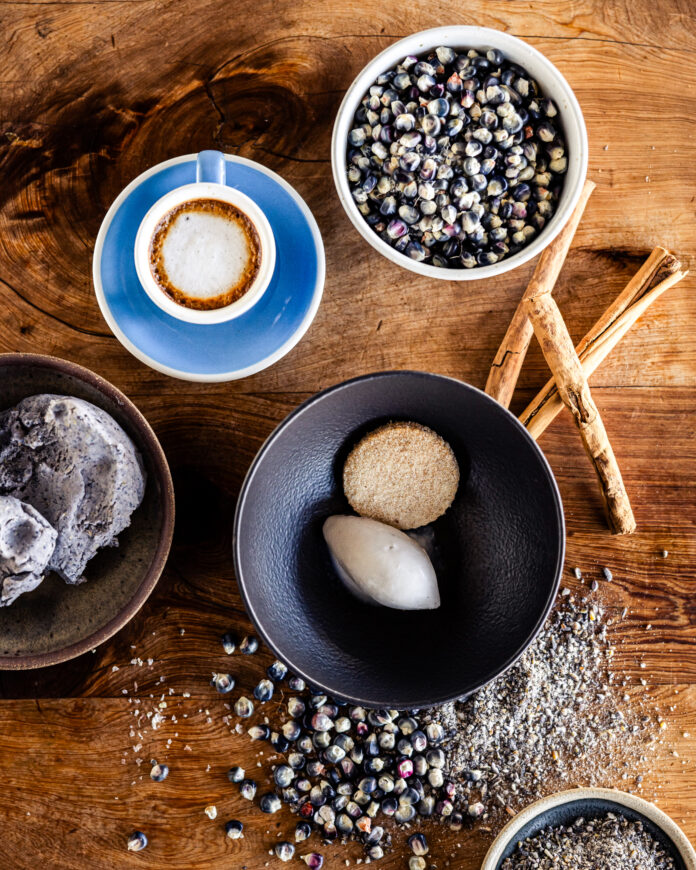
Gaviria’s goal? To source the best corn to make the best masa. When a farmer handed him a kernel to try, Gaviria bit into it. He knew instantly that he was on the right track. He remembers it was a yellow bolita variety from Central Oaxaca with a denser starch content–ideal for making large-sized tortillas. It tasted of butternut squash, pumpkin, and carrot. “I tasted things that I didn’t expect to taste,” he says. He discovered that’s because the yellow bolita contains beta carotene, the orange-yellow pigment that converts to vitamin A in the body. 

A person dressed in all blue steps out of a house with a basket on their head.

The flavor was richer, nuanced, and far more interesting than other corn Gaviria had tasted. And wouldn’t better-tasting corn make better-tasting masa? Masa, the dough made from corn treated with alkaline water through a process called nixtamalization, is the magic ingredient for everything from tamales, pupusas, gorditas and of course the beloved corn tortilla. 

A clear plate holds a meal of tempura made with fresh masa on top of a yellow striped table.

Growing into Agriculture

Gaviria, whose mother was born in Mexico, his father in Cuba, and he in Miami, got on the trail of “flavor-forward agriculture” while apprenticing at Blue Hill at Stone Barns in Pocantico Hills, NY. He was a fly on the wall as culinary thought-leaders from around the world–the likes of Blue Hill co-owner and chef Dan Barber, Ferran Adrià, Enrique Olvera, and Harold McGee–talked about agriculture that favors flavor over yield. “And I didn’t want the foods that I grew up eating to be left behind or in any way absent from the conversation,” he says. 

A stone holds a puffed up tortilla made of masa with a table in the background.

Those conversations inspire his journey to source corn from farms growing it for generations. Gaviria says that most of the corn harvested in the United States never ends up on our plate. It’s used for biofuel, animal feed, or exported. Much of the tiny portion that is used for food winds up as high fructose corn syrup. What Gaviria found in Mexico were farmers who were growing corn the way it’s been grown for centuries–for taste.  

On the left is a photo of a cookie and shot of espresso on a plate that's on a teal table then on the right is a red and white plate of waffles topped with berries and whipped cream on a blue table.

Local is Just Better

Gaviria hopes that you’ll taste masa made from landrace corn–locally adapted and traditional varieties – and then you won’t look back. To get you started, he’s distilled what he’s learned in Masa, a veritable masa encyclopedia, including step-by-step instruction on how to make your own masa, from kernel to dough. There are recipes, but they’re really starting points to create dishes that highlight the versatility of masa. 

A book cover for the book masa by Jorge Gaviria that features a black background behind a stack of masa tortillas.

Gaviria says he started working with a handful of farmers, buying their corn and then turning it into masa and masa harina (the dehydrated form of masa). Today, he works with thousands. In doing so, he has found an immense admiration for what they grow and how they grow it. And also, for the heritage of masa itself. “It’s as inspiring as the creation of the wheel to me,” he says. “It’s right up there in the great list of human achievements.” 

Story and Styling by Julia Platt Leonard
Photography by Graydon Herriott, Courtesy of Chronicle Books

Subscribe to TABLE Magazine‘s print edition.
Enzo Mari Exhibition at Design Museum in London

0
A wall calendar and desk calendar with big black block lettering against a white background by Enzo Mari.
Enzo Mari’s wall and desk calendars for Danese

Perhaps best known for his desk and wall calendars for Danese and his graphic apple and pear prints, Italian architect and designer Enzo Mari was a quiet—but not passive—genius. A major exhibition in London this spring and summer (March 29-September 8) spans Mari’s 60-year career, showcasing his incredible range. It includes furniture pieces, graphic design, and installations. I had the great privilege to interview Mari about 10 years ago in Milan. He was warm, humble, and charming.

Enzo Mari’s La Mela and La Pera prints of a simple illustrated red apple on the left and a simple green illustrated pear on the right.

Enzo Mari’s La Mela and La Pera Prints

Mari believed deeply in the idea that beautiful and useful design was for the many, not the few. He wanted his objects to be accessible, affordable, and to make a personal connection with the people who used them. He also connected with the artisans and manufacturers of his designs, ensuring that his objectives—functionality, quality, and cost—were met.

A series of 5 chairs made from bleached wood while each features a piece of colored metal as one of the limbs.

From Enzo Mari’s Autoprogettazione Collection

In 1974, Mari published the book Autoprogettazione, which included DIY furniture using only rough boards and nails. He was the original “maker” and instructed readers how to build practical and useful pieces with simple techniques. To Mari, the making was more valuable than the object.

Enzo Mari passed away due to complications related to COVID days before a retrospective of his work opened at the Triennale Milano in October of 2020. 

A wooden bench made out of basic, bleached wood from Enzo Mari on a tile floor.

From Enzo Mari’s Autoprogettazione Collection

Story by Stephen Treffinger

A footer photo with a grey and white marble background, three TABLE Magazines and subscribe info and button

Subscribe to TABLE Magazine’s print edition.

Tableware for the Great Outdoors

0
A variety of white tableware, white and orange napkins, orange accented silverware, and many crabs decorate a wooden table covered in newspaper while dining outdoors.
Photo courtesy of Hudson Grace

Even if the Winter hasn’t been terribly awful, it’s still nice when Spring arrives. Longer days, open windows, fewer layers. And, eventually, dining outside. Make the most of precious open air eating with tableware so nice you’ll even want to use it indoors as well as outdoors.

A selection of 6 opaque but colored glasses for tableware outdoors in colors black, blue, red, teal, yellow, and green against a white backdrop.
Photos courtesy of Williams-Sonoma

DuraClear® Tritan Outdoor Multicolored Double Old-Fashioned Glasses (set of 6) from Williams-Sonoma

Shattered glass is such a pain to get out of the pea gravel. Plus who needs the fuss of hand washing crystal after a barbecue? These BPA-free, dishwasher safe beauties won’t crack, break, cloud, or discolor to boot.

A variety of white tableware, white and orange napkins, orange accented silverware, and many crabs decorate a wooden table covered in newspaper while dining outdoors.
Photo courtesy of Hudson Grace

Melamine Street Eats Dinner Plate from Hudson Grace

With the look of paper plates, these long-lasting melamine versions will keep that casual vibe going for your tableware. They come in a variety of sizes as well as other shapes (including hot dog sleeves!) Dishwasher safe and break resistant.

A white plate on top of a white and purple patterned table setting holds white and purple patterned napkins folded to a point.
Photo courtesy of Pomegranate

Geo Feather Fuchsia Napkin | Set of 4 from Pomegranate

Paper napkins. Really? These Boho-chic, hand block printed cloth napkins in 100% cotton are colorful while transporting you to someplace fancy. Sigh, if only they still made that orange Bain de Soleil gelée.

A small rechargeable camping lamp sits on a wooden bench beside a coffee cup while three campers sit around a fire in the background.
Photo courtesy of Graypants Studio

Graypants Wick from Graypants Studio

Rechargeable models (typically using USB connections) are easiest. These charming aluminum lights can stay plugged in inside by day and brought outside at dusk. It’s a bit of tech that somehow feels old fashioned, in the best possible way.

A blue striped tablecloth on a table ready for outdoors eating, featuring white tableware on top.
Photo courtesy of Serena and Lily

Awning Stripe Tablecloth from Serena and Lily

First of all, that tassel edge! This yarn-dyed cotton cloth is just the right balance between casual and chic, and will complement everything you put on top of it. Machine washable, too, so no need to worry. Available in three sizes including square.

Story by Stephen Treffinger

A footer photo with a grey and white marble background, three TABLE Magazines and subscribe info and button

Subscribe to TABLE Magazine’s print edition.

An Inspiring Time at Paris Design Week 2024

0
A round iridescent lamp sits on top of a long, wide black lamp post.
Photo courtesy of John Pomp

After several seasons of safe furnishings designed for nesting, Paris Design Week puts on its party clothes and heads out to celebrate design with a rush of exuberant color, bold pattern, and more than a few glasses of bubbly.

The night was cold but the party was on fire—almost literally. Schumacher held a event, titled “A Night of Mystery”, at L’hôtel de Bourrienne, during Paris Design Week in an ornate space in an Empire period building completed in 1790.

Throughout the crowded venue, what seemed like thousands of candles were placed on every surface, including the floor and piano. The atmosphere was joyous and warm (in all senses of the word), the passed hors d’oeuvres particularly delicious, the champagne cold and free-flowing. It was one of those parties where everyone had three other places to be, but no one left. A sense of post-pandemic optimism and joy floated through the rooms.

A woman gives a tarot reading with three cards in front of her as red lighting lights up Paris Design Week.

Seeds of Change

In the rear of the apartment were several tarot card readers. I sat down at my allotted time and drew three cards from the deck, half expecting some scene out of Carmen, the reader belting out “La Morte!” at full volume. (It didn’t happen.) I drew The Empress and two Pages. My very lovely, candle-lit interpreter told me that the seeds of creativity had been planted, and the spark of creativity would now move from theory to practice, from accumulation to actual output. Sign me up!

A circle window showing a blue sky and clouds sits on a white wall as Mathieu Lehanneur sits to the right, looking at it.
Photo courtesy of Mathieu Lehanneur

The idea of seeds and growth was a recurring theme around town during Maison&Objet and Déco Off. At the fairgrounds, Mathieu Lehanneur, the Maison&Objet Designer of the Year, said during an interview: “I don’t have a mission. I prepare the seeds. It’s up to the gardener.” Lehanneur has designed, among a great many other things, the Olympic torch for the 2024 games in Paris. His work often explores the connection between technology and humanity.

A black and white floral print sample of a wallpaper design from Paris Design Week.
Photo courtesy of Arte

Meanwhile, at the Arte showroom in St. Germain, seeds appeared in an haute couture-inspired wall covering called La Perle with a pomegranate pattern where the arils were hand-applied pearls. The pattern, in on-trend black and white, was the definition of fecundity.

A chair with a red fabric featuring black thistles over it from Paris Design Week.
Photo courtesy of Kevin Kerr

Impressive Finds at Déco Off and Beyond

In town, at Déco Off—which concentrates on fabric and wall coverings—the focus is less commercial and has remained a bit more confident. Even so, the offerings felt fresh and spontaneous. Philadelphia-based designer John Pomp had an exhibition at Triode gallery in St. Germain and was the recipient of a Créateurs Design Award for Best Product Design for his Sun Ra Totem, which—because of its black base—acts as a sort of floating beacon. (Créateurs is a peer-to-peer award program that celebrates architecture, interior and product design, photography, and journalism.)

A round iridescent lamp sits on top of a long, wide black lamp post.
Photo courtesy of John Pomp

London-based Fashion designer Ozwald Boateng’s collaboration with Poltrona Frau was a reimagining of the classic Chester Sofa, but in colors probably only dreamed of by its original upholsterers. “I introduced a new design language while preserving the familiar framework, illustrating the essence of design as a dynamic force that evolves tradition to prevent stagnation and ensure continued relevance. For me, the evolution of tradition is imperative. Otherwise, it risks becoming obsolete.” He saw the chair as a canvas for storytelling, incorporating new elements and giving it an update. “Design, with its transformative capability to shape experiences, can be a catalyst for fostering hope.”

A man in a red suit sits on a yellow chair with other suits in the wall blocks behind him.
Photo courtesy of Ozwald Boateng

A New Way of Living?

During Paris Design Week, Lehanneur presented a project called Outonomy, a sort of off-grid living space pared down to the most basic elements: a small living structure, a roof garden, a few entertainments. Again, he sees in his work the connection between the seeds he creates and hope that could potentially come out of it. “Outonomy is not fully complete. It’s not a turnkey project. It’s a seed, an idea. I created it to get feedback from the visitors to Maison&Objet. It is an open platform, an open idea. By myself, I’m not able to change anything. I need other people to take part in it. So I can only propose a seed, but if people want to live with and take care of this seed, it can turn into a hope tree.”

Story Stephen Treffinger

A footer photo with a grey and white marble background, three TABLE Magazines and subscribe info and button

Subscribe to TABLE Magazine’s print edition.

A Taste of Local Terroir for Spring Travel 2024

0
The right and of a man inspecting dark grapes for winemaking.

How about a taste of terroir for Spring travel 2024? Terroir can be a tricky term to tackle. This French concept doesn’t just apply to wine – in fact, it’s generally applicable to any agricultural product from bread to cheese to meats and beyond. So what does it mean, and how does it apply to Lake Erie Wine?

There’s an obvious etymological link between terroir and terre, the French word for earth or land. Unsurprisingly, the soil itself is part of the concept of terroir, and within the context of Lake Erie, that means the free-draining sand and gravel soils over a clay base. Why is this important? Grape vines do their best work when they get just enough water to survive but not quite enough to thrive. The sand and gravel topsoils mean that vines have to dig deep to find water, and this also means that they don’t get waterlogged in periods of high precipitation. This is good news because the berries don’t swell with water and dilute flavors, and the green parts of the canopy don’t become overgrown. Instead, the vines can concentrate their efforts on ripening fruit, and the clay base soil retains water so that the vines are never parched beyond the pale.

But the soil, the land, is only part of the equation. Terroir is something more all-encompassing that also takes into consideration things like climate, neighboring vegetation, topography, and anything else that creates a unique sense and flavor of place. It’s why Riesling grapes grown on the sunny shores of Lake Erie, moderated by lake temperatures that allow for a gentle and long growing season, taste different than those grown in Australia’s high-elevation Eden Valley, for example.

Think of terroir as the signature of a time and place. Although it might be hard to define, you know it when you taste it.

Story by Adam Knoerzer / Photography by Jeff Swensen

A bottle of red wine with grapes in front of it sitting on a wooden picnic table outside in what looks like a wooded area.

Presque Isle Wine Cellars

A man and a women standing in front of the Penn Shore Winery Sign with 2 dogs on leashes.

Penn Shore Vineyards


A close-up of a green grape leaf on a grapevine.

PA Wines


A close up picture of a grapevine with grapes in the process of ripening.

Lake Erie Wine Country


A photo of the outside of a building with multicolored stacked stone, wood, and white trim with a statue of a green standing frog on the right of the building.

KingView Meadery 


A grape vine that is just budding.

Johnson Estate Winery


Light tan colored wine barrels from 21 Brix stacked sideways on metal racks.

21 Brix

Visit our Spring Travel Guide 2024 for more information about these wineries and other great Spring Travel locations.


Content and Photography provided by locations.

A footer photo with a black background and subscribe info and button

Subscribe to TABLE Magazine‘s print edition.


Create a free account, or log in.

Gain access to read this content, plus limited free content.

Yes! I would like to receive new content and updates.

Table Magazine wants to know your location.

TABLE Magazine operates regional sites - Knowing your location helps us route you to the appropriate site for the best experience.