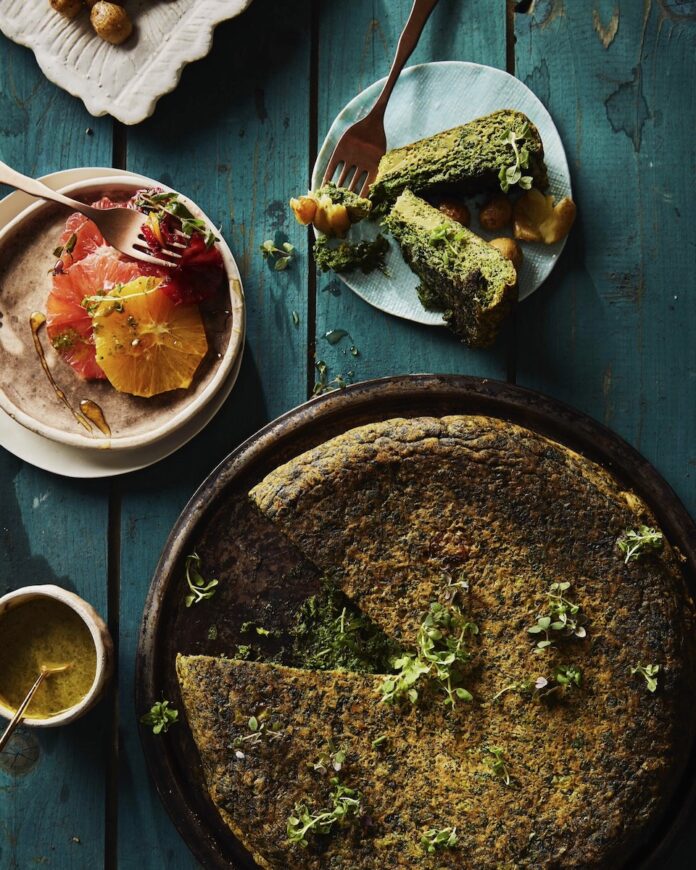
Nowruz, the Iranian (or Persian) New Year, means “new day” in Farsi. It’s humankind’s most ancient celebration; Nowruz is approximately 4000 years old, older than Easter, Holi, or Ramadan. Food plays an important role in this holiday because of the fresh, green ingredients that begin to peek out of the ground in Persia, signaling winter’s end. This kuku sabzi is an herbed omelet that’s perfect for the traditional midday family gatherings typical of Nowruz. It would make a wonderful brunch entrée any time of the year.
What Do People Eat for Nowruz?
In addition to kuku sabzi, other popular recipes shared with TABLE readers by Chef Palak Patel include; ghormeh sabzi – a lamb and kidney bean stew; ash-e-reshteh, Persian New Year’s soup with beans, noodles, and herbs; Persian jeweled rice; and whole-roasted whitefish with a tangy tamarind sauce served on a bed of green lentils. Nowruz is also a popular time to eat sabzi khordan, an herb platter including mint, basil, and Persian cress. Nowruz is 13 days long, and families typically have huge picnics on the final day where they eat dishes like this one.
1 medium leek, white and pale-green parts only, finely chopped
8 large eggs
1½ tsp kosher salt
1 tsp baking powder
1 tsp freshly ground black pepper
¼ tsp crushed red pepper
½ tsp ground turmeric
¼ cup tarragon leaves
1 cup finely chopped cilantro
1 cup finely chopped dill
1 cup finely chopped parsley
Instructions
Heat 2 tablespoon oil in a 10″ skillet over medium. Cook shallot, garlic, and leek, stirring occasionally, until very soft but not brown, 10–12 minutes. Transfer to a plate and let cool. Wipeout skillet; set aside.
In a large bowl, whisk eggs, kosher salt, baking powder, black pepper, turmeric, and crushed red pepper. Gently fold in cooled shallot mixture, add herbs: cilantro, dill, tarragon, and parsley.
Turn broiler on to high and adjust the rack to top.
In a large skillet, heat the remaining oil over medium. Carefully pour in egg mixture; spread evenly across the pan with a spatula. Using a lid to cover and cook the frittata until it is set on the sides and the bottom, approximately, 8–10 minutes. Remove the lid and place under broil, until the top is set, setting oven timer to 1 minute.
Once it’s cooled slightly and easy to handle, use a large and invert onto a large serving plate.
Thandai, a saffron and pistachio drink, plays a central role in the celebration of Holi, which welcomes the return of spring. This drink is delicious with a gujiyas — a sweet empanada-like dish also associated with Holi.
Where Does Thandai Come From?
Thandai comes from the northern parts of India and southern parts of Pakistan, mostly Southern Punjab, Sindh, and Balochistan. It typically uses almonds, fennel seeds, watermelon kernels, cardamom, saffron, milk and sugar. But there are many variations of it. A fun fact…there’s a version of thandai that uses cannabis leaves, called bhang in Hindi. This is not that version, though if you go off the recipe to experiment, we can’t stop you. Palak Patel’s recipe is a traditional version using saffron as the dominant spice, which also gives it its beautiful yellow. You’ll want to use a spice mill to put together the Thandai masala, or a clean coffee grinder.
A handful of dried rose petals or rose water for garnish (optional)
Instructions
Add the blanched almonds, cashews, pistachios, fennel seeds, white poppy seeds, black peppercorns, cardamom powder, cinnamon powder, and nutmeg into a blender or spice grinder. Grind to a fine powder.
In a small bowl, add saffron with hot water to bloom.
In a heavy bottom saucepan; add milk and saffron water. Bring the milk mixture to a gentle boil.
When the milk mixture begins to boil, add maple syrup and stir.
Add in the thandai masala mixture to the milk and simmer for another 5 minutes. Using a whisk to remove any lumps. Turn off the heat and allow the thandai to cool and refrigerate.
To serve, pour into a cup and garnish with dried rose petals or rose water.
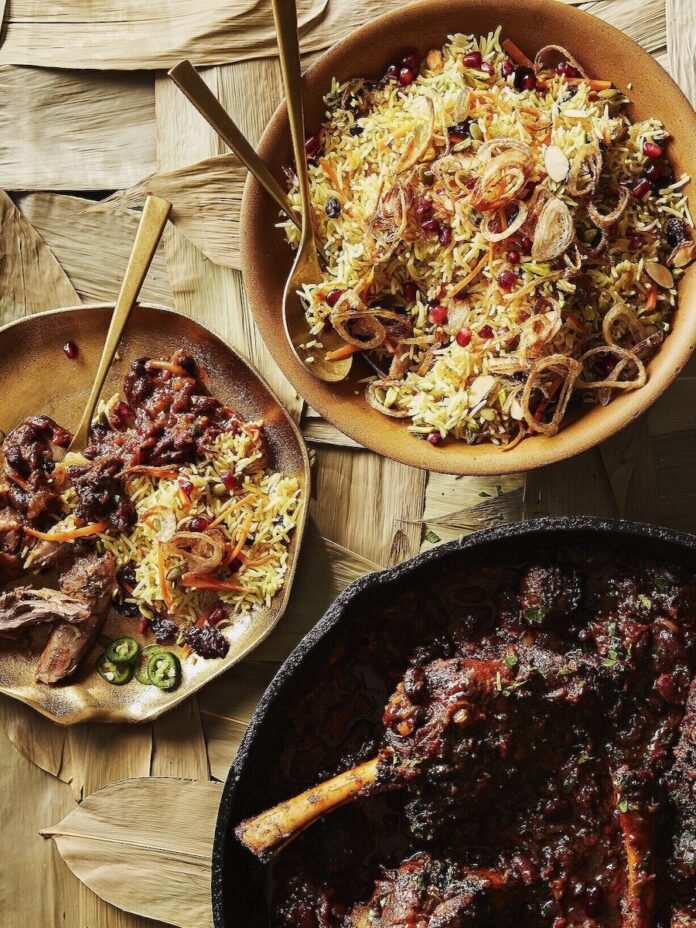
This recipe from Chef Palak Patel is part of a series where we delved into springtime traditions from around the world. Persian Jeweled Rice is a dish for Nowruz, a spring celebration that acts as a sort of “new years” in Central Asia. Doesn’t it make more sense to start the new year when the flowers are blooming rather than in the dead of winter? This rice is easy to make and is a great base for a platter of all kinds of decadent Nowruz foods, including Chef Palak’s Persian Lamb and Kidney Bean Stew.
What to Serve with Persian Jeweled Rice
Persian Lamb and Kidney Bean Stew is a great combination with this jeweled rice dish. You can also add a mint and cilantro chutney as a sauce on the side. Or, combine it with some other regional sauces and spices if you have a personal favorite.
A simple recipe that connects you to a long history!
Ingredients
Scale
2 cups aged basmati rice
1/4 cup slivered almonds
1/4 cup pistachios
Kosher salt
2 medium carrots, peeled, cut into matchstick-size pieces
2 tbsp dried tart cherries
1/4 cup dried currants
1/4 cup Persian green raisins
¼ cup dried apricots, chopped
1/4 tsp saffron threads, crushed and soaked in ¼ cup hot water
3 tbsp unsalted butter
4 tbsp olive oil, divided
1 large onion, thinly sliced
¼ tsp ground cinnamon
¼ tsp ground cardamom
¼ tsp ground black pepper
¼ tsp ground turmeric
1 tsp ground cumin
Instructions
Preheat the oven to 350°. Place almonds and pistachios on separate baking sheets and toast until golden brown, 5–8 minutes; let cool. Set nuts aside.
Using a fine-mesh sieve and rinse rice under cold water until water runs clear. Soak rice in cold water for 1 hour up to 24 hours. Drain through a fine-mesh sieve.
In a large pasta pot, add water and bring to a rolling boil, season with salt and gently add rice making sure to not break the grains. Cook rice stirring occasionally until grains have lengthened but are still firm. Drain and rinse under cold water. Spread rice in a thin layer on a baking sheet to cool.
Combine tart cherries, currants and green raisins in a small bowl and cover with hot water; let them soak for 10 minutes. Drain and set aside.
Place saffron in another small bowl and add 1/4 cup hot water; set aside.
Heat butter and 1 tablespoon oil in a large skillet over medium heat. Add onion slices and carrot sticks, season with salt, and cook, stirring often, until soft and beginning to brown. Add spices and 1 tablespoon saffron mixture. Cook, stirring constantly, until fragrant.
Reduce heat to low, add soaked cherries, currants raisins, and apricots and cook, stirring often. Stir in reserved nuts, season with kosher salt. Remove from heat and keep aside.
Heat remaining 3 tablespoons of oil in a large wide heavy pot over medium heat. Add half of rice, spreading evenly; add fruit and half of the nut mixture in a thin layer, then remaining rice, spreading evenly.
Using a spoon, create circular holes in the rice mixture for steam to escape. Drizzle remaining saffron mixture over rice. Place a clean kitchen towel over the pot, fit the lid over the pot. Be sure no steam can escape.
Cook on medium high heat there is steam, 5–8 minutes. Reduce heat to very low or move the pot to a smaller burner and cook without stirring until the rice is tender and the bottom layer of rice is browned, about 20 minutes.
Spoon rice into a serving plate and sprinkle with the remaining toasted nuts.
Chef Palak Patel researched the spring festivals of India, Iran and Uzbekistan to develop recipes celebrating warm weather. These are some of the most ancient celebrations of humankind, marking the ancient new year…aka the start of spring.
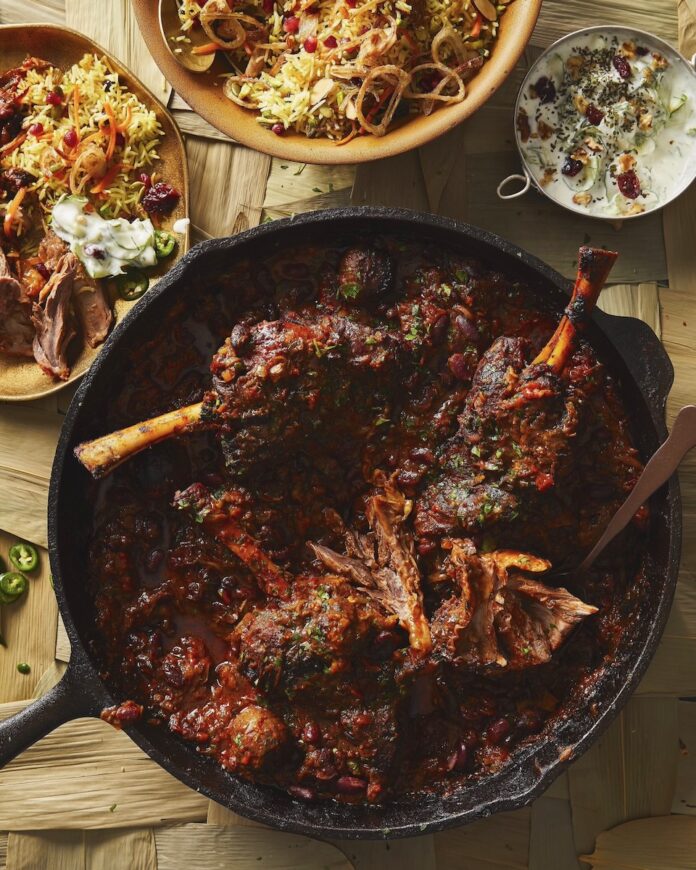
Nowruz in Iran is a time when families prepare hearty and joyful dishes to enjoy together. This Persian Lamb and Kidney Bean Stew is one example of how people celebrate the return of good weather. The dishes are abundant, full of flavor, and very satisfying. Serve this with Persian Jeweled Rice for a bountiful Nowruz spread.
What is Nowruz?
Nowruz is an ancient celebration in the Caucasus, Central Asia, and South Asian regions, all of which have influences from ancient Peria. Nowruz’s roots are in Zoroastrianism, a religion that predates the Abrahamic faiths. It’s a holy day for Baha’i and Shia Muslims, but is often a secular holiday families use to gather together and celebrate what they’re grateful for. One way to celebrate gratitude is through a stew, where all different ingredients come together to make a delicious whole. This Persian Lamb and Kidney Bean Stew is shareable with as many people as you’d like to invite over, celebrating how warmer weather often precipitates togetherness.
3 large carrots, peeled, cut into 1/4-inch-thick rounds
4 garlic cloves, minced
4 dried Omani limes, punctured with a sharp knife
¼ tsp saffron threads
1 tsp ground turmeric
1, 750 ml bottle dry red wine
1, 28 oz can diced tomatoes with juices
1, 14 1/2 oz can low-sodium chicken broth
1, 14 1/2 oz can low-sodium beef broth
3 cans kidney beans, rinsed
Kosher salt to taste
Freshly ground black pepper
5 tsp chopped fresh rosemary
2 tsp chopped fresh thyme
2 tsp grated lemon peel
Instructions
Sprinkle shanks with kosher salt and fresh pepper. Working in batches, heat two tablespoons of oil in a heavy large pot over medium-high heat. Add shanks to the pot and cook until brown on all sides, about 8 minutes. Transfer shanks to a bowl and rest.
In an extra-large dutch oven, add onions, carrots, and garlic to the pot and sauté until golden, about 10 minutes. Add remaining ingredients. Return shanks to pot, pressing down to submerge. Bring liquids to boil. Reduce heat to medium-low. Cover; simmer until meat is tender, about 1 ½ hour.
Remove the lid and simmer until meat is very tender, about an hour longer.
Transfer shanks to platter; tent with foil. Boil juices in a pot until thickened, about 15 minutes. Season with salt and pepper. Spoon over shanks.
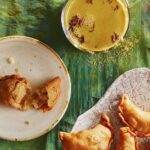
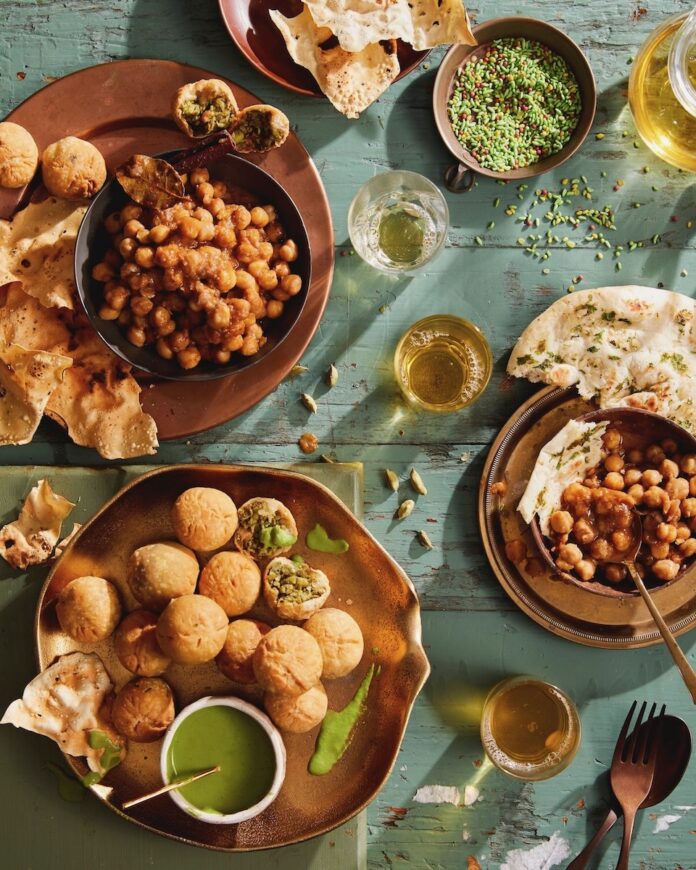
These Kachori fritters, compact packages of peas and edamame, are part of India’s annual Holi festival. Holi celebrates the return of spring and abundance. (You might recognize it as the “festival of colors” where people of all faiths come together to celebrate with colorful dyes and exuberantly joyful music and dance. Chef and Food Network star Palak Patel shares her recipe for Kachori fritters to celebrate the holiday.
What is Kachori?
Kachori is a round, deep fried pastry that can have many different kinds of fillings. People eat it all across South Asia, in India, Bangladesh, and Pakistan, but originally from the Indian province of Rajasthan. You make kachori out of maida, a special kind of wheat flour originating in India, though we used AP flour here to make it easier for US cooks. It’s a convenient travel snack for the many on-the-go professionals in India, as well as a filling (but not overly so) carb refuel on hot days. (The milder spices in it are more suited for a hotter climate). Our take on it has peas and edamame, but feel free to customize it to your liking!
To make the filling, add peas, edamame, coconut, and ginger to a food processor and pulse to a coarse paste and then remove to set aside.
Heat the oil in a saute pan over medium heat. Add pea mixture stirring well, for 4-5 minutes.
Stir in the cumin powder, garam masala, coriander powder, cayenne pepper, cinnamon powder, and turmeric powder, cook for another 5-7 minutes, or to ensure there is no moisture left in the pan but the peas are still brightly colored. Season the mixture with salt, add lime juice, cashews, and cilantro mix well.
Remove from heat and transfer the pea mixture to a bowl and set aside to cool completely.
For the dough and fritters:
To make the pastry dough, add flour into a mixing bowl and make a well in the center. Add the salt and oil to the well, then rub the mixture together using your fingertips and mixed thoroughly.
Add cold water one tablespoon at a time and knead the dough until it is soft to the touch.
Rest the dough for 30 minutes and cover.
When ready to make fritters, take a little oil and rub the dough doll to create a smooth surface.
Pinch a small piece of dough, approximately the size of a small plum, and then using a rolling pin roll into an even circle about 3 inches. Or use a pastry cutter to make an even circle.
Place the filling into the center about a tablespoon. Bring the edges of the circle and pinching tightly around the filling. Seal at the top by closing edges and trim any excess dough with a knife. Roll each ball into a ball using palms of the hands.
Heat oil at 300 and gently lower the kachori fritters into the hot oil using a strainer and gently fry until the pastry is golden brown.
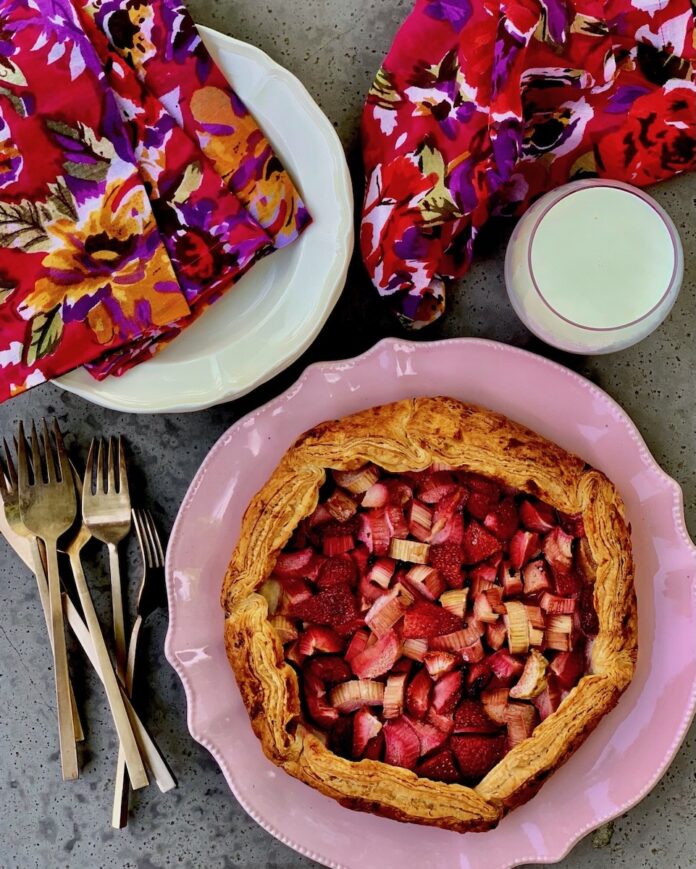
Carpe diem, or whatever the Latin equivalent would be for pie, and try this delicious strawberry rhubarb tart recipe at home. The balance of sweet and tart is perfect…especially with a glass of cold milk. This recipe comes from the folks at Mediterra, one of our favorite bakeries. They know a good thing when they see it.
What is Rhubarb?
Rhubarb is something you might see hitting the produce section as the weather gets warmer, though larger grocery add it to their assortment in early spring. It’s not as ubiquitous as strawberries or blueberries, but it’s nonetheless a great ingredient for baking tarts because of its natural acidity. The beautiful color of rhubarb comes from its stalks, which have a bright pink hue. For your strawberry rhubarb tart, you’ll want to get the freshest possible rhubarb, all firm, crisp, and shiny. Avoid rhubarb that looks limp or shriveled, or if its skin has blemishes on it. Also, rhubarb is a vegetable, not a fruit, so if you eat this tart, you’re technically eating your veggies!
10.5 oz unsalted butter, very cold (1 cup + 5 tbsp)
For the filling:
All-purpose flour (for surface)
1 lb. rhubarb (about 3 cups), cut into 1 inch pieces or 2 inch and halved down center, whichever you prefer.
8 oz strawberries, quartered. That’s about a cup…but adding more won’t hurt!
1 tbsp plus 1½ tsp of cornstarch
⅓ cup sugar, plus more for sprinkling
½ tsp vanilla extract
1 egg
Instructions
For the crust:
Mix salt into water, keep ice cold.
Put flour in the work bowl of a food processor.
Add butter, cut into 1-inch chunks, to flour.
Pulse until most butter bits are the size of peas.
Add salt-water and pulse for a few seconds, until dough starts to come together in a ball.
You should still see some butter chunks.
Turn onto a lightly floured surface, form into two equal disks, then wrap and chill for at least 2 hours.
For the pie assembly:
Preheat oven to 400°. Roll out dough on a well-floured surface to a 14″ round, rotating dough and tossing more flour underneath as needed to keep it from sticking. Transfer dough to a large parchment-lined rimmed baking sheet. Place rhubarb, strawberries, cornstarch, and ⅓ cup sugar in a medium bowl. Scrape in vanilla seeds and discard pod; toss ingredients to evenly distribute.
Mound filling in center of dough, making sure to scoop up all the sugar and cornstarch in bowl, and spread out, leaving a 2″ border around edges. Fold dough up and over filling, overlapping slightly. Brush dough with egg and sprinkle dough and filling generously with sugar.
Bake galette until filling is bubbling and crust is deeply browned, 40–50 minutes. Let cool.
Recipe by Mediterra Photography and Styling by Keith Recker
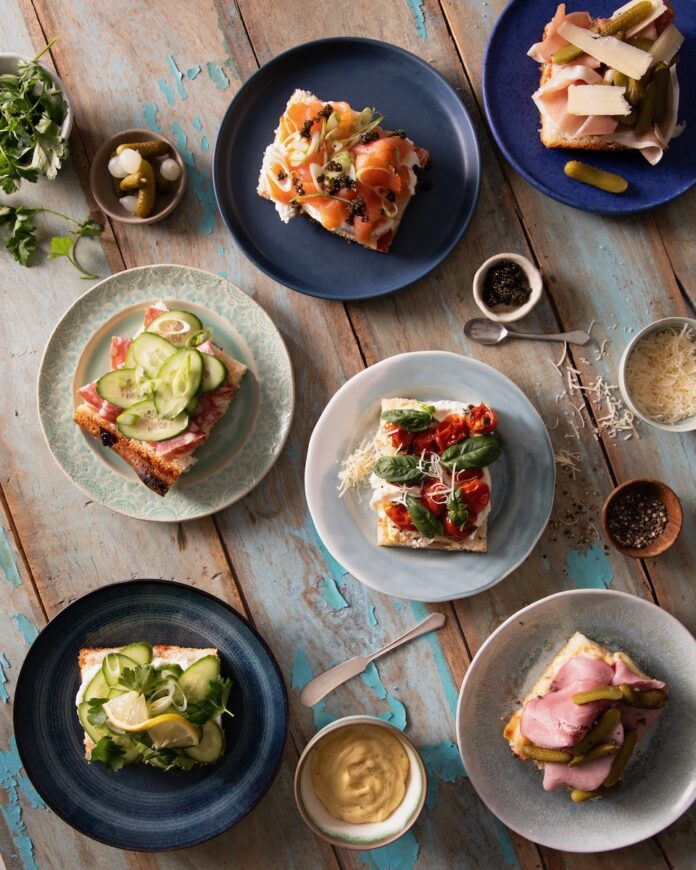
Chef Selina Progar looked to her childhood idol Martha Stewart to make her Martha Stewart-Inspired Focaccia. Looking at the glorious results, it just makes sense to build delicious sandwiches with that homemade bread.
Selina Progar reminisces about watching Martha Stewart’s cooking shows growing up, admiring her bustling productivity and attention to detail. She says these viewing experiences, as well as poring over the wonderful Martha Stewart Living magazine, were important steps on her journey to becoming a food industry professional.
Focaccia makes a wonderful base for the best lunch or picnic sandwiches. Its butteriness and crispness combine beautifully with elements like herbed cream cheese, salmon, cornichons, prosciutto, cucumbers, and lemon ricotta. You can even use these Martha Stewart-Inspired Focaccia Sandwiches recipes as a starting point before adding on your own favorites like banana peppers, spinach, or balsamic dressing.
How to Rehydrate and Reheat Focaccia for These Sandwiches
Did you happen to make your focaccia using our Martha Stewart-inspired recipe a few days ago and now want to use it for your sandwiches? Good news is that it is super simple to reheat this homemade bread and bring it back to life. Simply run your loaf of focaccia lightly underneath water to bring moisture back into the fluffy inside of the bread and also help crisp the outside. Then, place on a baking sheet and bake in the oven at 350 degrees for around 8 to 10 minutes.
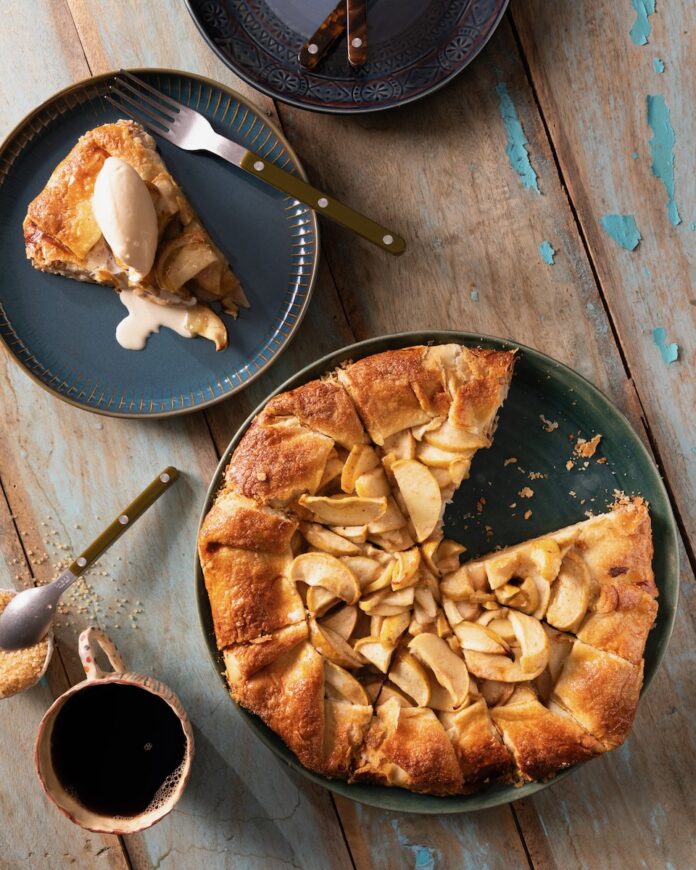
Apples and cheese seemed destined for each other, with their delicious contrast of sweet and salty. This combination helped Chef Selina Progar, whose fascination with all things Martha ignited in childhood, dream up a Martha Stewart-Inspired Apple Crostata with Cheddar Cheese Crust. Her recipe is adapted from Martha Stewart’s Cheddar-Crusted Apple Pie.
The Martha and Chef Selina combine Granny Smith apples and cheddar cheese to make the perfect balance of sweet and savory adapts perfectly to crostata form, and is easier to make. The crostata lets the apples take center stage while a hint of sharp cheddar lingers. What could be better than serving this recipe up for an Italian picnic once spring starts to bloom?
What is a Crostata?
Much like a tart, this freeform Italian recipe leaves an open face to showcase the filling while still wrapping around the edges. The crostata was developed during an era when savory pies were all the rage in the pre-Christian era. However, you can always use a fruity or sweet filling if you choose. The best part about a crostata is you can make it without using a pie dish, just simply use a sheet pan instead. The product is a unique, rustic, crunchy treat with a warm filling.
Cheese and apples work together better than you may imagine.
Ingredients
Scale
For the pie dough:
8 oz all-purpose flour #1
1 tbsp salt
1 tbsp sugar
2 sticks (8 oz) butter, cold cut into small chunks
5.5 oz ice water
1 tbsp vinegar
All-purpose flour for dusting
1/2 cup cheddar cheese
For the filling:
8–10 apples, I chose honey crisp, but use a crisp baking apple like ever crisp, or granny smith
2 tbsp lemon juice
3/4 cup brown sugar, packed
1 tbsp cinnamon
1 tbsp vanilla extract
1 tsp salt
1/4 cup all-purpose flour
Sugar, sanding if you have it, but regular sugar also works
For the egg wash:
1 whole egg
1 egg yolk
Instructions
For the pie dough:
Cut butter into small pieces and place back in the fridge.
Make ice water, strain, rescale.
Add to the mixer with the paddle attachment; flour, sugar, salt, butter and mix until the butter is pea sized.
Add ice water and vinegar, add to the mixer. Mix just until a solid piece of dough forms.
Place a dusting of all purpose flour on parchment paper and roll out 2 pieces of pie dough into a 14-inch round that is about the thickness of a quarter.
Sprinkle cheddar cheese on one piece of the dough, then lay the second piece of dough over the cheese and gently roll the two pieces together. Lightly dust the top layer of pie dough with flour to avoid sticking.
Cut into a 14-inch circle. Place dough with parchment on the sheet pan and put it in the fridge for at least 30 minutes
For the filling:
Slice the apples. I left the skin on but you can peel them.
Combine all the ingredients in a large mixing bowl and toss or stir until apples are completely covered with slices and flour.
Once dough is chilled, place apples in a pile in the middle of the dough leaving 2-3 inches of dough around the edges.
Fold the dough into the apples one piece at a time, overlapping each piece before the last.
Bush with egg wash and sprinkle with sugar.
Bake at 375 degrees until apples are soft and crust is golden brown, about 1 hour and 20 minutes. Check often. Bake until pie is golden brown.
Let cool slightly then serve with whipped cream or ice cream (al a mode).
Cook Up the Rest of Selina’s Martha Stewart-Inspired Recipes
Rodolfo Gianserra began to work with Sangiovese grapes by chance. In a shipment of root stock of his signature grape, Tintilia, a smattering of Sangiovese found its way in. “Luckily, they were mountain Sangiovese, so I could grow them in Molise,” he remembered. Gianserra’s winery, Agricolavinica, is in the small town of Ripalimosani in Molise, a rugged, rural province near the Adriatic Sea—not where Sangiovese, more typical of Tuscany, usually grows.
Rodolfo Gianserra Wants You to Get to Know Molise, The Greatest Wine Region You’ve Never Heard Of
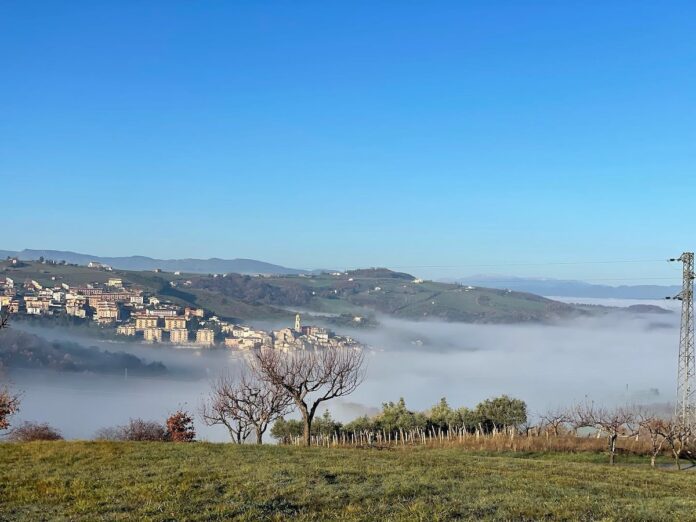
Molise, the second-smallest Italian region, has only one indigenous wine grape: Tintilia. It’s also Italy’s “youngest” region, since it used to be part of Abruzzi e Molise. They separated in 1963. Wild boars forage in the foothills, and at night, there’s little light pollution in the vast, dark skies. In Molise’s town squares, it’s common for people to sit in outdoor cafés or at the stoops of bars all night talking, perhaps over a bottle of Gianserra’s Tintilia from Agricolavinica. There’s a joke saying “il Molise non esiste,” poking fun at its small size and obscurity. But it does, in fact, exist, and it has some of the most unique wines in Italy.
The Sangiovese accident is characteristic of Gianserra’s attitude towards winemaking. He’s inventive, wastes nothing, and wants to allow the land he loves to speak for itself, rather than intervening in its processes. “My fight in life is to make Tintilia known and loved,” he said. In my case, he was preaching to the converted. Tintilia is one of my favorite grapes. It contributes mightily to complex, singular wines that feel smooth and dignified but still approachable. The grape is both fresh and full-bodied, acidic without sacrificing flavor. Tintilia is a high-altitude grape and has the crispness that high-altitude soil provides. Its deep garnet color is mesmerizing to look at in a glass. It has a complexity that makes me want the experience of drinking it to never end.
Bringing Tintilia to the World
Though Gianserra said his Tintilia isn’t a “meditation wine” to wax poetic over and instead more to pair with food and enjoy, I found his 2018 vintage nonetheless worthy of spending time with. From the first aroma of tobacco and spice emerging from the glass, I knew it was a star.
Two of Gianserra’s wines
Gianserra’s take on orange wine, a skin-contact Trebbiano, is only 11% ABV and more refreshing and clearly acidic than other skin-contacts from Slovenia or Georgia. Like a song that allows the singer to use her full vocal range, Gianserra’s wines justify their medium, so to speak. They’re wines from the unique soil of Molise, a mixture of clay, sand from the Adriatic beaches, and mountain brush.
Because Molise has no indigenous white grapes, Gianserra brought in Riesling and Sauvignon Blanc, two high-altitude grapes that could thrive in Molise’s cold climate. The result is highly quaffable but refined white wine with pleasant acidity. Gianserra prefers wines that he calls “drinkable,” lower-ABV and designed for sharing in a meal setting. The idea of making wines “drinkable” might sound like an obvious thing for a winemaker to do, especially in Italy. But there are wines that are higher-concept and layered, or more ideal for aging, or where the winemaker cut corners for a faster entry to market.
Because they lack funky taste and cutesy marketing, Gianserra’s wines are not what we in the States might associate with “natural wine”. Though in Italy wines do have to meet certain standards to be “organic,” what Americans might call “natural wine” in Italy might just be…wine.
Low Intervention That Allows Molise’s Terroir to Shine
Part of Gianserra’s low-intervention winemaking involves using stainless steel barrels. Every harvest starts at 6:30 in the morning and ends at 1PM, which helps avoid sulfites in the grapes. Then, the grapes go into the stainless-steel barrels. “The problem with stainless steel is that you need time to age the grapes, whereas with other containers, the process gets accelerated. But once you get into a schedule with it, it’s okay,” Gianserra said.
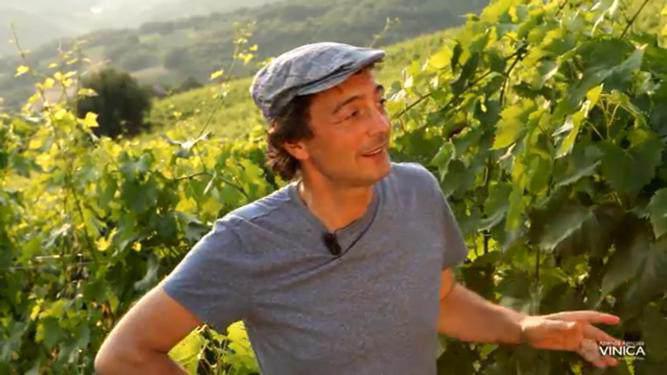
Rodolfo Gianserra in his vineyard.
Some people have visited his cellar and said it looks almost surgical in how clean it is, which is no accident. Gianserra is a dentist and oral surgeon as well as a winemaker, whose time studying in the United States nearly twenty years ago made him want to take advantage of Italy’s epicurean history. “I realized what I was taking for granted in Italy,” he said. Under the wrong vision, a surgeon’s clinical cleanliness could result in wines that lack character or feel sterile. But Gianserra’s fastidiousness gives the wines room to breathe.
The accidental Sangiovese from 2020, the first “Sangiovese del Molise,” is a unique version of the grape that gives it a fresher flavor profile with more acidity. There is something about Gianserra’s wines that feels very open, already at the place that some other wines need decanting to arrive at. Though that harvest of Sangiovese wasn’t one he’ll necessarily repeat, he saw the product as another opportunity to showcase Molise’s unique terroir in Italy.
Americans can get his wines at restaurants all around the country, as well as at restaurants in Rome, only two and a half hours from Molise. But he encourages people who travel to Italy to explore beyond the tourist destinations. “Molise is very untouched and unpolluted, how Italy used to be,” he said. “It’s a nice place to escape from a crazy world. Quality over quantity, that’s Molise’s motto.”
Story by Emma Riva Photo courtesy of Rodolfo Gianserra
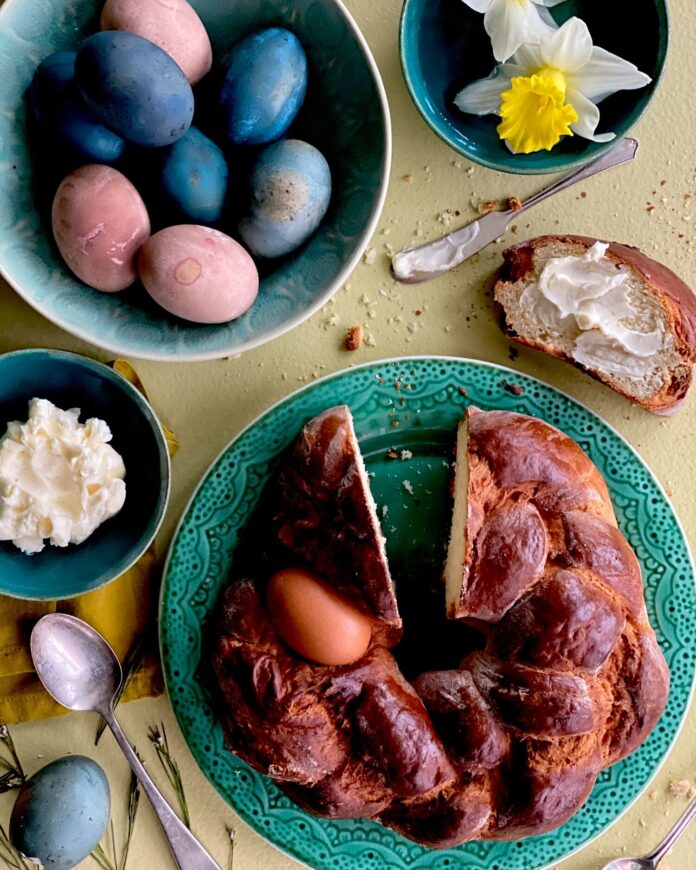
Like many European countries, Italy has its own take on a sweet, aromatic Easter bread: Pane de Pasqua.
Though similar in texture to Panettone, a traditional Christmas bread, Pane de Pasqua does not contain candied fruit or nuts. The loaves of brioche-style bread are often braided into a crown and topped with an egg, icing, and sprinkles.
The origins of this traditional Italian Easter bread are muddy, but one thing’s certain: for many, Easter wouldn’t be complete without this sweet dessert. Add this Italian Easter Bread to your holiday spread this year using this recipe from the late Larry Lagatutta, founder of longstanding Italian bakery and cafe Enrico Biscotti Co. in the Strip District.
What is Fresh Yeast in Our Italian Easter Bread?
Fresh yeast is what you’ll commonly see bakers using in recipes like this. It comes in a compressed block which retains around 70% moisture. Moisture makes a big impact in fermentation. You’ll find this type of yeast to be almost crumbly and also have a stronger smell than other kinds of yeast. Since this yeast is fresh it does not last forever. In fact, the shelf life is about two weeks. You’ll want to check your local specialty markets for availability, though some grocery stores can carry it as well.
1 oz fresh yeast (or two packets of dried yeast mixed with 1/4 cup warm water and 1 tsp sugar, then allowed to rest for 5 minutes)
4 oz fat (lard, Crisco, margarine, butter, or butter blend)
1 cup sugar
3 eggs
4 oz hot water ( 1 cup)
5 cup flour
Egg (optional)
Instructions
Cream together yeast, fat, and sugar. Then, add the remaining ingredients and mix until the dough is stringy (about five minutes). Cover with plastic wrap and let sit for about an hour, until it triples in size.
Turn the dough out onto a well-floured board. Divide into three pieces, and push them into three rectangles. Roll and pinch each rectangle into a log, then braid the three logs together. Place an egg into the dough if desired.
Bake at 350 for one hour. You can check by tapping the bottom of the loaf or by inserting a knife into the bottom of the loaf. It will come out clean when ready.
Recipe by Larry Lagatutta Story by Maggie Weaver Photography by Keith Recker