Despite ever-mounting evidence and a barrage of catastrophic events–people are still largely complacent about climate change. Because just watching the news and trying to absorb the information seems unable to tip us into sufficient action, the emotional connection forged by compelling works of art might be our last hope: humans are good at avoiding data, but when feelings are involved, we tend to get fired up.
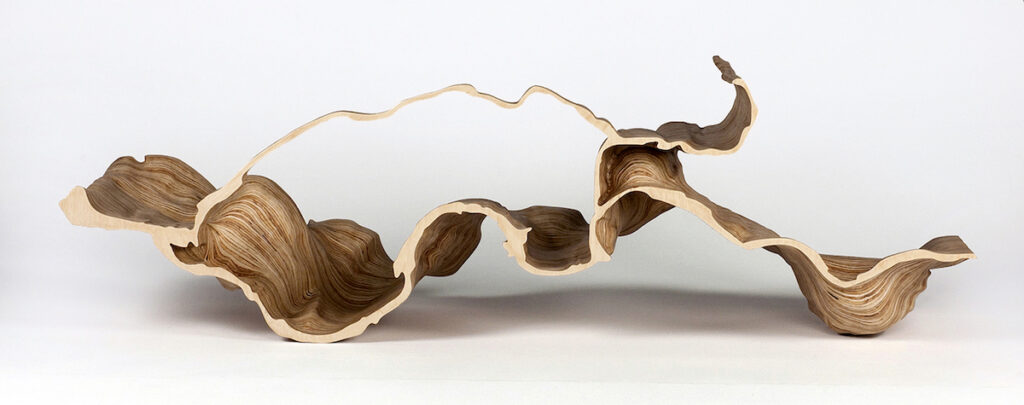
Adrien Segal’s Molalla River Meander, 2013 Carved plywood, Dimensions: 15 x 46 x 11 inches (38 x 117 x 28 cm)
That fire is exactly what’s needed to change our behavior before the damage to our planet is irreversible. We are seeing the effects of climate change in our own Western Pennsylvania neighborhoods. Our riverside communities see flash-flooding more frequently. Urban heat islands are raising city temperatures by an average of five degrees. Severe weather events have increased in recent years.
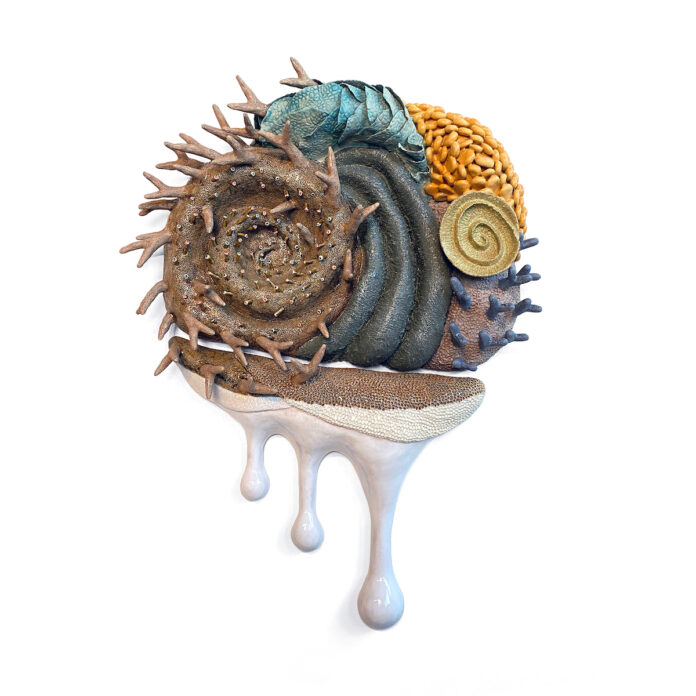
In addition to examining the work of four contemporary creators, Climate Awakening: Crafting A Sustainable Future will serve as a catalyst for community engagement by hosting a series of action events that explore the artistic, intellectual, and social issues relevant to the show. Featured artists include Adrien Segal, Courtney Mattison, Susie Ganch, and Meghan Price. The show opened on September 8 and runs through January 13, 2024.
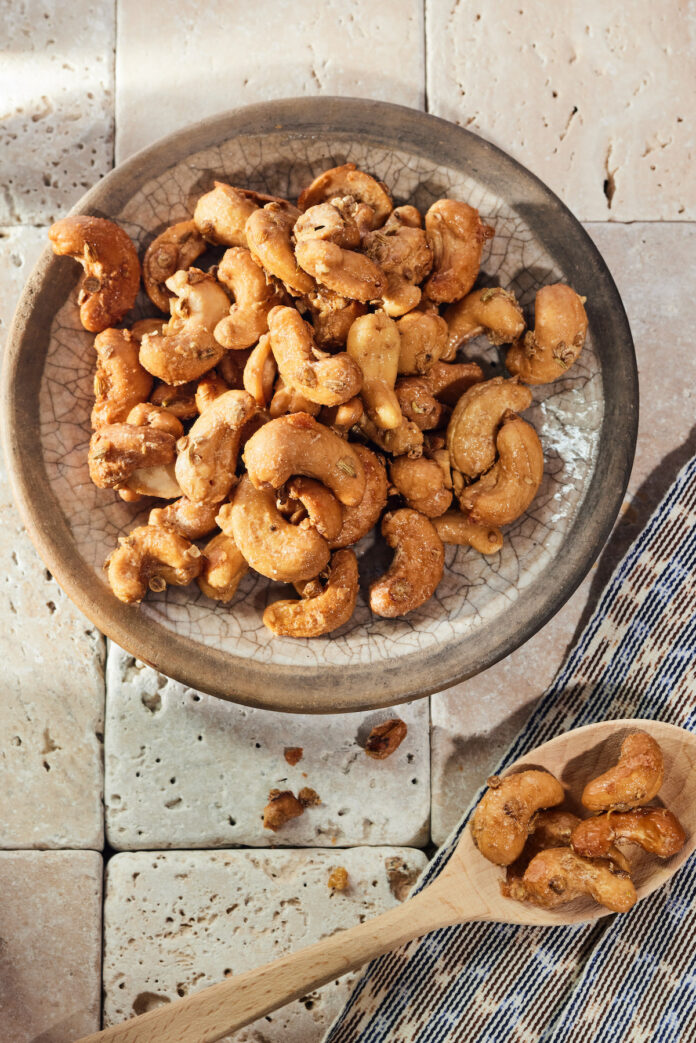
What does neutral taste like? Earthy, nutty, crunchy curiosity. To savor a bit of neutral’s wonderful qualities, try The Taste Curators‘ recipe for Fennel and Coriander Cashews.
The impact of color is so profound that it’s been said that it influences 85% of our purchasing decisions. When you really think about it, this is as true when picking out the freshest bunch of basil as it is when choosing a new hat or new wallpaper. If we open ourselves up to it and acknowledge its power, color makes for impactful experiences.
When trying the following herb roasted cashews recipe, take a moment to stop and think about what you are tasting. Enjoy the moment and savor the palate happening in your mouth and the palette on your plate.
Fennel and Coriander Cashews Recipe
INGREDIENTS
1 tsp coriander seeds
1/2 tsp fennel seeds
1 tsp kosher salt
1 large egg white
2 tbsp sugar
2 cups (9 oz) roasted unsalted cashews
INSTRUCTIONS
Preheat the oven to 275 degrees. Line a small rimmed baking sheet with parchment paper and set aside.
In a small skillet, combine the coriander seeds and fennel seeds. Place over medium heat, stirring often, until lightly toasted and fragrant, about 2 minutes. Cool slightly. Using a mortar and pestle or the back of a skillet, lightly crush the seeds.
In a medium bowl combine the salt, egg white, and sugar. Whisk until thick, creamy and ribbony, about 3 minutes. Add the nuts and toasted crushed seeds and fold together to coat the cashews in the egg white. Spread evenly on the prepared baking sheet and roast for 30 minutes, stirring halfway through. Turn the oven up to 300 degrees and roast another 15 minutes. The nuts should be lightly golden and just slightly tacky to the touch. Allow to cool to room temperature before serving.
Nuts can be made up to 2 days in advance if stored in an airtight container in a cool, dry place.
Story and Styling by The Taste Curators / Recipe courtesy of Lish Steiling, The Taste Curators / Photography by Lauren Volo
Calling all art lovers: events in Pittsburgh this week include art actions, an exhibition opening, and a gallery crawl. Your collection might need a new addition…
3 Rivers Outdoor Co., September 22
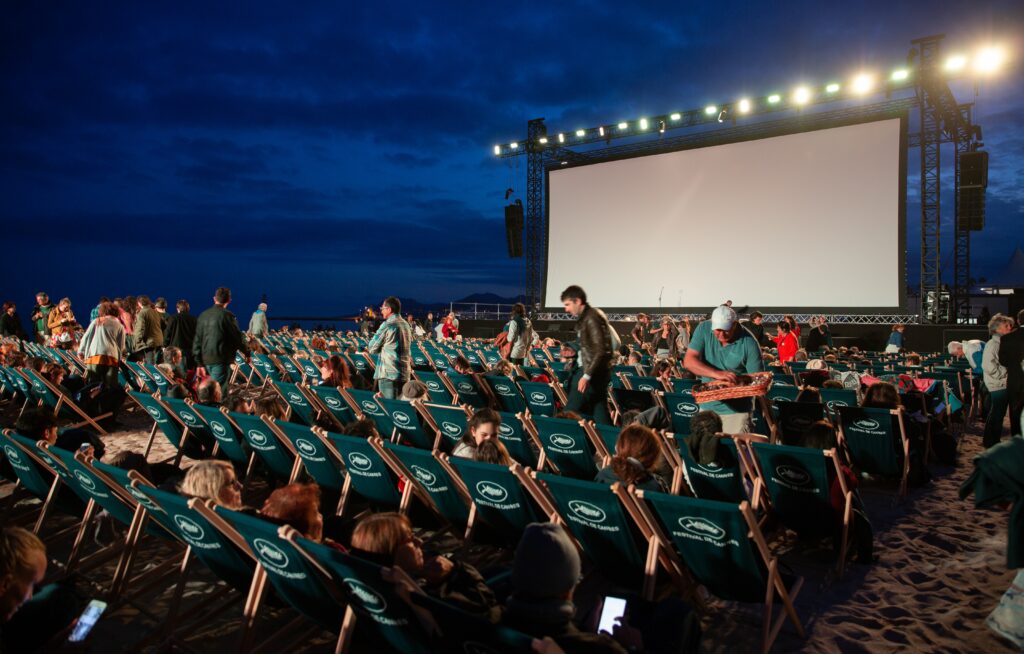
What’s more epic than watching a film about the outdoors while seated outdoors? Before the screening of On the Road Reel 2 starts at 8:30pm, take part in games and activities like corn hole, shopping, and listening to live music.
Photo courtesy of Pittsburgh Glass Center’s Facebook
Rockwell Park, September 22
Ten percent of Pittsburgh Glass Center’s annual operating funds are generated at this one-night-only party and glass art auction. Not only is this fundraiser an opportunity to purchase unique, handmade glass, it’s also a chance to help support free public programming and glass education in Pittsburgh.
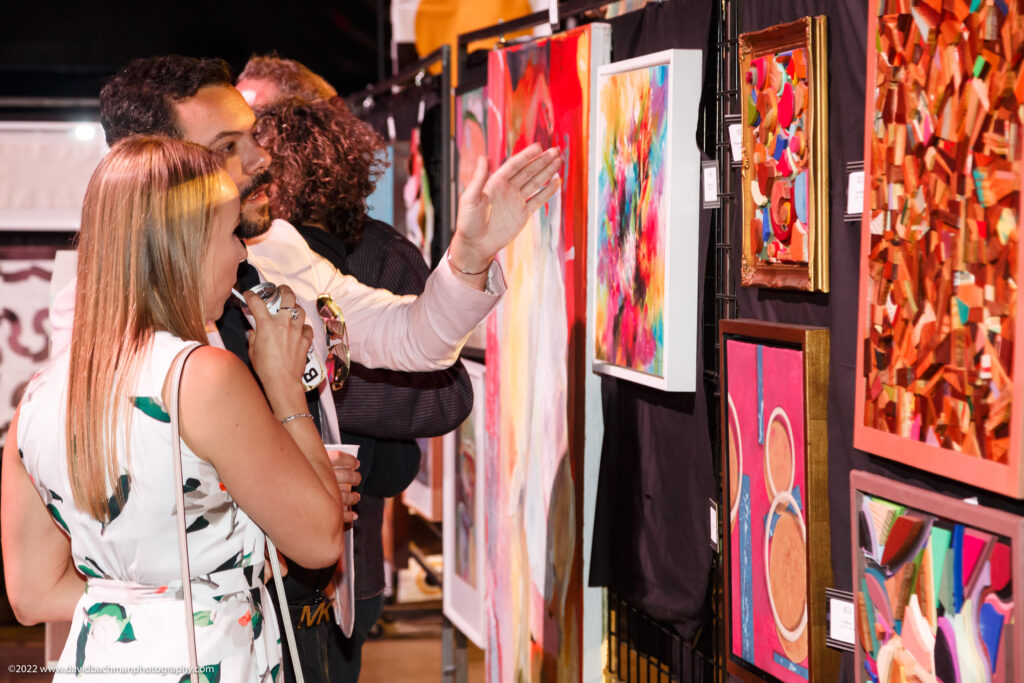
PERSAD Art For Change 2022. Photo by David Bachman
Stage AE, September 22
If you’re looking to add painted or framed artwork to your home’s collection, the Persad Center’s 36 annual art auction takes over Stage AE on Friday. The proceeds from the artwork purchased during this event support HIV/AIDS-affected communities and provide mental health services to the LGBTQ+ community.
Wood Street Galleries, Opening Reception September 22
Artist Jenson Leonard’s first solo exhibition uses film and computer monitors to comment on the intersection of Blackness and capitalism. “My film seeks to disabuse notions of completion, whether it be completion of the human, the nation state, or civil society,” Leonard says of Workflow. “[Methods] to maximize profits and production can be traced back to methods worked out and perfected in the cotton and sugar cane fields hundreds of years prior.”
Downtown, September 22
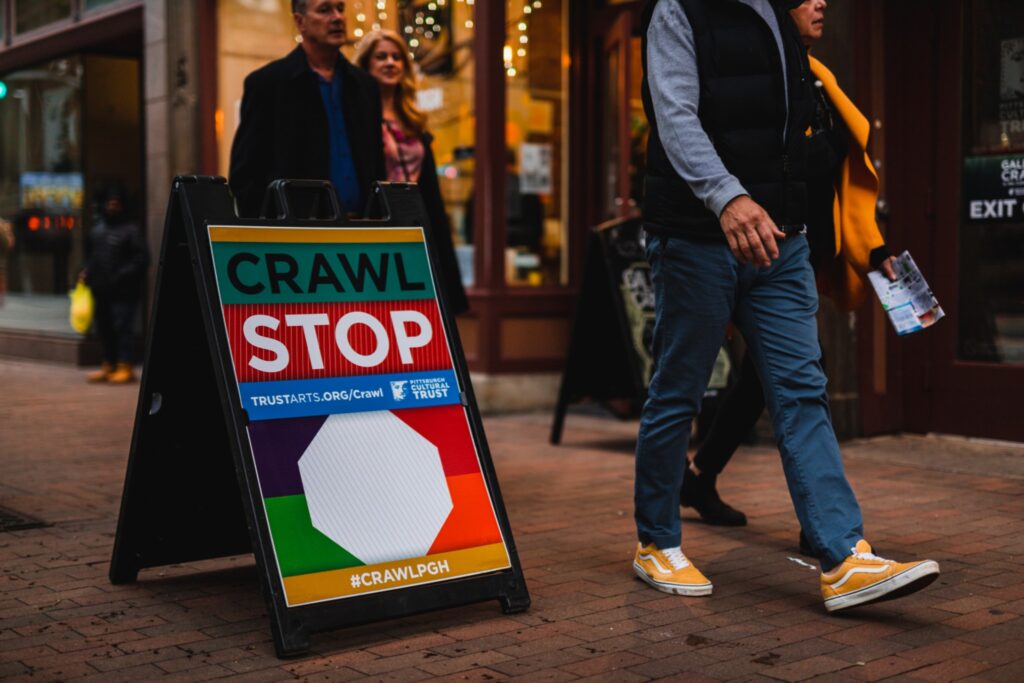
A silent disco, a performing dance piece, the Market Square Night Market, Workflow‘s opening reception, and street magic. Find all this and more during the fall iteration of the Pittsburgh Cultural Trust’s Gallery Crawl.
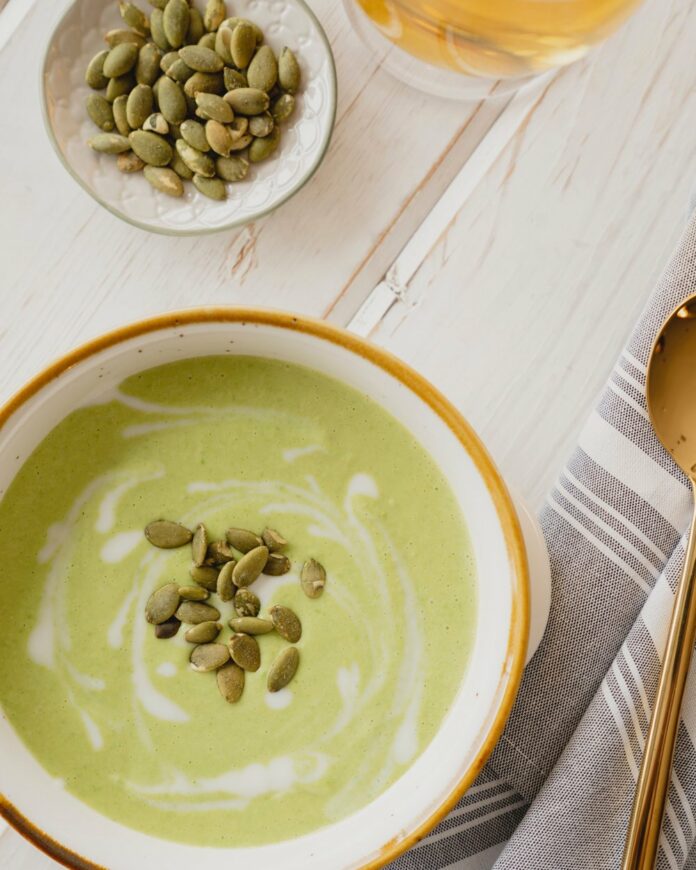
This Caramelized Fennel, Onion and Pea Soup recipe is a warming and delectable winter soup created by Chef Rachel of the now-closed Pair With Dead Oak restaurant in California. Her menus fused together varying local ingredients seasoned with warm spices and decadent textures.
Tips for Cooking with Fennel
Fennel is a versatile ingredient with a unique licorice-like taste. As you’re preparing it, you want to always remove the tough core and slice it thinly and evenly. In this fennel soup, it gets caramelized to bring out a more complex flavor alongside the onions and garlic. With any caramelization, you want to be sure that you’re not over-cooking it and burning it. You want soft and flavorful, not brittle and bland!
In large saucepan melt butter on high heat, reduce heat to medium and then add fennel, onions, and sugar, stirring occasionally. When butter is getting brown add garlic powder, top with vegetable stock, and turn heat up to high. Cook for 5 minutes.
Add frozen peas, cream, and salt. Bring to a boil, cover, and reduce to simmer for 10 minutes.
Carefully add mixture to blender: blend starting on low then gradually to high. If mixture is too thick, add more stock.
Pour soup back into saucepan; add salt and pepper to taste.
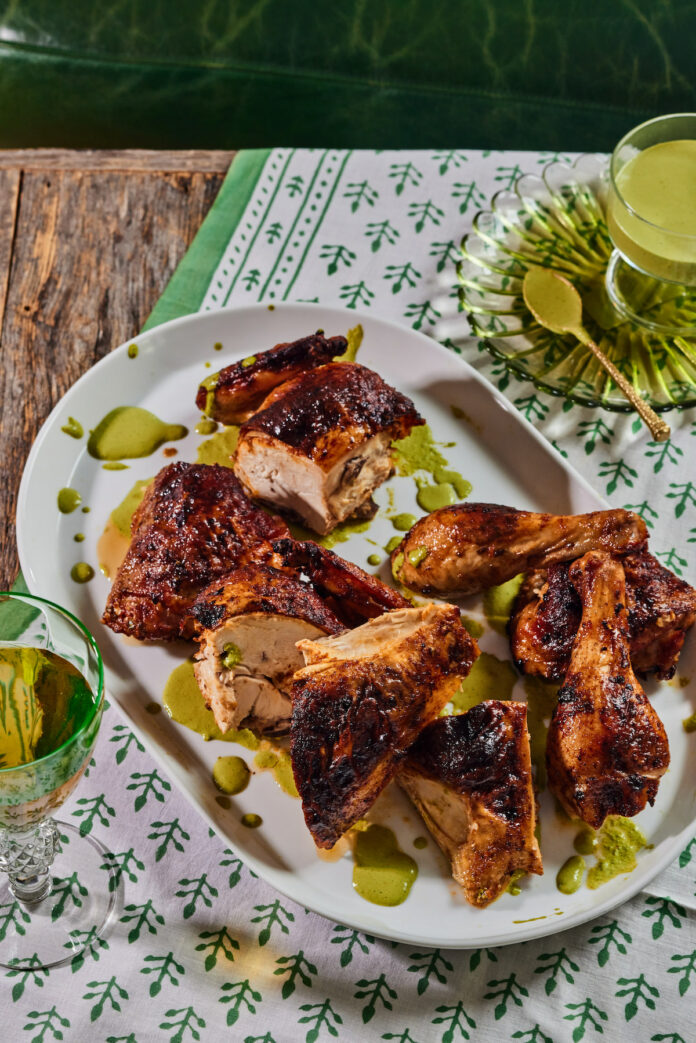
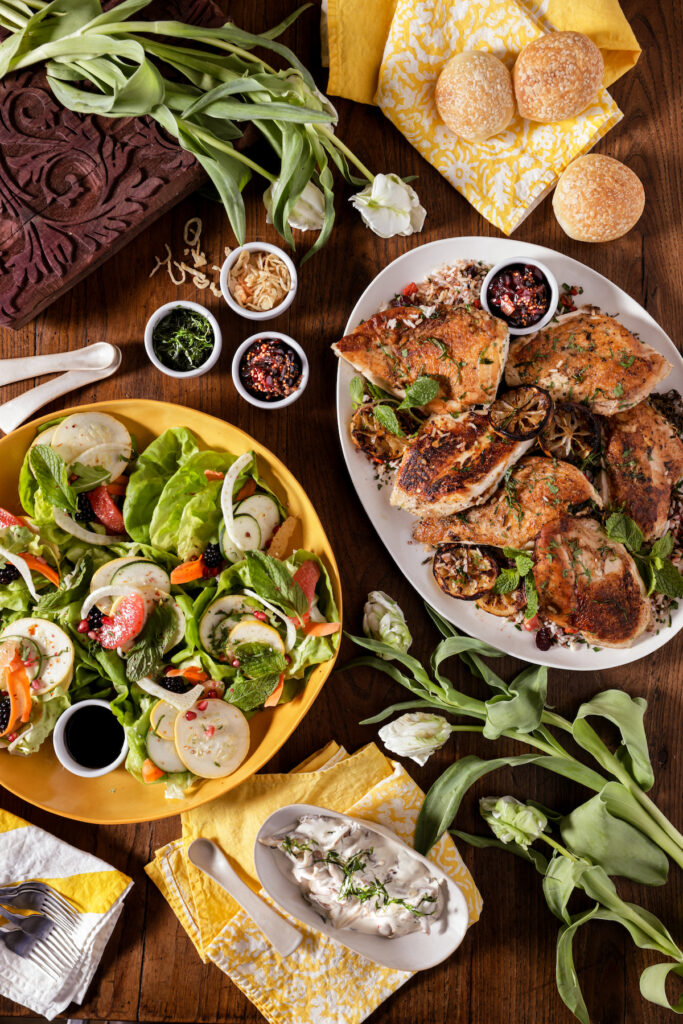
What does green taste like? Herbaceous, fresh brightness that feels like a new start. To savor a bit of green’s wonderful qualities, try The Taste Curators‘ recipe for Roast Chicken with Spicy Green Sauce.
Colorful Influences in Our Roast Chicken Recipe
The impact of color is so profound that it’s been said that it influences 85% of our purchasing decisions. When you really think about it, this is as true when picking out the freshest bunch of basil as it is when choosing a new hat or new wallpaper. If we open ourselves up to it and acknowledge its power, color makes for impactful experiences.
When trying the following Roast Chicken with Spicy Green Sauce recipe, take a moment to stop and think about what you are tasting. Enjoy the moment and savor the palate happening in your mouth and the palette on your plate.
1 (3 1/2 lb) chicken, backbone removed and flattened with the heel of your hand
For the sauce:
1 poblano pepper, seeded and chopped
1 tsp Calabrian chili paste
1 cup packed cilantro leaves and tender stems
1/2 cup basil leaves
1/4 cup Italian parsley leaves
1 small garlic clove
1/2 cup mayonnaise
1/4 cup sour cream
1 tbsp freshly squeezed lime juice from 1/2 a lime
3/4 tsp kosher salt
Instructions
In a small bowl, whisk together 1 tablespoon salt, paprika, cumin, garlic, scallions, red wine vinegar and 3 tablespoons olive oil. Spread the marinade all over and under the skin of the chicken. Place in the chicken in a bowl and cover with plastic wrap or in a resealable plastic bag. Refrigerate for 8 hours or up to overnight.
Preheat the oven to 425 degrees F.
Remove the chicken from the refrigerator 30 minutes before roasting.
Meanwhile, in the pitcher of a blender combine the poblano pepper, chili paste, cilantro, basil, parsley, garlic, mayonnaise, sour cream, lime juice and salt. Puree until the mixture is smooth, about 30 seconds. Pour into a bowl and refrigerate until ready to serve.
Place the chicken on a rimmed baking sheet. Drizzle with the remaining tablespoon of olive oil and sprinkle with the remaining 1/4 teaspoon salt. Roast until golden brown and an instant read thermometer inserted in the thickest part reads 160 degrees F, about 45 minutes. Allow the chicken to rest for 10 minutes before carving and serving with the green sauce.
Prep Time:45 minutes, up to 1 day unattended
Cook Time:45 Minutes
Story and Styling by The Taste Curators
Recipe courtesy of Lish Steiling, The Taste Curators
Photography by Lauren Volo
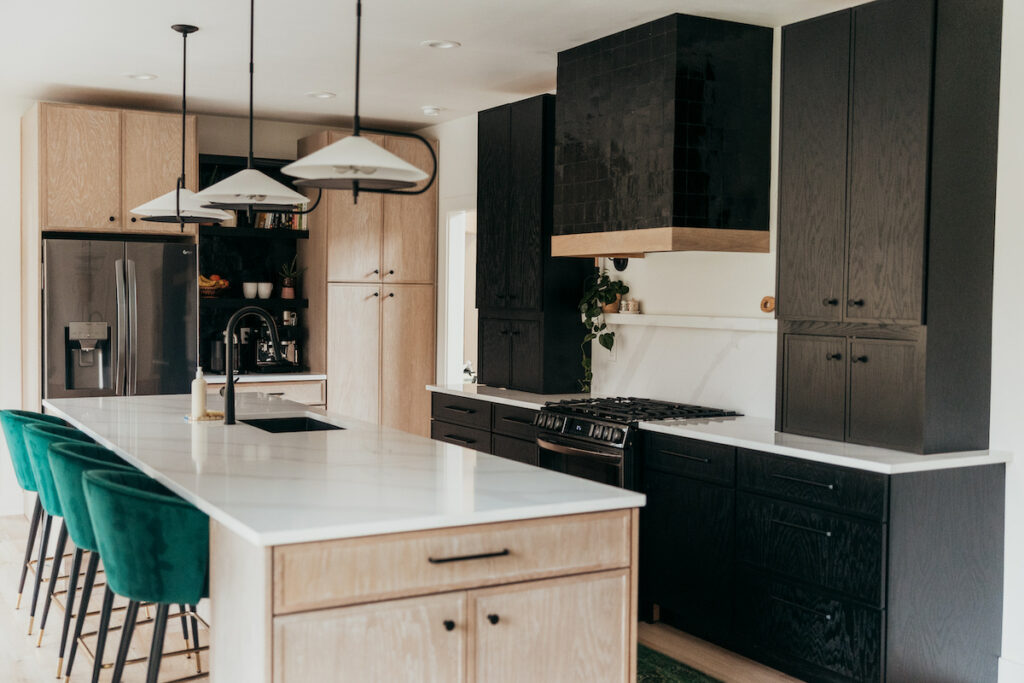
DB Design Center renovates a kitchen for a family just starting out. The results: sleek, stylish, and functional.
You might expect Doug Barrante to be an investment banker or a stockbroker since he has a BA in economics from Pitt and an MBA in finance and marketing from Penn State. As it turns out, his mom had a bigger influence on him and his brother and business partner, Paul, than his professors. Doug is the head of operations and design for DB Design Center in Cranberry Township; Paul is chief business officer.
“Mom was an interior designer and had her own art gallery, and we would work with her,” Doug says. She was a designer for Dream Waterbeds, and after the store closed for the day, we would go in and do the showroom displays.”
The space needed to reflect the clients’ “trend-forward” design taste.
Boldly Go!
DB specializes in kitchens and bathrooms but can tackle any project. Their forte, Doug says, is “turning boring suburbia into sleek contemporary.” A recent kitchen renovation by staff designer Chrissy Norman did just that. The location — just outside North Park — was great. “But it was a really boring 1990s home that had been rented,” Doug says. “The tenant had trashed the kitchen, and the landlord called us to replace the countertops. We told them he was wasting his money.” Someone else could remodel the kitchen to their liking.
That’s what happened. A young couple — two women just starting their family — bought the house and asked for DB’s help. The clients are very “trend-forward,” Chrissy says, “so the space needed to reflect that.” But it also needed to be childproof, a goal Chrissy achieved even though she “pushed the design elements and made bold choices.”
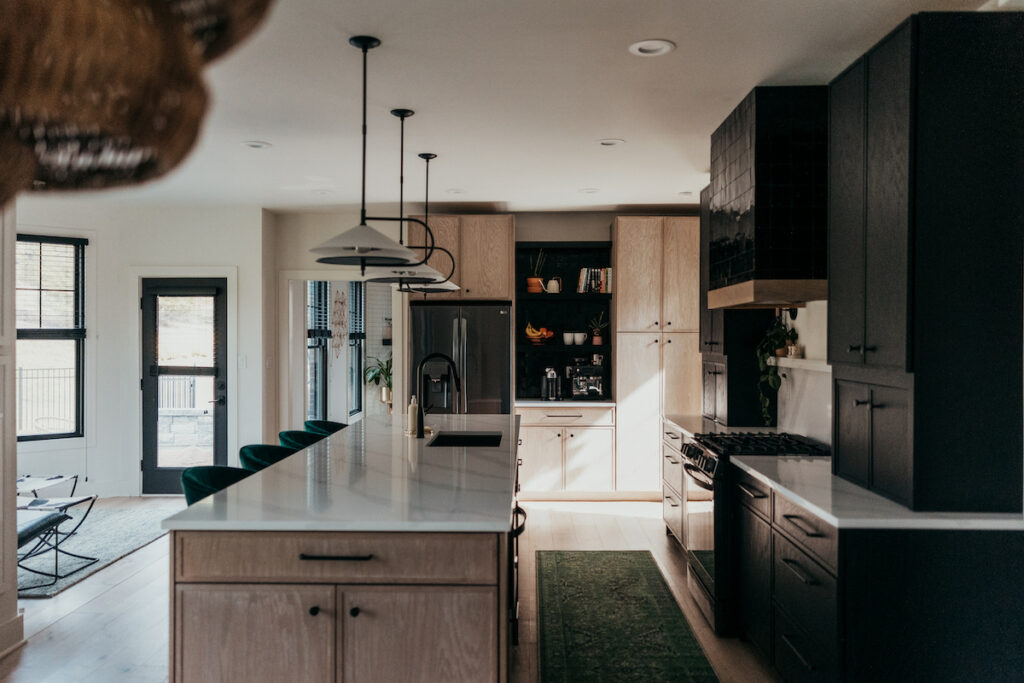
A large white granite center island begged for pendant lights.
All An Illusion
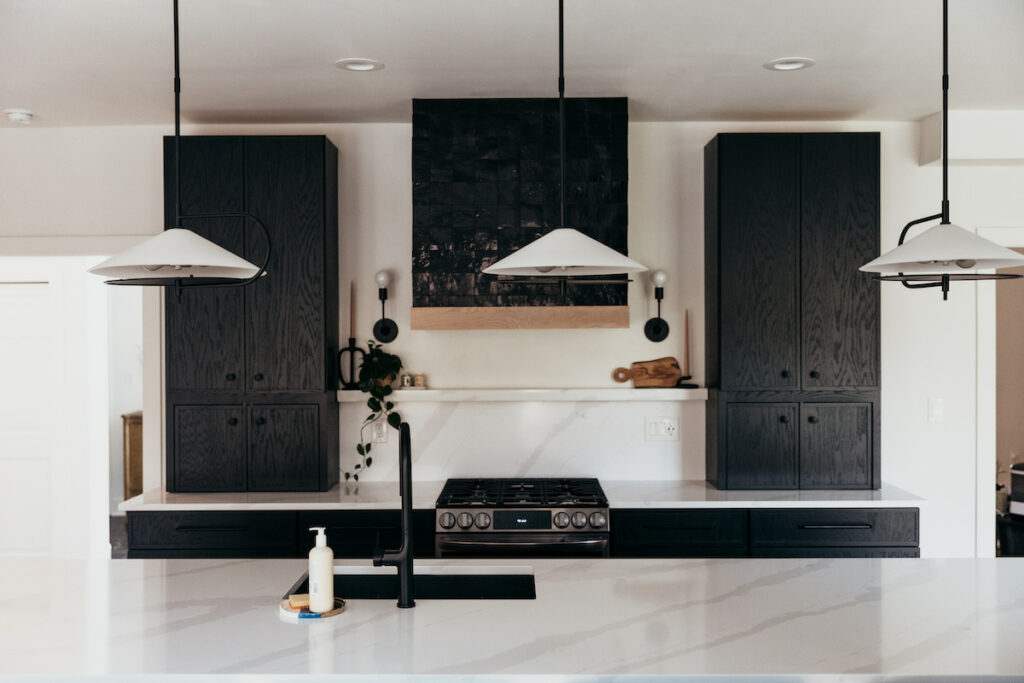
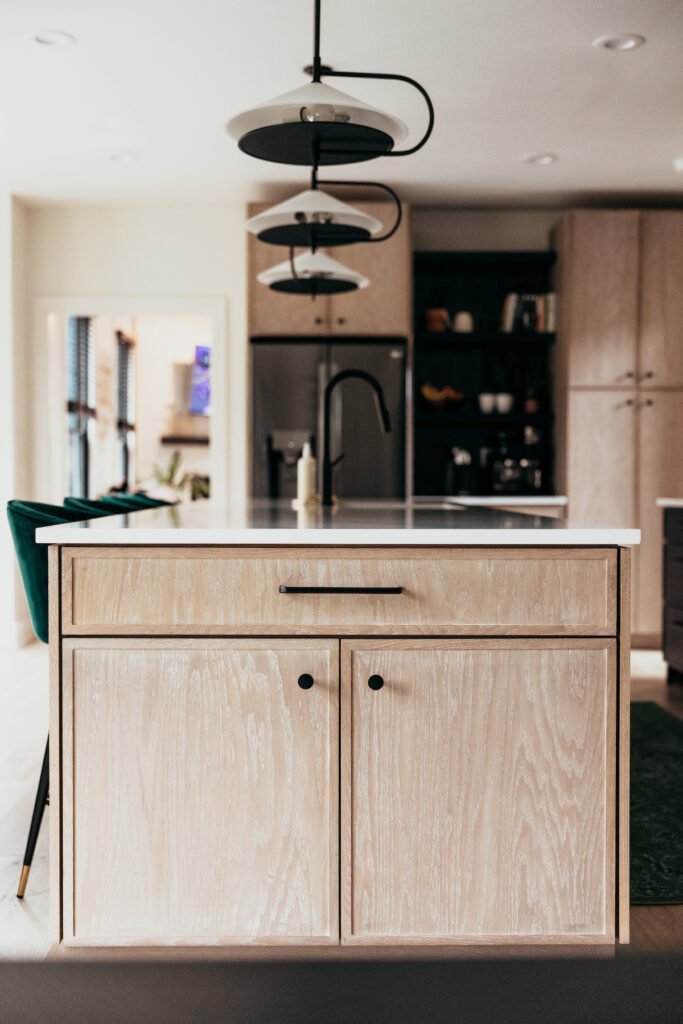
Her biggest challenge was creating the illusion of more space. Removing the wall between the dining room and kitchen created an open floor plan but cut down on wall space for cabinets. To solve that problem, they installed a giant white granite center island with ample room for storage at both ends. Once installed, the island begged for three signature pendant lights.
“Lighting is so important in my design choices,” Chrissy says. “Kitchen lighting is at eye level, so making a statement there is a must for me… the shape of the [black] rod swooping around the light pendant caught my eye, and the scale for the space sold me. [The pendant lights] were just the right amount of interesting without overpowering the overall design.”
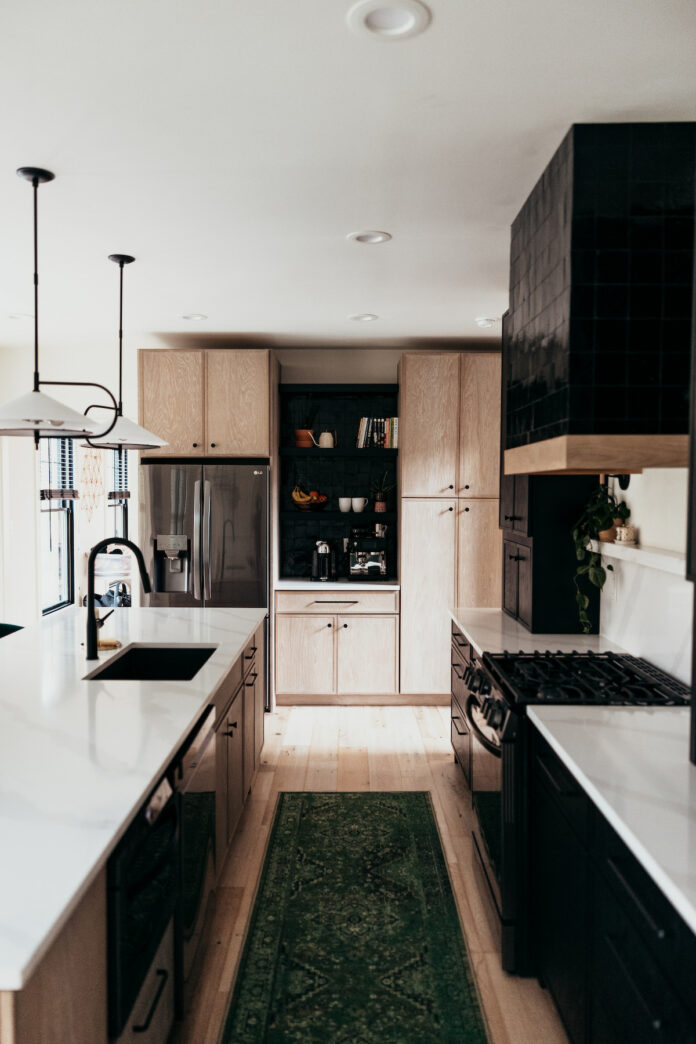
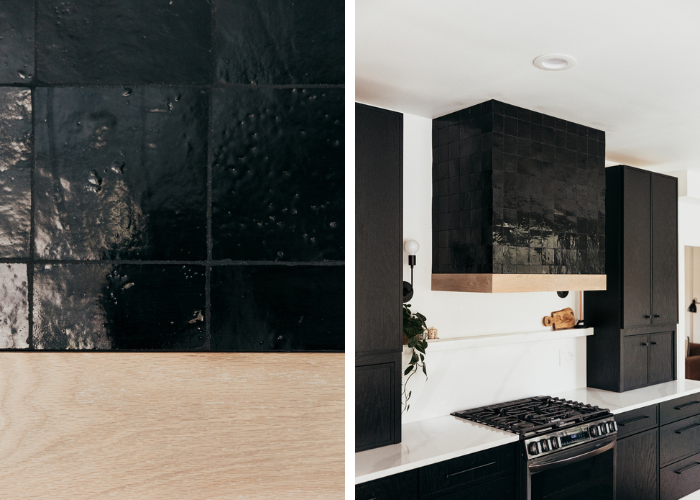
The color black is featured throughout the kitchen.
Black is the New Black
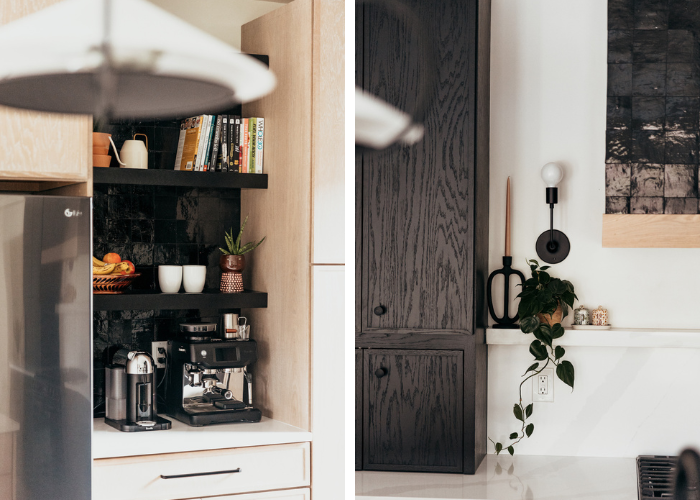
Black is prominent throughout, accenting the light-stained floors and oak cabinetry. The tall faucet and granite workstation sink in the island, both by Kraus, the hardware, and the gleaming zellige tile range hood by Villa Lagoon are all black. The appliances are black stainless, a pretty but practical choice, Doug says, because its matte-like finish is not likely to show fingerprints. (DB does not supply the appliances but recommends clients purchase from a reputable dealer. “Most of them go to a local appliance dealer like Don’s,” says Doug.)
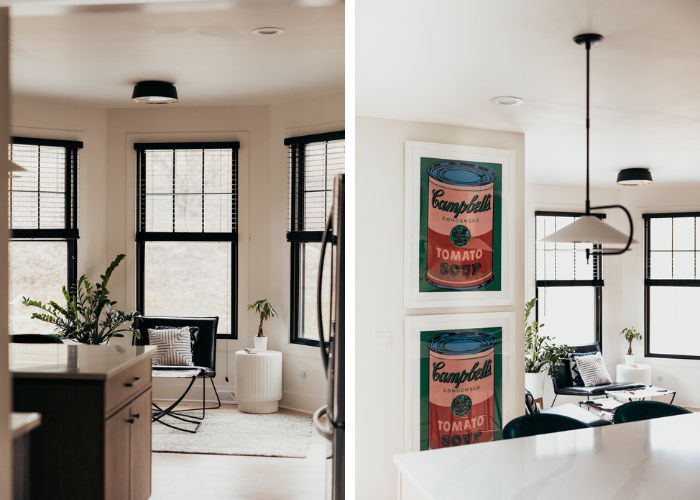
The kitchen is actually three distinct but complementary spaces. On one side of the prep island is a casual dining area with a chunky black rectangular table and bench; on the other is a cozy nook with black leather chairs and animal-printed foot stools, perfect for coffee and conversation. The Pella window frames are black, but because they are unadorned, light fills the room. A whimsical three-tiered rattan chandelier over the table lightens the mood.
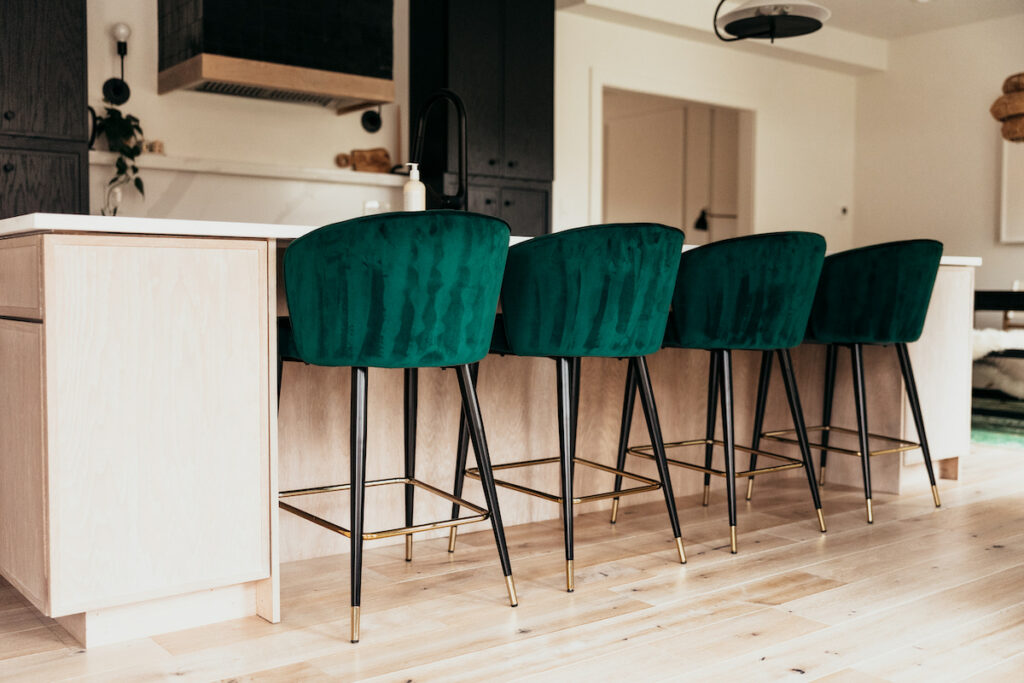
Emerald chairs act as a splash of color.
The only splash of color in the design is the emerald green stools that flank the island. The integrated space is a perfect backdrop for the couple’s extensive art collection, which Chrissy helped place.
A Fine Balance
DB Design Center’s designs are fresh and contemporary but not so trendy as to need constant updating. Doug’s approach? Choose relatively traditional styles and finishes for expensive items such as cabinetry. Choose cutting-edge fixtures, hardware, and accessories because they can be changed easily. For instance, the pulls on the cabinets, which are called cocktail knobs and look a bit like a martini glass from the side: they would be easy to switch out should a new vision for the space take root.
Seems like the sweet spot, then, is somewhere between being quick to embrace new trends and trending too far over the top. That’s a good piece of advice Doug might have received from his mother.
Appliances
LG 36” French Door Refrigerator
LG 30” Slide-In Natural Gas Range
LG Top Control Smart Dishwasher
ZLINE 24” Built-in Microwave Drawer
Story by Susan Fleming Morgans / Photography by Tyler Norman
In interviews with five photographers from the United States and Canada, Mark Oppenheimer explores an essential element of 21st-century visual culture: the food photo. Whether taken by a professional with an expensive lens and a support team, or by a passionate amateur wielding a smartphone, images of food abound in our world. Settle in for a good read about what motivates the pros, and what they think makes their work not just good, but deliciously transformative.
Henri Cartier-Bresson, the French photographer who revolutionized the art of photography in the 20th century, famously coined the term “decisive moment.” He referred to it as the perfect alignment of all the elements of a scene, resulting in a compelling image that captures the essence of the subject.
Well-constructed, professional food shots can be as intimate as a portrait, visually revealing flavor, texture, temperature, and temptation. The missing bite out of a piece of cake allows us to imagine that we are enjoying that cake. As photographer Scott Goldsmith says, “a good food photograph should evoke intrigue, curiosity, and desire.”
Driven by social media and smartphones, food photography has been democratized to the point that it is undeniably part of our visual culture, encouraging us to connect over our shared love of food, and to learn about and explore different cultures through their cuisines. Food photographs are documents that will one day serve as a visual record of our culinary and cultural history, making the photo albums on our phones both biographies and travelogues. Our images connect us to the story of our lives and to cherished aspects of culture and tradition.
Following are excerpts from recent interviews with five skilled food photographers, sharing valuable insights into their art, as well as showcasing some of their finest work.
Donna Griffith
Donna Griffith is an award-winning Canadian photographer known for capturing the beauty and essence of interior design, architecture, and food. Working with top designers, architects, and chefs, her images have been featured in House & Home, Style at Home, Canadian Living, and more.
Food styled by Sasha Seymour
How do you approach a food shot differently than a portrait?
Food doesn’t talk back. When you’re working with food, you pretty much control everything, although there will be times some food doesn’t want to behave and things melt or wilt.
Laura Petrilla has been chasing the light ever since she was a teenager. At 16, she managed a neighborhood photo studio. By 19, Laura had booked her first photography assignment. In addition to her work as a photographer, Laura is also a trained birth doula. She resides in Pennsylvania with her two daughters, Freya and Fauna.
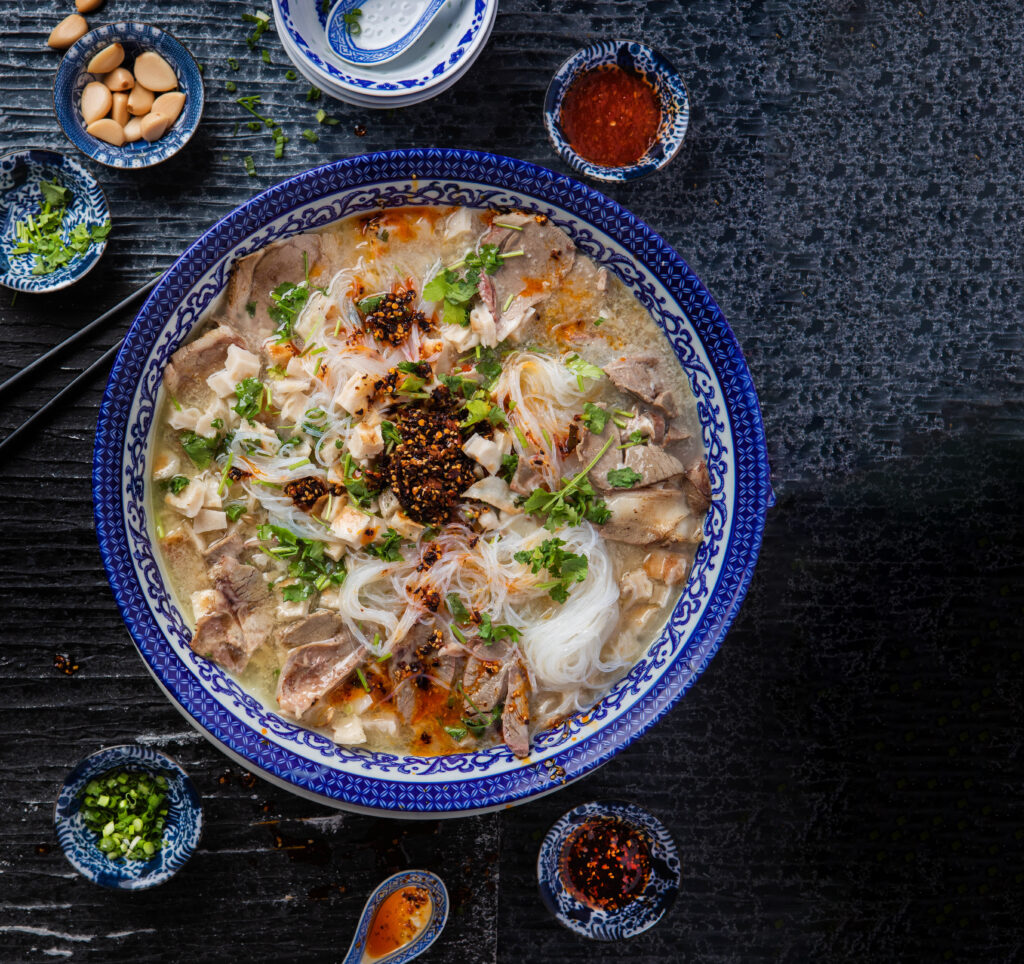
A dish of traditional Szechuan mutton soup, styled by Ana Kelly.
Are you shooting a plate of food or telling a story?
It’s a story when I’m working with chefs. We work together to curate and build the shot, and I see the story come to life. There’s a kind of ebb and flow, a dance of harmony, which helps find the harmony within the photo.
Over a four-decade career, Penina Meisels has received a James Beard Award and an Addy Award, and her photos are in the collections of the Smithsonian, the National Sporting Library, and the Library of Congress. With more than 30 books to her name, Penina has collaborated with Julia Child, Jacques Pepin, Joann Weir, and Williams Sonoma. She lives in Santa Fe with her loyal corgi, Dr. Watson.
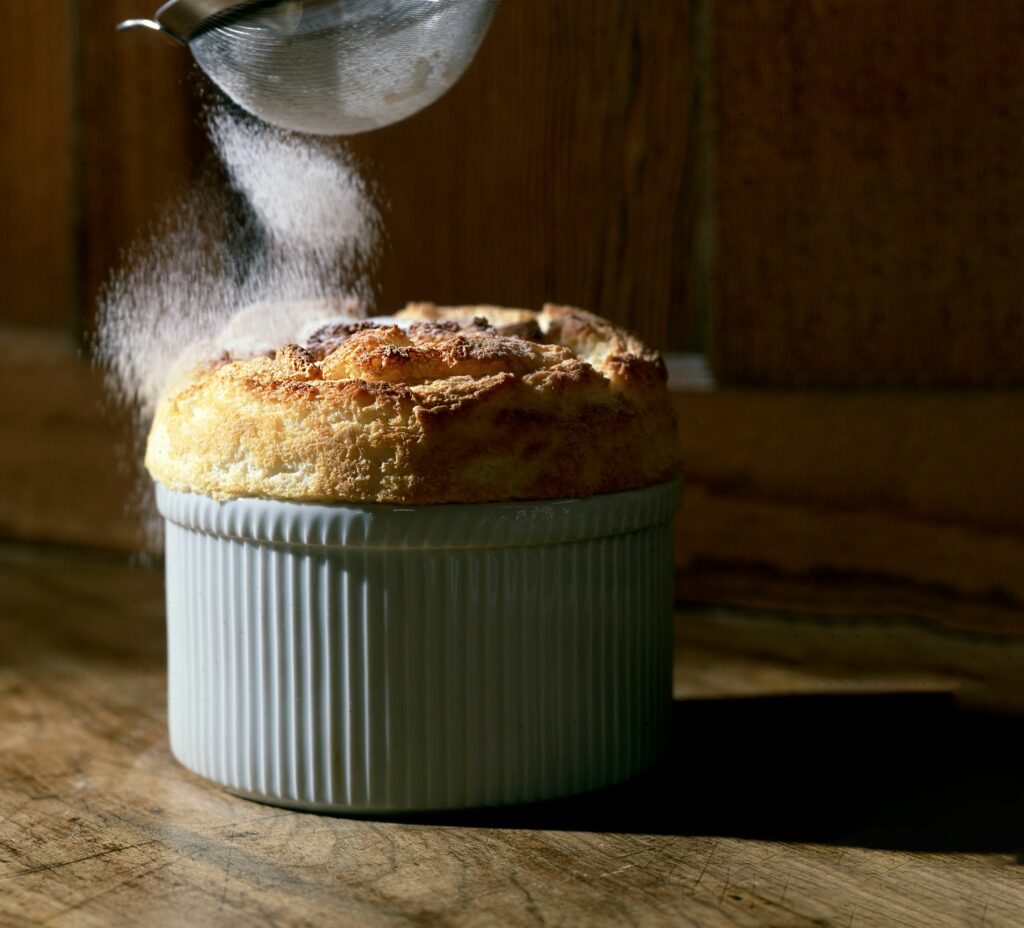
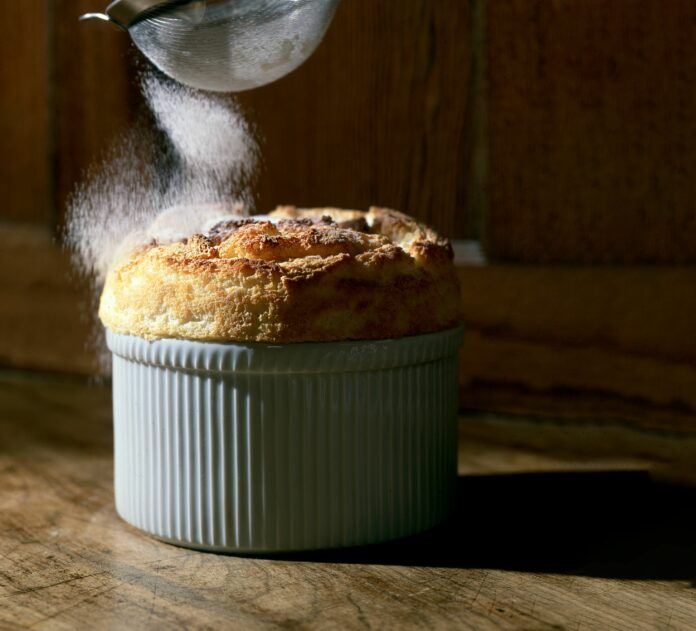
Vanilla bean soufflé with mango sauce, photographed by Penina Meisels for Williams Sonoma.
How do you work within the constraints of an assignment?
One of the reasons I love doing cookbooks is that it’s editorial work. The constraints involve following the recipes that are given to us. Sometimes the author will give us snapshots of what that dish is supposed to look like. Sometimes we follow, sometimes we don’t. There’s creative license.
Scott Goldsmith is a seasoned photojournalist with an expertise in food photography. Whether photographing a landscape, a portrait, or a plate of food, Scott approaches his subjects with a heartfelt and compassionate openness, evoking a sense of vulnerability.
How do you prepare a shot when you’re going on location?
Unlike most food photographers, I can’t script it. I like it best when nothing is preconceived. I just have to see it and feel it; to know whether it’s working or not. My best work happens when I’m inspired by unique locations.
As a child, Tira Howard captured her world with a point-and-shoot camera. After studying writing and acting in college, she returned to photography in 2013. She once considered being a war correspondent but abandoned the idea after her husband reminded her of her family responsibilities. Tira and her family reside in Santa Fe.
Tira Howard explored the markets of Singapore’s Little India last year. A scrumptious plate of Genovese Classico photographed (and enjoyed) in Naples.
How do you engage a viewer’s emotions in the shot when you can only imply the other senses?
You’re telling another human’s brain to read the frame in a way that feels good. Moving the eye from left to right, with lighting and composition, letting the rule of thirds work, following the kind of spiraling of the Fibonacci sequence, because it’s naturally occurring. And it often elicits its own emotional response. Pleasure, like sweets, is universally enjoyed.
Tira Howard explored the markets of Singapore's Little India last year. A scrumptious plate of Genovese Classico
photographed (and enjoyed) in Naples.
In interviews with five photographers from the United States and Canada, Mark Oppenheimer explores an essential element of 21st-century visual culture: the food photo. Whether taken by a professional with an expensive lens and a support team, or by a passionate amateur wielding a smartphone, images of food abound in our world. Settle in for a good read about what motivates the pros, and what they think makes their work not just good, but deliciously transformative.
Tira Howard
As a child, Tira Howard captured her world with a point-and-shoot camera. After studying writing and acting in college, she returned to photography in 2013. She once considered being a war correspondent but abandoned the idea after her husband reminded her of her family responsibilities. Tira and her family reside in Santa Fe.
In many of your shots there is an implied unseen presence round the edge of frame.
I feel like there’s something unnerving about the desire to have everything revealed. I enjoy secrets, and having secret worlds to exist in, because I think that makes what’s visible so much more interesting. I want there to be questions still left to answer at the end of your interaction with one of my images.
How would you describe working on set with your team?
With food photography, you’re coming to it from a place in time. You’re in your life, meeting other people who are participating in the creation of the image. You’re working as a team with a chef or someone who’s styling the scene. We converge around a plate of food that’s not going to last longer than the few minutes we’re there to photograph it.
What is the story you want to tell?
It’s all so temporary, so fleeting. And the eating of what’s in the image, the implied eating of it, is an invitation. In a photograph, that invitation just keeps on being extended. It’s always an invitation to pleasure.
How do you engage a viewer’s emotions in the shot when you can only imply the other senses?
You’re telling another human’s brain to read the frame in a way that feels good. Moving the eye from left to right, with lighting and composition, letting the rule of thirds work, following the kind of spiraling of the Fibonacci sequence, because it’s naturally occurring. And it often elicits its own emotional response. Pleasure, like sweets, is universally enjoyed.
Would you talk a little bit more about yourself working as an artist?
I think a lot of times it’s easy for artists who are trying to make a living to lose track of the meaning of what they’re doing. I want to feel the importance of every little stupid thing I have to do to arrive at an image that feels good. I want to make everything important. I want to elevate everything that interests me.
What do you hope to accomplish with your work?
More than anything, I want to have meaning in my life, and do meaningful work. It’s a tightrope, an almost impossible task, but I absolutely want, on the day of my death, to have at least some work that’s left behind that has meaning for other people, even the commercial things I do.
Food shots can seem very isolated, depicting a world that’s clinical, lacking a sense of human interaction.
I struggle to stay away from a clinical kind of documenting. That’s not what I’m interested in. I’m interested in that moment before you take your first bite, or if you’re in the middle of a bite, or the origin of the dish. I don’t understand the appeal of just showing a plate of food lit very clinically, because it looks to me like it’s just a crime scene photo.
Story by Mark Oppenheimer / Photography by Tira Howard
In interviews with five photographers from the United States and Canada, Mark Oppenheimer explores an essential element of 21st-century visual culture: the food photo. Whether taken by a professional with an expensive lens and a support team, or by a passionate amateur wielding a smartphone, images of food abound in our world. Settle in for a good read about what motivates the pros, and what they think makes their work not just good, but deliciously transformative.
Scott Goldsmith
Scott Goldsmith is a seasoned photojournalist with an expertise in food photography. Whether photographing a landscape, a portrait, or a plate of food, Scott approaches his subjects with a heartfelt and compassionate openness, evoking a sense of vulnerability.
What’s the best part about shooting food?
I like to work with chefs because their hearts [are] in it. They’ve figured out the dish, how it’s put together, and they have a story to tell.
What are the elements of a good food shot?
Intrigue, curiosity, and desire. If somebody looks at a picture and they don’t want to eat the food, then I failed.
Looking at your work I see you like the mayhem. It’s as if you have a street sense in a studio setting. You make it seem as though you suddenly caught the moment.
Good food styling is that you don’t place everything and then move it. You just let it happen. Then it’s my job to see where I should stand. It’s my job to find out where I need to go. I’m watching everything that’s going on, which is part of my early training. Everything in life is chaotic.
How does your interest and training in other disciplines influence your photography?
Similar to [Cartier-]Bresson, I like to sketch. I use the camera as a sketch book. I sketch with my camera ‘til I get there. It’s a messy process. I try to present the chaos in somewhat of an organized way that makes it more interesting than if I hadn’t.
How do you prepare a shot when you’re going on location?
Unlike most food photographers, I can’t script it. I like it best when nothing is preconceived. I just have to see it and feel it; to know whether it’s working or not. My best work happens when I’m inspired by unique locations.
Your work has a natural approach to it. What’s the story you’re trying to tell?
Starting out as a photojournalist, I feel I know what’s real. I like the idea of naturalism. I want the food to look so natural and real that the photographer just happened by. It’s a subconscious feeling.
What’s it like working for magazines?
I’ve learned not to listen to editors because if I do, they won’t get my best work. I will always work intuitively and from my heart. I make them think I’m listening to what they’re saying and then I just do what I want to do. Usually, it works out a lot better.
Story by Mark Oppenheimer / Photography by Scott Goldsmith
Vanilla bean soufflé with mango sauce, photographed by Penina Meisels for Williams Sonoma.
In interviews with five photographers from the United States and Canada, Mark Oppenheimer explores an essential element of 21st-century visual culture: the food photo. Whether taken by a professional with an expensive lens and a support team, or by a passionate amateur wielding a smartphone, images of food abound in our world. Settle in for a good read about what motivates the pros, and what they think makes their work not just good, but deliciously transformative.
Penina Meisels
Over a four-decade career, Penina Meisels has received a James Beard Award and an Addy Award, and her photos are in the collections of the Smithsonian, the National Sporting Library, and the Library of Congress. With more than 30 books to her name, Penina has collaborated with Julia Child, Jacques Pepin, Joann Weir, and Williams Sonoma. She lives in Santa Fe with her loyal corgi, Dr. Watson.
Are there similarities between shooting sculpture and food?
In a food shot, there are so many different layers. It’s a team sport, not a single person endeavor, and so one of the big layers is the team. The end product is only as good as the weakest component.
How do you work within the constraints of an assignment?
One of the reasons I love doing cookbooks is that it’s editorial work. The constraints involve following the recipes that are given to us. Sometimes the author will give us snapshots of what that dish is supposed to look like. Sometimes we follow, sometimes we don’t. There’s creative license.
How do you prepare yourself before you hit the set?
I try to start with a blank mind, without anything to say or any particular purpose. I investigate these questions: what am I trying to say with it? And who am I saying it to? It’s kind of the Twyla Tharp method of the creative process; not starting with a preconceived notion of what it’s supposed to be, which requires being comfortable with discomfort.
What is the moment of engagement, that thing that hooks your curiosity?
If I don’t get goosebumps the viewer isn’t going to be curious. I want to capture beauty and to try, if possible, to make something that’s already beautiful more beautiful.
Do you think there is a decisive moment in food photography?
I think that the phrase decisive moment was something said when a film load had only 24 to 36 frames. Now, in the digital age it is no longer relevant. We no longer have the moment. We just have to figure out the start and the finish. We pick the shot from what is in-between.
How has failure lead you to the choices you make as a photographer?
It’s my best teacher. I don’t think of it as failure but rather as well, it didn’t work out first try, let’s try again. It goes back to the idea of being comfortable with discomfort for me.
Ideally, are you shooting a beautiful plate of food or a story?
I get annoyed when people just shoot a plate of food. I want a story, a sense of place, an emotion. Is it someplace that you want to walk into and sit down? You want to see the rest of the table, eat that food, know what it tastes like. A photo of a straight plate of food doesn’t really spark my curiosity.
Story by Mark Oppenheimer / Photography by Penina Meisels