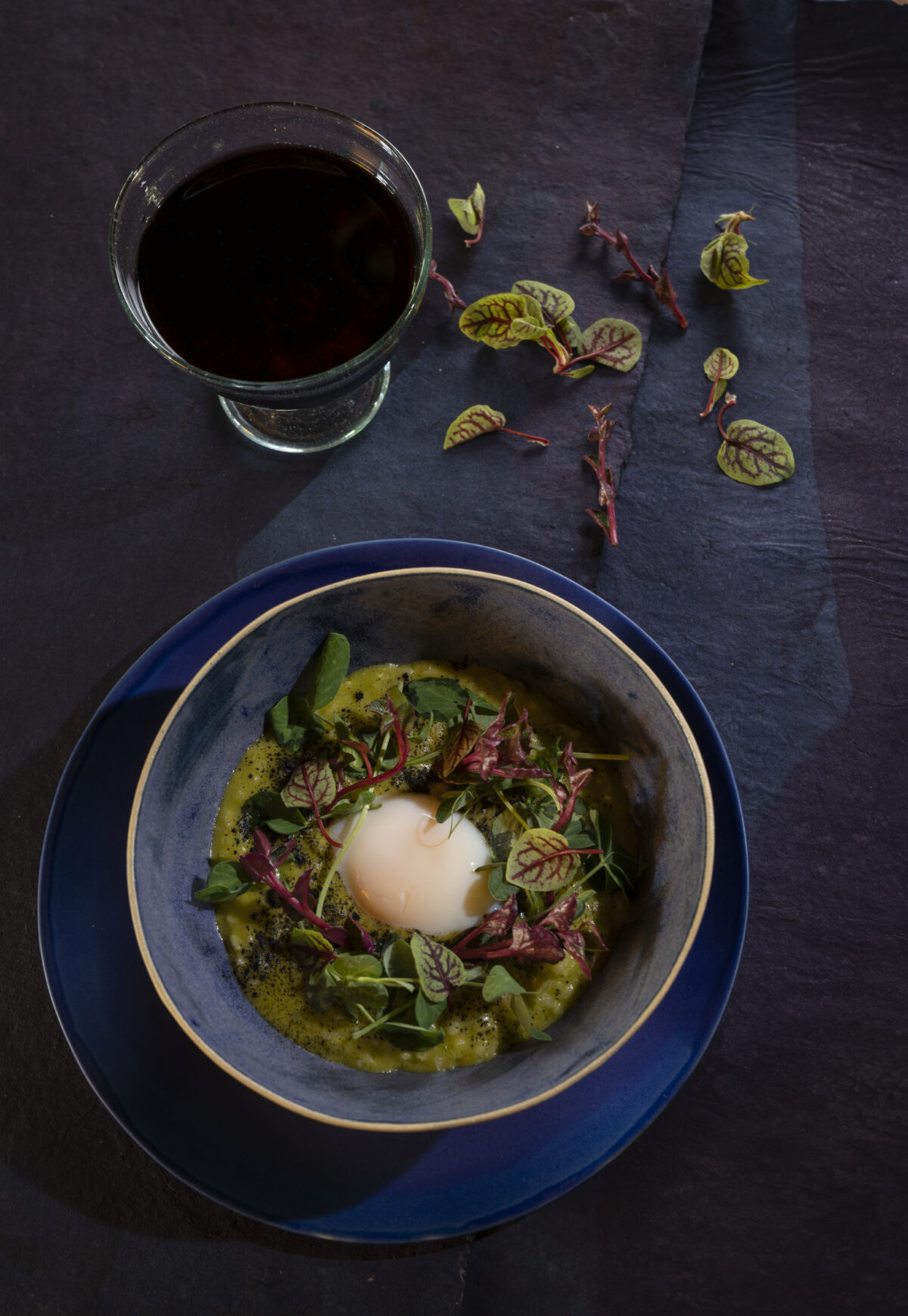
Chef Rafe Vencio's take on ginisang munggo, a classic Filipino comfort dish.
This beans and greens recipe is a take on the Filipino dish ginisang munggo. Shelling beans or peas are used in place of the usual mung beans, and the addition of smoked fish, pork, and bok choy makes this the perfect fall comfort meal.
Beans and Greens Recipe
(Adapted from the Filipino recipe ginisang munggo)
Serves 2-4
INGREDIENTS
1 lb bok choy or pak choi, washed and cut in half
1 tbsp fresh garlic, minced
3 tbsp olive oil
1/2 cup red onion, small-dice
1/2 lb pork belly, cut into ½-inch pieces
4 large Roma tomatoes, medium-dice
2 cups chicken/pork broth or water (substitute meat/vegetable bouillon)
3 cups fresh shelling beans or peas
1/2 cup smoked fish meat (trout/sardine/mackerel/milkfish)
1 large stalk of celery, medium-dice
1 cup bitter melon, optional
1 cup bitter melon leaves if available, optional
Crushed pork rinds for garnish
INSTRUCTIONS
Sear or grill bok choy or pak choi and set aside, seasoning with salt and pepper to taste.
Sauté garlic in olive oil until lightly browned and add onion next, cooking until translucent about 3-4 minutes.
Remove garlic and onion then sear pork until evenly browned.
Add tomatoes and cook until chunky like tomato sauce. Return garlic and onion then add the liquid. Bring to a boil and simmer until liquid has reduced to a sauce consistency and pork is tender, about 15-20 minutes.
Add fresh beans, smoked fish, celery, and bitter melon with leaves if using. Cook covered with the lid slightly open for about 5-8 minutes. Add water if it looks too dry or thick, about 1 cup to adjust with the cooking of the beans.
To plate, spoon over beans on top of the grilled bok choy or pak choi and garnish with crushed pork rinds. Serve while still hot with a side of white rice.
Recipe by Rafe Vencio/ Photography by Laura Petrilla
Lumpia - Filipino spring rolls - make a tasty appetizer any day of the week.
These lumpia (spring rolls) are packed with delectable goodness: ground pork, carrots, and bottle gourd, all rolled into one carry-along snack or light lunch.
Lumpia with Bottle Gourd and Carrots Recipe
Serves 2-4
INGREDIENTS
1 package spring roll wrappers, thin
1 lb ground pork
1/2 cup finely grated bottle gourd, juice squeezed out
1/2 cup finely grated carrots, juice squeezed out
2 tbsp fresh garlic, minced
1/4 cup red onion, minced
2 eggs, lightly beaten
1 tbsp fresh ginger, finely grated
2 tbsp cilantro, finely chopped
1 tbsp Maggi seasoning or Worcestershire sauce
1 tbsp soy sauce
1 tsp salt
1 tsp black pepper
Oil for deep-frying*
Banana ketchup or sweet and sour sauce for dipping
*The ideal temperature for frying is 350-370 degrees. Can be made ahead of time and frozen, pull out to fry anytime.
INSTRUCTIONS
Separate the spring roll wrappers and set aside; put a plastic wrap or towel over it to prevent from drying.
Combine all ingredients and mix thoroughly.
Lay out a spring roll sheet and spoon about 1 ½-2 tablespoons of filling like a log on one end. Roll the sheet over and brush the end with egg wash to seal. Cut in half.
Fry in small batches until golden brown and it starts to float to the surface. Let drain on paper towels for a few minutes and serve while still hot with your choice of dipping sauce.
Recipe by Rafe Vencio/ Photography by Laura Petrilla
Pinakbet is a regional specialty from Ilocos which has become ubiquitous to a national dish with varying distinctions depending on the ingredients. A key ingredient is either bagoong alamang (fermented shrimp paste, which I prefer since it’s easier to find in any Asian grocery store), or burong isda (fermented fish sauce, akin to fish sauce but different in appearance). Cooking the vegetables in succession at the right doneness and allowing the liquid from each vegetable to cook the dish into a stew is what makes the recipe successful. This dish can be vegan without the addition of either key ingredient.
Pinakbet Recipe
Serves 2-4
INGREDIENTS
4 cloves garlic, minced
1 small red onion, medium-dice
1/2 lb pork belly or shoulder, cut into 1-inch pieces, optional
1 tbsp shrimp paste or red miso*
4 Roma tomatoes, quartered
2 cups vegetable/chicken/pork broth or water
2 cups squash, cut into 1-inch pieces
1 large Japanese or Chinese eggplant, cut 1-inch thick
1 large bitter melon, seed part scooped out and cut into 1-inch pieces
8-12 okra, trim ends and cut in half lengthwise
2 cups long beans, cut into 1-inch pieces
*Shrimp paste and pork can be omitted; substitute white miso paste in replacement of either or both.
INSTRUCTIONS
Heat oil in a casserole or medium saucepan.
Sauté garlic until lightly brown and add red onions next. Cook until translucent about 3-4 minutes on medium-high heat.
Remove garlic and onion then sear pork belly/shoulder until browned on all sides.
Add shrimp paste if using and sauté for about 2-3 minutes.
Return garlic and onion mixture then add tomatoes. Crush the tomatoes while cooking and add broth/liquid once tomatoes are crushed. Place lid slightly cracked and simmer for 15-20 minutes or until pork is slightly tender.
Add squash and cook halfway through: depending on the size of the cut, it may take between 3-5 minutes on medium-high heat. Add the rest of the vegetables and simmer until tender but slightly crisp for another 3-5 minutes.
Mary Menniti’s efforts to preserve the wisdom of green-thumbed Italian immigrants living throughout Pittsburgh have nourished many of us with their reminder of the Italian art of living well and “eating good.” Her Italian Garden Project is now over 10 years old, and as many of the gardeners are growing older, sharing their stories and ways of life is more important than ever.
A Summer in the Italian Garden
A few summers ago, while lost in the throes of a research project for school, I found myself spending a significant amount of time in Italian gardens here in Pittsburgh. While I expected to get a decent grade for my hands-on work, I never anticipated what changes in me would come from connecting to these folks and their gardens. By way of that since-forgotten assignment, I was introduced to Mary Menniti, the founder of the Italian Garden Project.
I spent time with Mary and her friends in their gardens, all tucked away in the hills of Pittsburgh. What secrets did I learn from these green-thumbed nonni? How best to store freshly-picked beans and tomatoes. How to serve an entire family from one season’s small harvest. Their knowledge of how to live happily.
Mariano, now 92, snuck me his homemade limoncello (which was delicious), and shared stories of his childhood in Italy. Of course, because eating is more than agricultural research, we dined on cheeses and olives, and Mary’s secret family recipe for biscotti. I felt a connection to something that had long been gone. So focused on assignments and busy worrying about my future, I had forgotten about my past.
Marisa Damico and Great-Aunt Lisa
Looking Back
I was reminded of gardening with my grandmother in the summers as a school-aged child, helping her to pickle and can ripe peppers and tomatoes to keep beyond the growing season. I was reminded of the sense of connectedness that she had to the ground. How she just knew what to do with the earth. I remember her laughter. That is how I feel when I spend time with Mary and the gardens she knows so well.
Mary, too, got her start with gardening through her elders. Her grandfather settled in New Castle after immigrating from Italy in 1912. When Mary was born, he retired to spend his tending to a few acres filled with chickens, sheep, and in Mary’s eyes, “the most amazing garden … he got to spend his retirement days doing exactly what he wanted to be doing. It was so reminiscent of how he grew up before he left his family.”
When Mary would come home from school, she would spend the rest of her day in his presence, helping to harvest ripe vegetables. “As I picked up a hoe and hacked ineffectively at the ground, my grandfather would laugh and say ‘If there was a war, you people would starve.’ Those ‘you people,’ I knew, were my brothers and me and others who were the youth of the 1960s and ‘70s.
He was right. Compared to this hardworking Italian immigrant from the province of Caserta, my generation was a pampered lot,” said Mary. “We had none of the skills and knowledge to grow our own food and survive by our own hands.” Despite his teasing, Mary adored her grandfather. His heavy accent, and calloused hands. His unassuming manner and humble character. “I got to be with someone who shared a sense of homeness,” Mary says with a smile. “That love of gardens and animals and sense of peace influenced me a lot.”
Everything that Mary’s grandfather grew in their garden reflected his childhood in Italy, from unique tomato varieties to Swiss chard and dandelions. He loved his fig trees, to which Mary credits her personal interest in documenting them throughout America. “From his love of gardening grew my own.” Her grandmother would cook all that beautiful bounty into meals for their large family in her classic Italian kitchen.
Pietro Curigliano
Fresh Roots
As soon as Mary had her first home, she planted a garden. When spending time in other people’s gardens, she found that her favorites were ones that reminded her of her childhood. “The ones with rows of tomatoes and peppers, pole beans and Swiss chard, garlic and fennel, and of course, fig trees.”
Mary has experienced two vastly different ways of being. Sharing the simple, yet full, life of gardening and homemaking with her grandfather in her childhood juxtaposed with the contemporary American life she experienced as she grew older. “I’ll bet my grandfather didn’t know he was participating in intergenerational learning when he scolded me in the garden. Today I see what is missing. That’s a big focus of my work. Focusing on a way of life.” A life practicing the connection to food, family, and the Earth. To Mary, there is a sense of well-being and contentment that is lost without these three practices. “What is horticultural therapy other than what Italian gardeners do every day where they tend their gardens, strengthening their bodies and souls.”
Branching Out
Since that initial summer, Mary has connected me to so many Italian immigrants and their grandchildren, including Marisa. Marisa grew up in her grandmother’s garden, who is now too sick to tend to it herself. Able to speak Italian, Marisa helped me gather stories of the gardeners she grew up with. Marisa explained to me that she has a lot to learn, too, especially as her family grows older. She sees the act of Italian gardening a way to stay connected to her heritage. Marisa and I are the same age, and it was fascinating to see someone with the same generational desire for continuing education and tradition.
Marisa and I spent an evening gathering stories in the Morningside neighborhood in the heat of July. The gardens were practically bursting with produce. Walking with Marisa, she pointed out that you can tell which ones are younger gardeners and which ones are Italian. “There’s something about the soil in Morningside,” she said with a soft smile on her face. I knew this day was important to her, just as it was to me.
As I walked into Marisa’s Great-Aunt Lisa’s garden, I was welcomed by sprouting eggplant, three kinds of basil, and crawling bean stalks. I sat with them on that warm summer evening, under the shade of overhanging grape vines, listening to stories told in a garden.
Rough Hands
To Lisa, prior to coming to the States in 1966, this was a way of life. “We had a big farm. We worked hard.” She was a wheat farmer as a child, harvesting it all by hand. “Everything is different. It’s not like before, you know. Before we used to work hard for everything with hands. Now, it’s different.” She kept it up when she moved to Pittsburgh.
“Dominic used to have a big garden,” Lisa said of her late husband, whom she moved with from Italy. “He would work all day, and then come here and work on his garden all night.” Dominic would preserve tomatoes and can sauce. “We would roast them. Put them in a jar.” They use these canned goods all throughout the year, for celebrations including San Rocco in August and La Vigilia in December, feeding upwards of 30 friends and family. “We had many, many, many feasts here at that table,” Lisa says of the freshly painted red picnic table we were sitting on together, which she and Dominic built when they first moved in.
She still keeps up the traditions she and Dominic did together, just as she paints the table every year, in preparation of the meals that will be gathered around it. “We make soppressata every year. Still!” Marisa, too, takes part in this yearly tradition, saying, “Yeah, it’s in January. It’s fun!” “Every year, we make 120 pounds,” says Lisa. They would go to the Strip District to get meat from their butcher. “We make the sausage downstairs and hang it in our basement. It’s a lot of work, but we get together with the family. It’s fun.”
When asked if Lisa felt Dominic when she gardened, she said, “Of course.” As happy as she is to keep up the traditions they shared, Lisa also told me that she “missed him in the garden.” She said, not meeting my eyes, “I have so many memories that it makes me upset. He was young.” Still, the garden helps her to remember Dominic despite the heartache. “But I enjoy it. I tell you though, I can’t do much now. But I like to keep doing it because of my husband. To fix the land like we did. Now he’s with God. He works over there.” Marisa also continues her great-aunt’s traditions, saying, “I’m learning. They have such good soil because they’ve been doing this for so long. I’d like to have a garden like this someday.”
A Small Piece of Home
Later that night, we visited Pietro Curigliano’s garden, tucked within three tall brick walls, which he built himself years ago. It was filled to the brim with Roma beans, peppers, tomatoes, and, of course, fig trees. After five decades of working with fig trees in unforgiving Western PA weather, Pietro has become an expert. A revered fruit to Italian Americans, the fig adapts and thrives in a land not its own, much like the initial immigrants who grew them. Many Italian immigrants even carried small fig trees over to the States with them. Growing a fig tree when they arrived in the US was a way to have a small piece of home in the unknown. He excitedly showed us how he grafted two different kinds of fig trees together, and how he was working keeping birds away from eating his bounty.
Because of the harsh winters, he wraps them in tarps to keep them warm. There was only one year, Pietro told me, that he was unable to keep a fig tree alive. It was winter and he had broken his leg. “No one else could wrap it for me.” Pietro gave me two shoots from the trunk of the fig tree so that I could grow them at home myself and continue the legacy.
Deeping the Roots
The Italian Garden Project began 10 years ago, and it’s still growing. “2011 was the start of the project, but I began doing tours in 2009. They became extremely popular and each was filled to capacity.” Mary found that, just like me, other people love being in these gardens, too. Helping her with a tour in 2021, I saw the tour-goers speak with the gardeners and be amazed at their knowledge, at how naturally gardening has come to them. In return, the gardeners are amazed that there is such newfound interest in something that they have done their entire lives.
What started as a way to share gardening tips from long-time Italian gardeners through tours has grown into much more. “All these ideas for me came together: sustainability, family, seed- saving.” The gardens shared by the Italians who have settled in Pittsburgh have become increasingly relevant for people as they’re starting to recognize all the different things that come out of the Italian garden as parts of their lives.
“People are understanding the project more. They see this way of life and want it for themselves.” Italian gardeners have been eco-friendly since they first arrived in Pittsburgh. Rain barrels, composting, seed saving–these forms of conservation have always been an act of continuation despite their existing circumstances. The current emphasis on eating locally and with the seasons is an inherent part of these backyard gardens, including their efficient space. Tucked in small city lots, these Italian gardens can often produce enough to feed large families. They serve as a glimpse into the past that can lead into a brighter, more sustainable future.
Contentment and Connection
As said by Mary, “People see this way of life and when they do, it almost makes them see what is missing from their daily lives. This connection to the Earth. To food, to tradition, and family, and people… So much of what is missing from the contemporary ways of life I know. These folks are role models for contentment and connection, and that’s really become the focus of the project as it has grown. It’s moved from trying to capture the gardening techniques and skills and knowledge that they have, to looking at the way of life as a whole. What it is about them that they have, that is missing from where daily life is going for most of us.”
I will remember my time in the garden with Mary and her friends with great appreciation, and the lessons of life that they have taught me. I’m still tending to that fig tree in hopes that it will grow and continue the legacy. There is much to learn if we are willing to listen, look, and remember.
Story by Lindsay Anne Herring / Photography by Jeff Swensen
What’s right now? Because the world changes so quickly, that question burns in our minds regularly. As humans, we live through our senses, and part of the answer involves art and design that soothes us, supports us, and delights us. We need that nourishment to face the challenges of our time, at home and in society at large. TABLE Magazine looks at fall and winter trends in art, craft, and design that are just right for our lives in 2023, like the following stealth luxury.
Hiding in Plain View
The Burgh’s Gilded Age titans flaunted their wealth at every turn. These days, the ultimate luxury statement is to hide all obvious signs that your wallet is full. No designer logos. No bling. No loud colors. Just stealth luxury: beautiful materials forged by master artisans into designs worth wearing, and keeping, forever.
Time Flies
Designed in the too-cool-for-school 1960s, the Breitling Top Time speaks in a subtle, sleek voice about speed, precision, and quality. Here, the B01 Triumph edition sports a 41mm steel case and racing-style leather strap. Available at Orr’s Jewelers.
Made in Pennsylvania
Soulful, earthy hues in olive, navy, russet, English tan, sienna, and black. Leather goods designed and made only to order in eastern Pennsylvania by Hemlock + Hyde, a husband-and-wife team pursuing their dreams of fine craftsmanship. Available at hemlockandhyde.com.
Photo by Federico Torra
Complex Illumination
The ethereal pendant’s transparent sections are created by pouring glass into a rotating mold to obtain a unique, textured finish. Inside, polished extruded aluminum and linear LED components provide direct and indirect downward (and decidedly moody) lighting. Designed by French brothers Ronan and Erwan Bouroullec, and available in three lengths.
Hushed Tones
The sueded texture of brushed silk. A classic houndstooth pattern rendered in black and camel. The fluid movement of fabric cut skillfully on the bias. Combine for a classic look, or wear as separates with black or blue denim for a casual elegance. From Vince. Available at Larrimor’s.
Story by Stephen Treffinger and Keith Recker / Principle Photography by Dave Bryce
What’s right now? Because the world changes so quickly, that question burns in our minds regularly. As humans, we live through our senses, and part of the answer involves art and design that soothes us, supports us, and delights us. We need that nourishment to face the challenges of our time, at home and in society at large. TABLE Magazine looks at fall and winter trends in art, craft, and design that are just right for our lives in 2023.
At Your Fingertips
Embrace the radical touchability of dramatic faux fur, sensual feathers, crinkled leathers, and exaggerated knits. Part of the appeal of these dramatic textures doubtlessly derives from our continuing evolution out of pandemic caution and back into living fully. But some of the energy that draws us to these assertive and engaging options comes from our desire to be noticed. Clad in these treasures, how could you be overlooked with this 2023 trend?
Fired Up
Make your wardrobe as multidimensional as you are with this colorfully tipped faux fur jacket from Lisa Todd. Black cashmere sleeves touched with a bit of neon pink drama. Available at Carabella in Oakmont.
Birds of a Feather
The Estelle Black Feather Clutch by Olga Berg moves with every breath or breeze. Its constant motion brings dynamism and spontaneity to your look. Finished with a gleaming gold frame, clasp and long chain strap, it’s large enough to fit your evening essentials. Available at Kristi Boutique in Aspinwall.
Story by Stephen Treffinger and Keith Recker / Principle Photography by Dave Bryce
Marcel, who hails from Corsica, and is the owner of relatively new — and now must-go — French café and crêperie, Mille, in Santa Fe, was originally a scientist. He made his way to New Mexico to work at Los Alamos National Labs but found himself often yearning to return to his family roots of baking and cooking. His grandparents owned and ran the original Mille in the small Mediterranean village he grew up in. So when the opportunity presented itself to open a café — first in Los Alamos and then in Santa Fe — he jumped at the chance. And he has achieved what he set out to do: create a simple and accessible French food experience with a diversity of offerings for all to enjoy.
After indulging in a savory crêpe or a salad niçoise, you might be too full for dessert. But don’t let that stop you from taking a slice of this amazing almond and pear cake (Tarte Bourdaloue) with you home for later. There had been high demand for a gluten-free dessert at Mille, but this sumptuous treat won’t disappoint the most gluten-ravenous among us. Marcel brings his scientific mind to bear on this task and uses only a handful of ingredients in the perfect balance and exact baking conditions to create something classic.
Our friends over at Tonic recommended pairing this with some sherry. And they were not wrong. The soft, round nutty and fruity flavors from the sherry further enhance those same flavors in the cake. This is a perfect way to end a New Mexican autumnal day in French style.
What’s right now? Because the world changes so quickly, that question burns in our minds regularly. As humans, we live through our senses, and part of the answer involves art and design that soothes us, supports us, and delights us. We need that nourishment to face the challenges of our time, at home and in society at large. TABLE Magazine looks at fall and winter trends in art, craft, and design that are just right for our lives in 2023.
Earth and Fire
Fired earth pieces go back many thousands of years, and the material continues to inspire new generations of artists and artisans. Pushing the limits of form and technique brings shapes that are simple, sinuous, and sometimes even a little scary.
Shadow Play
A combination of nostalgia and otherworldliness, the flowerlike, handmade Ana pendant has an open form so it will cast intriguing shadows around the room. The Brooklyn-based designer, Virginia Sin, seeks to refining building forms with coils and exploring the limits of clay.
Artful Entanglement
St. Louis-based Daniel Shapiro creates imaginative, one-of-a-kind sculptural lighting and furniture. The Large Wall Squiggle is made from more than 30 feet of extruded stoneware and features nine bulbs in what look like the mouths of lampreys. It is available in various finishes. Inquire for price and availability at helloshapiro.com.
Photo by Adam Milliron
Philip Soucy
Slender tendrils of porcelain swirl into vessels by Pittsburgh ceramist Philip Soucy. Like undersea lifeforms, no two are alike: each moves to its own current. A recent series of vessels takes on tinges of ancient ochre color thanks to a soda-firing process. Just as Soucy’s coiling creates unpredictable shapes of Soucy’s work, the kiln’s color effects are spontaneous, doubly ensuring that no two vessels are ever alike. Available at Lawrenceville’s Shoppe B and thesoucyshop.com.
Photo by Adam Milliron
Marce Nixon-Washington
This young local ceramist boldly explores the patterns of African textiles in her recent work. The rich textures of her coil-built vessels are evidence of the physical process of their creation. Bold patterns wrap these vases, inspired by Mali’s bògòlanfini textiles, made with fermented, iron-rich mud. Her beautiful glazed compositions radiate joy, which seems to be Nixon-Washington’s gift to every viewer who takes a moment to contemplate the work. Find her on Instagram @marce-clay.
Story by Stephen Treffinger and Keith Recker / Principle Photography by Dave Bryce
Duke Ellington at piano, with dancer Charles 'Honi' Coles and Billy Strayhorn looking on, in the Stanley Theatre, Pittsburgh, Pennsylvania, c. 1942 - 1943. (Photo by Charles 'Teenie' Harris/Carnegie Museum of Art/Getty Images)
An instinctual refocusing at the start of the school year lingers on in most of us, even if some decades stand between us and graduation. Let’s embrace the impulse by embracing new experiences, seeing new things, and hearing some new sounds. The ‘Burgh is ready to satisfy all of these urges this fall.
Alba in Conexiones Liberty Magic, September 6-October 1
Magician Alba brings a bit of Buenos Aires’s signature enchantment and allure to Pittsburgh during her almost-month-long residency at Liberty Magic, creating an experience that mixes unusual stories, adventure, and engagement with the audience.
Sound Series: An Evening with Julian Lage Carnegie Lecture Hall, September 6
Touring to support his two latest albums, The Layers and View with a Room, contemporary jazz virtuoso guitarist Julian Lage visits Oakland for an intimate evening of masterful, moving music.
Broadway at the Overlook West End Elliott Overlook, September 7-10
Get a sneak peek of the Pittsburgh Musical Theater’s upcoming season—which includes Grease, Million Dollar Quartet, Evil Dead The Musical, and more—set against the city skyline. The hour-and-a-half performance will feature selections from their 2023 musical picks, snacks, and refreshments.
Climate Awakening: Crafting a Sustainable Future Opening Reception Contemporary Craft, September 8
Featuring work from Susie Ganch, Courtney Mattison, Meghan Price, and Adrien Segal, four artists visiting Pittsburgh, Contemporary Craft’s latest exhibition focuses on climate change and aims to promote community engagement and social change through art. Climate Awakening: Crafting a Sustainable Future will be available to view until January.
Steve Martin and Martin Short. Photo by Mark Seliger
Pittsburgh Irish Festival Carrie Blast Furnaces, September 8-10
Back for its 32nd celebration, it’s once again time to revel in Irish history and tradition. This year’s festival updates include card and cash accepted for beverages instead of tokens, as well as additional parking.
Steve Martin & Martin Short Benedum Center, September 14-16
We’ve most recently gotten to experience the dynamic comedy duo of Steve Martin and Martin Short on Only Murders in the Building. Now, the pair steps away from the screen to give us a chance to enjoy the captivating chemistry they forged from a decades-long friendship and many shared career experiences.
Taste of Jazz August Wilson African American Cultural Center, September 15
Kicking off the annual Pittsburgh International Jazz Festival is an evening of great music and food from local restaurants, including Over Eden, Eddie Merlot’s, Spirits & Tales, Emerson’s, and more.
Pittsburgh International Jazz Festival Highmark Stadium, September 16-17
Returning for its 13th iteration, the Pittsburgh International Jazz Festival brings together local jazz musicians with internationally known and up-and-coming artists for a weekend of good music and even better vibes.
Andy Frasco & The U.N. Photo by Stephanie Parsley
Seventeen Carnegie Museum of Art, September 16
Interracial romance, vulgar language, teenagers discovering the highs and lows of life: Initially set to air on PBS, this 1982 documentary directed by Joel DeMott and Jeff Kreiens has never been shown on television over concerns of its content. How does it come across over 40 years later? See it and judge for yourself.
5K Beer Run Cinderlands Warehouse, September 16
Exercise and reward yourself with a brew! Starting and ending at Cinderlands, this 5k-course weaving through the Strip District and Heritage Trail can be run, walked, or jogged, and ends with a free beer from Cinderlands, games, live music, and even more fun.
Pittsburgh Chinese Cultural Festival Mellon Park, September 16
Nowhere else in Pittsburgh can you experience Asian cuisine, music, dance, games, exhibits, and more all in one place. Hosted by the Pittsburgh Chinese Cultural Center, they aim to promote awareness and appreciation of Chinese culture while facilitating the assimilation of Chinese immigrants.
Mexican War Streets House & Garden Tour North Side, September 17
Private homes and gardens open to the public during the 51st annual Mexican War Streets House & Garden Tour, a rare chance to peek behind the closed doors of beautiful historic and restored North Side residences.
Billy Strayhorn: Something to Live For O’Reilly Theater, September 19-October 8
The career and impact of jazz legend Billy Strayhorn comes to life through a stunning score in this world-premiere musical directed by Kent Gash and written by Rob Zellers.
Photo by Marius Ciocirlan
Trax Farms Annual Fall Festival Trax Farms, September 23-October 22
It’s officially fall when it’s time for the annual Trax Farms Annual Fall Festival. Running every Saturday and Sunday throughout October and kicking off the final weekend in September, expect to experience all the autumn activities: hayrides, pick-your-own pumpkin patches, a corn maze, and more.
Moulin Rouge! The Musical Benedum Center, September 27-October 8
The fantastical world of Baz Luhrmann’s revolutionary film takes over the stage at the Benedum Center for a usual experience where bohemians and aristocrats mingle in a spectacular production of glitz and romance.
Stevie Nicks PPG Paints Arena, September 27
Fleetwood Mac may no longer be together, but we can still experience the magic of their music and sound when Stevie Nicks’s tour landslides into Pittsburgh. The setlist is rumored to include solo hits like “Edge Of Seventeen” alongside Fleetwood Mac greats like “Dreams” and “Gypsy.”
Sylvan Esso Stage AE, September 28
On their most extensive tour to date following the release of their 2022 album, No Rules Sandy, electronic pop duo (and couple) Sylvan Esso visit the North Shore for an explosive performance.
Andy Frasco & The U.N. Roxian Theatre, September 30
If you find yourself feeling uplifted and optimistic while listening to eclectic blues, rock, and funk band Andy Frasco & The U.N., that’s on purpose. As a fighter of daily depression, optimism is the only thing that keeps frontman Andy Frasco going every day, and he tries to make sure his music reflects that hope and delight.
Story by Jordan Snowden / Send your events tips to jordan@tablemagazine.com
What’s right now? Because the world changes so quickly, that question burns in our minds regularly. As humans, we live through our senses, and part of the answer involves art and design that soothes us, supports us, and delights us. We need that nourishment to face the challenges of our time, at home and in society at large. TABLE Magazine looks at fall and winter trends in art, craft, and design that are just right for our lives in 2023.
Grain and Figure
The rich, natural tones of wood, coupled with the organic pattern of grain and figure, made wood a staple of our visual language. Increasingly viewed as the precious commodity it truly is, artists coax out beautiful effects and splendid forms in a range of colors and textures.
Waves of Wood
Authentic wood, washed in color and inlaid on gold or silver grounds, brings a natural warmth to any space. The pattern, by Philip Jeffries, suggests a blanket of ginkgo leaves catching the light. Available in white with gold, oak with silver, charcoal with silver, and more. Available through Splurge Home.
On the Table
Pittsburgh artist Hanna Dausch says that her woodwork is a conversation between the past, present, and future of craftsmanship. These sensual lamps will bring a tactile intimacy to any room. Shown, left to right, mini table lamp in cherry, carved walnut table lamp, and bulb table lamp in ambrosia maple.
Grand Entry
Custom designed for a Troy Hill client by Caleb Sisco, this entryway cabinet has a new view to discover from every angle. Subtle curves, rendered in Pennsylvania hardwoods sourced with 75 miles of Pittsburgh, intrigue the eye. Hand-carved joints and ingenious storage solutions add their unique and visually dynamic forms. “As an artist who works with living materials, I place a great emphasis on identifying, preserving, and harnessing the natural beauty and character of each species of wood in order to fulfill the key aesthetic and functional aspects of each piece,” states Sisco. Explore the options for bespoke cabinetry for your home at customwoodworkingpgh.com.
Story by Stephen Treffinger and Keith Recker / Principle Photography by Dave Bryce