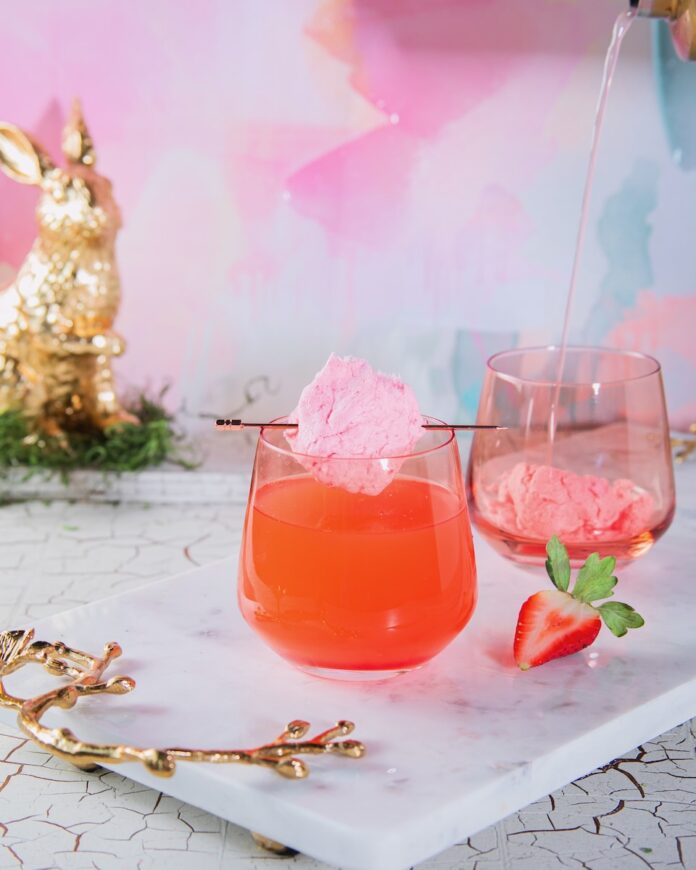
Start your Easter brunch off with Here Comes Peter Cottontail, a refreshing cocktail or mocktail bursting with bright notes of strawberry, lemongrass, and grapefruit. But the flavor experience doesn’t stop there. Vallozzi’s mixologists, Laura Karner and Stephanie Yarup, added more to the drink. “We immediately wanted to make a fun cotton candy cocktail when we heard our assigned line was ‘Here Comes Peter Cottontail.’ To welcome spring, we wanted a bright sangria with plenty of fruit and botanicals.” They complete their drink with pure fun: a puff of cotton candy garnish goes in the glass before you pour the cocktail. Plus, you can be just as fancy with your mocktail if that’s what you prefer.
What is Domaine de Canton in This Cocktail?
Domaine de Canton is the original ginger liqueur using only the finest ingredients. To start, the company farms ginger from Asia before hand-cutting it, rinsing it, and letting it dry for several days after. From here, hand-picked vanilla beans and honey stir into the recipe for a little bit of sweetness to balance out the sharp burst of ginger.
Here comes Peter Cottontail, Hoppin’ Down the Bunny Trail with a Buzzed Bunny Mimosa. Count us in! Upon hearing that his assigned lyric involved hopping down the bunny trail, Square Café’s Steven Krall pulled his juicer onto the bar. Then, in it went fresh carrots, ginger, and pineapple. Out came the freshest, most flavorful blend of juices. (Don’t worry; for those who don’t juice, he also specifies store-bought juice equivalents in his recipe.) Then, he adds lime or lemon sparkling water and a healthy dose of prosecco –which we omit in the mocktail version. With or without alcohol, the resulting Buzzed Bunny Mimosa will have you just as bubbly and jazzed as a buzzed bunny. Enjoy!
Where Does this Easter Song Originate From?
The popular children’s song Peter Cottontail, which comes around during Easter time, was written by Steve Nelson and Jack Rollins in 1949. It gained widespread recognition when Gene Autry performed it that same year, solidifying its place as a seasonal classic which then became a TV special. The song’s cheerful melody and narrative about Peter Cottontail’s journey to deliver Easter eggs makes it a staple of holiday playlists as well as children’s entertainment for generations. This also makes it the perfect pick as the inspiration for our Buzzed Bunny Mimosa. We should note, the song’s origin is in the songwriting partnership of Nelson and Rollins, not in any pre-existing folk tradition or the Beatrix Potter stories like the Peter Rabbit counterpart.
We promise this Buzzed Bunny Mimosa will have you smiling all Easter long.
Ingredients
Scale
1 bottle Prosecco or Italian spumante
6 pack of lemon-lime soda or lemon sparkling water
12 oz pineapple/ginger/carrot/lemon juice (see below for fresh and store-bought options)
For the fresh juice:
3/4 cup cut carrot sticks
1 inch piece of fresh ginger root
1 cup chopped pineapple
1 lemon, rind off
For the store-bought juice:
1 cup Dole Pineapple Juice
5 oz V8® Carrot Ginger juice
2 oz fresh squeezed lemon juice
Instructions
Shake juices in a large shaker with ice.
For the full-fledged mimosa: Pour approximately 6 oz of sparkling wine in glass (4 oz for flute). Slowly add approximately 4 oz of juice mixture (or to preference) at slight angle to avoid foam (2 oz for flute). Stir gently to combine. Garnish with pineapple skewer.
For the mocktail: Fill a 12 oz highball glass with ice. Strain 4-5 oz chilled juice mix over ice. Top with approximately 3-4 oz of lemon-lime soda (or lemon seltzer for less sweetness). Garnish with lemon skewer or slice.
For the fresh juice:
Using a juicer, process all ingredients into juice. Chill in refrigerator prior to use. Store any extra in a closed container for up to 3 days.
For the store-bought juice:
Add juices to a pitcher and stir to combine. Chill in refrigerator prior to use. Store any excess juice in a closed container for up to 3 days.
Recipe by Square Café’s Steven Krall Story by Star Laliberte Styling by Anna Franklin Photography by Laura Petrilla
Collin McNamee’s behind-the-bar genius lit up with the idea of capturing the ineffable, entirely magical quality of Hippity with a Rose and Lavender Easter Cocktail in a glass. In his view, no doubt inspired by the hallucinogenic interior of Cobra, Hippity is poetically and directly linked to the perfumed qualities of rose hip and lavender. So, his recipe starts with a colorful tea made from these floral elements. Add lemon juice and then strong honey syrup to complete his mocktail version, and a glug of the botanical notes of gin to bring a cocktail into being. The taste buds will wander happily through this garden of flavors. Not to mention, perhaps, you’ll meet the Easter bunny along the way.
What is Rose Hip in This Lavender Easter Cocktail?
Rose hip, the fruit of the rose plant, is a small, typically reddish-orange, berry-like part of the plant that develops after the rose flower’s petals have fallen. Rich in vitamin C, antioxidants, and other beneficial compounds, rose hips have been used for centuries in traditional medicine and culinary applications. They’re in teas, jams, jellies, syrups, and supplements, offering a slightly tart and also floral flavor profile. Beyond their nutritional value, rose hips also contribute to the rose plant’s reproductive cycle by containing the seeds that grow into new roses.
You all know the Peter Cottontail song that goes on about Hippity, Hoppity-ing down the bunny trail. When we asked The Commoner’s Blaise Malandra to make part of this song into a cocktail, Hoppity, of course, evoked the seductive appeal of hops. So, a hoppy, IPA-based drink was inevitable. Add to that special tingling of the taste buds drops of hopped grapefruit bitters, Cynar, Sfumato, and strawberry syrup. Then you get a treat that has all the appeal of jellybeans and Jolly Ranchers, but with a sophistication that’s entirely grown-up and delicious. Enjoy!
What is Sfumato in Our Hoppity IPA Cocktail?
Sfumato refers to a specific type of amaro which is an Italian herbal liqueur. The amaro’s name, “Sfumato Rabarbaro,” derives from the Italian word sfumato in the sense of smoky or hazy. This references the earthy, smoky, and slightly bitter notes of the rhubarb (rabarbaro) that is a key ingredient in this liqueur. It’s distinctive since it often also features alpine herbs and, most notably, rhubarb. Unlike other amari, it’s not necessarily sweet which means it combines well with the hoppity-ness of an IPA cocktail.
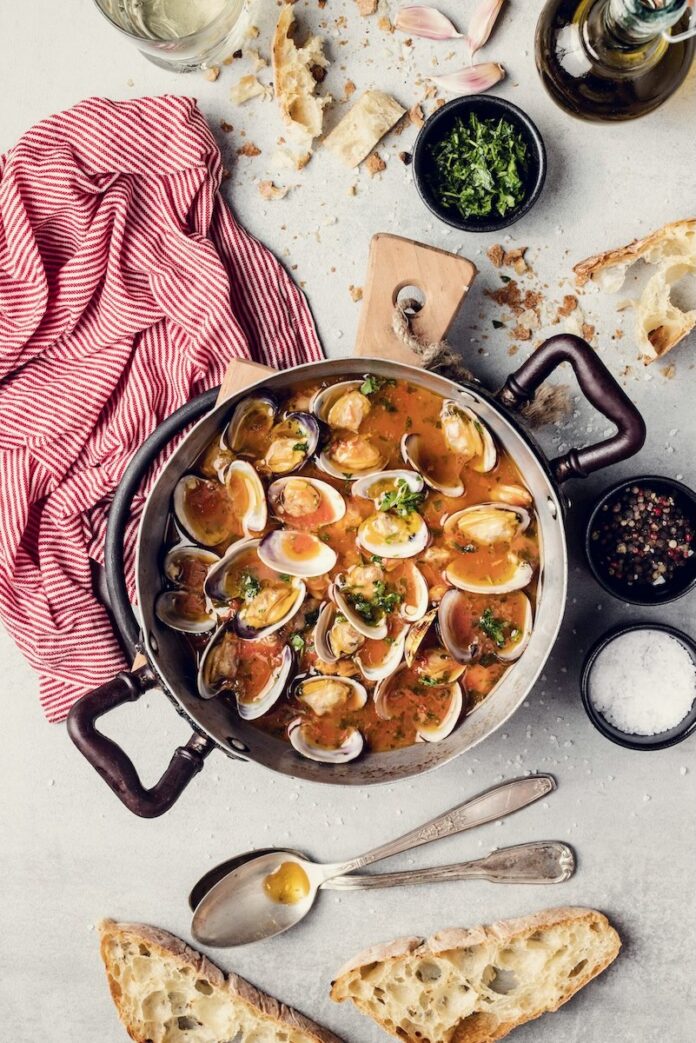
Eat! It’s good for you! Anybody with an Italian grandmother has heard this in the kitchen, at the dining table, and across a picnic blanket. Sara Ghedina, TABLE Magazine’s correspondent from Italy’s Veneto region, offers up some delicious, summery fish dishes, like this Tuscan Clam Soup, that are good for you. So, eat!
The History of Tuscan Clam Soup
The Italian name for this soup is cacciucco. It’s a rich Tuscan fish dish that likely came to being as a way for fishermen to use smaller, less valuable fish, then evolving into a staple dish in coastal areas like Livorno. Seafood is plentiful in the coastal regions in the north of Italy, so combining many different kinds into one soup is a great way to use all of it at once.
In a large bowl of cold water and sea salt, let clams soak for 2 hours to purge sand. Scrub under cold running water and then rinse a few times until water runs clear.
Place them in large pot covered with a lid and cook over medium-low heat for about 2-3 minutes until open. Shell all but a few and set aside. Strain cooking liquid and stir in tomato sauce until dissolved.
Heat 1/4 cup extra-virgin olive oil in a large pan, add 3 whole garlic cloves and cook until golden. Discard garlic, add shelled clams, minced parsley, clam/tomato liquid, white wine, salt and black pepper, and cook at medium heat for 5-6 minutes.
Meanwhile, drizzle 1 tablespoon olive oil over the bread slices, and toast them in the oven at 350 degrees for 6-7 minutes. While hot, rub with the remaining garlic clove and set aside.
Divide the soup into 4 bowls, add the reserved whole clams, drizzle with 1 tablespoon extra-virgin olive oil and serve with a slice of toasted bread.
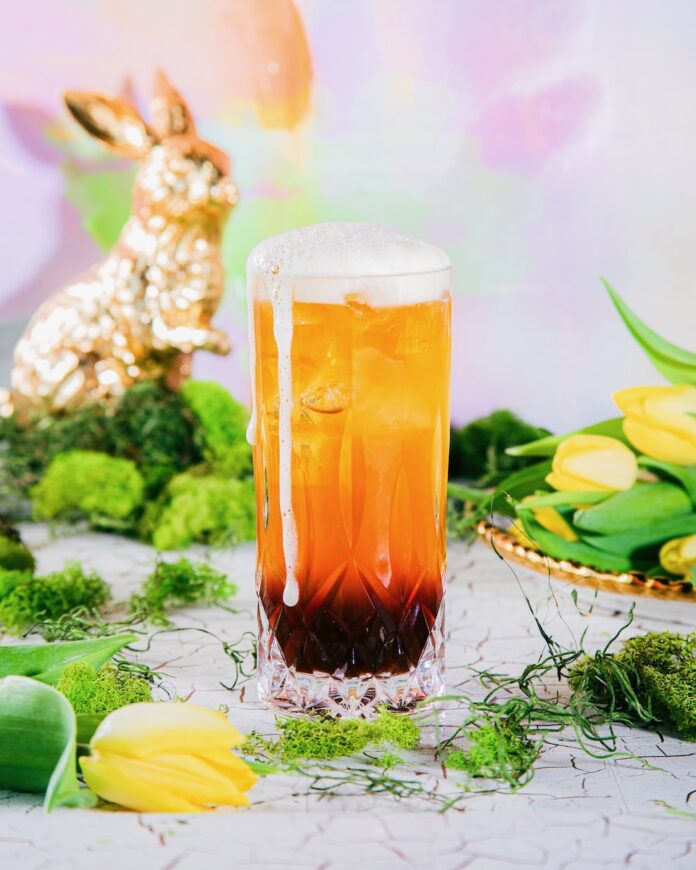
What does Peter Cottontail want when he finally reaches that delightful little bar at the end of the Bunny Trail? Carrot juice, of course. Cam Dickson reaches into his stash at Ritual House to add tequila, lemon and lime juice, vanilla syrup, and an egg white. After a hard shake in a cocktail tin, out comes a frothy, tangy, yet still sweet cocktail that would calm the nerves of even the jitteriest, travel-weary bunny. Swap out the tequila for pineapple juice in the mocktail version. Both will refresh and delight you!
How Did Carrots Become Associated with Easter?
The association of carrots with Easter, particularly in relation to the Easter Bunny, stems from a blend of cultural traditions and commercial influences. The Easter Bunny’s origins come from German folklore. Here it was was said a hare delivered eggs to children. As this tradition spread, particularly to America, the hare evolved into a rabbit. Carrots, a readily available root vegetable, naturally became associated with feeding this nocturnal visitor, even if it isn’t a first choice for rabbits themselves. Commercial advertising and children’s literature further reinforced this connection and still continues to today. Nowadays we see media portraying the Easter Bunny as a creature that enjoys carrots during its egg-delivering journey.
Who could deny a cocktail made with carrot juice on Easter day? The Easter Bunny sure wouldn’t!
Ingredients
Scale
2 oz Blanco Tequila
.75 oz lemon Juice
.5 oz lime Juice
.25 oz carrot juice
1 oz vanilla syrup (We make ours in house – see recipe below)
1 egg white or 1 barspoon of egg white powder
For the mocktail:
3 oz carrot juice
2 oz pineapple juice
1 oz lime juice
1.5 oz Lemon Juice
1.5 oz vanilla syrup
1 egg white or 1 barspoon egg white powder
For the vanilla syrup:
2 ¼ cups water
2 ¼ cups sugar
2 tsp vanilla paste
Instructions
Combine all ingredients in a cocktail tin, add ice and shake hard for 10 seconds, then strain back into small cocktail tin, discard ice, and shake again hard for 30 seconds.
Strain into a coupe glass through a tea strainer.
Garnish with two basil leaves positioned to look like bunny ears.
For the vanilla syrup:
In a sauce pot on low heat, stir all ingredients together until sugar is dissolved and paste is combined into the mixture.
Refrigerate in a covered container for up to a week.
Recipe by Ritual HouseMixologist Cam Dickson Story by Star Laliberte Styling by Anna Franklin Photography by Laura Petrilla
Betsy Wentz breathes new life into a historical house for a couple and their three children, introducing modern elements while also honoring the past.
Sewickley Designer Betsy Wentz Makes a Historical Home Family-Friendly
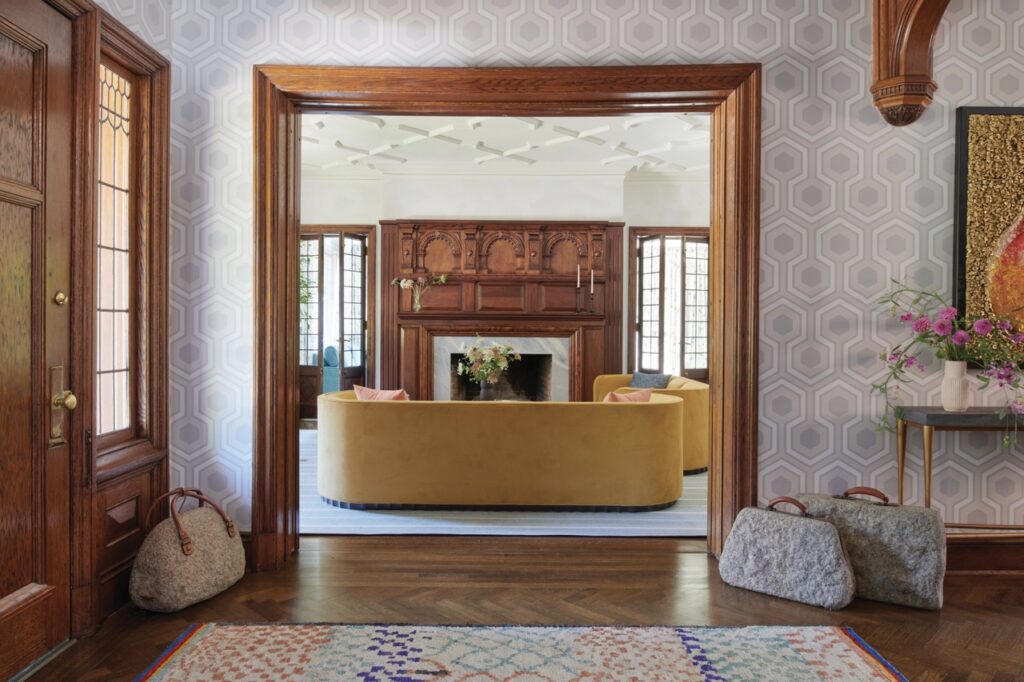
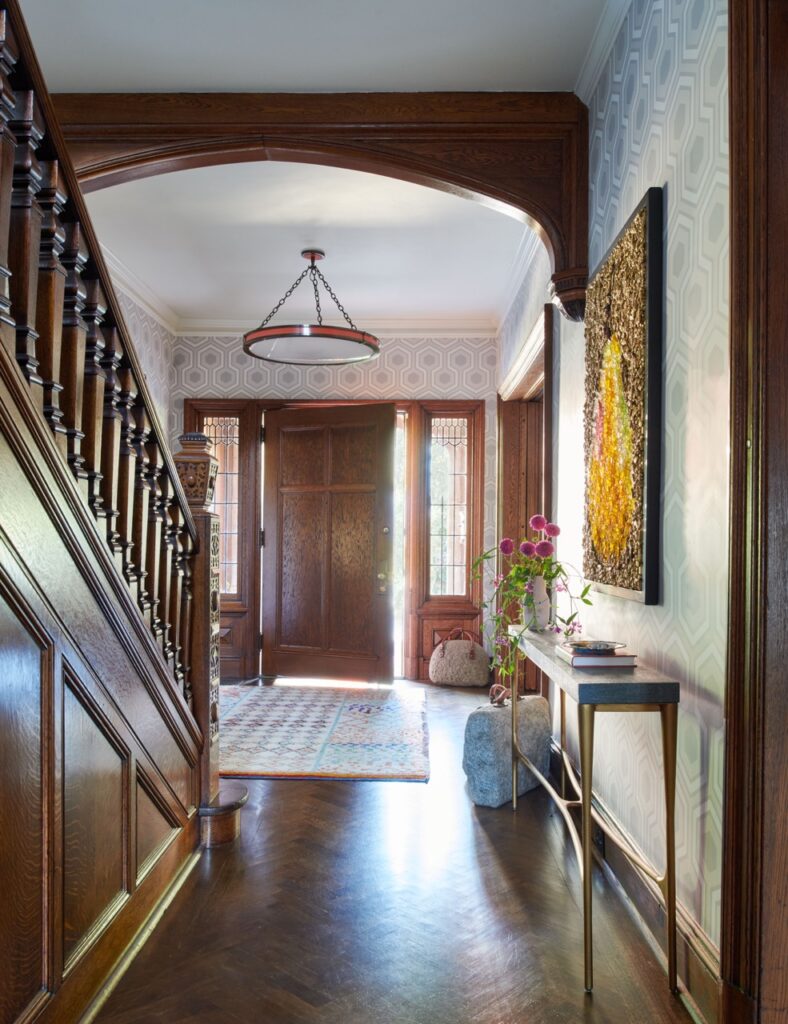
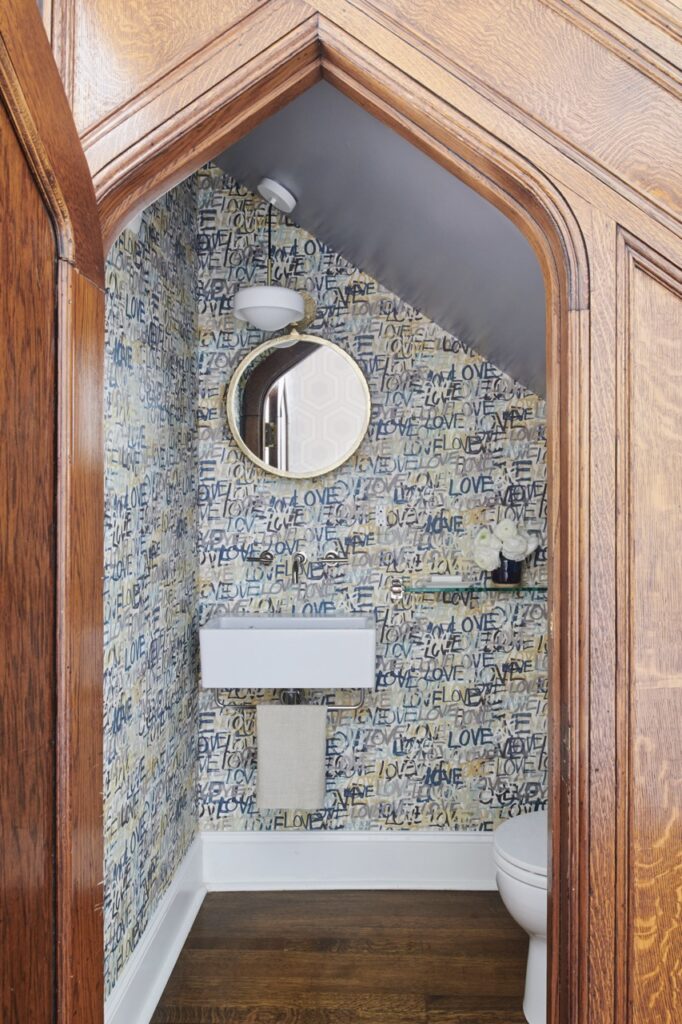
Designing a serious home for a young family is always a bit of a juggling act between livability and style. The house in question is a 1903 Pittsburgh landmark by MacClure and Spahr, who also built the Keystone and Union Nation Bank Buildings. Updating it meant deciding when to modify and when to maintain what was there. The couple is also passionate about collecting art, so striking and important pieces hang throughout the house. Designing backdrops to complement them was an important part of the equation.
Sewickley-based interior designer Betsy Wentz met the challenges by using varying intensities of pattern and color, at times pulling back—up to a point—to allow art to shine, and at others turning up the volume to create high-impact moments. Her clients wanted to make everything feel less serious, “but they also wanted to respect the bones of the house and make sure that we maintained the majority of the woodwork.” (The carpet in the foyer is by Rug and Kilim.)
Starting With the Color Palette
Wentz incorporated a rich palette of gold, deep blues, reds—and a fair amount of lilac. Even in places that are more subdued, flashes of bright hues catch and delight the eye. At the same time, an abundance of rich woodwork contrasts with the more updated elements, creating a delightful conversation between old and new. “There’s a lot of push and pull. It’s fun, it’s young, and it’s fresh.”
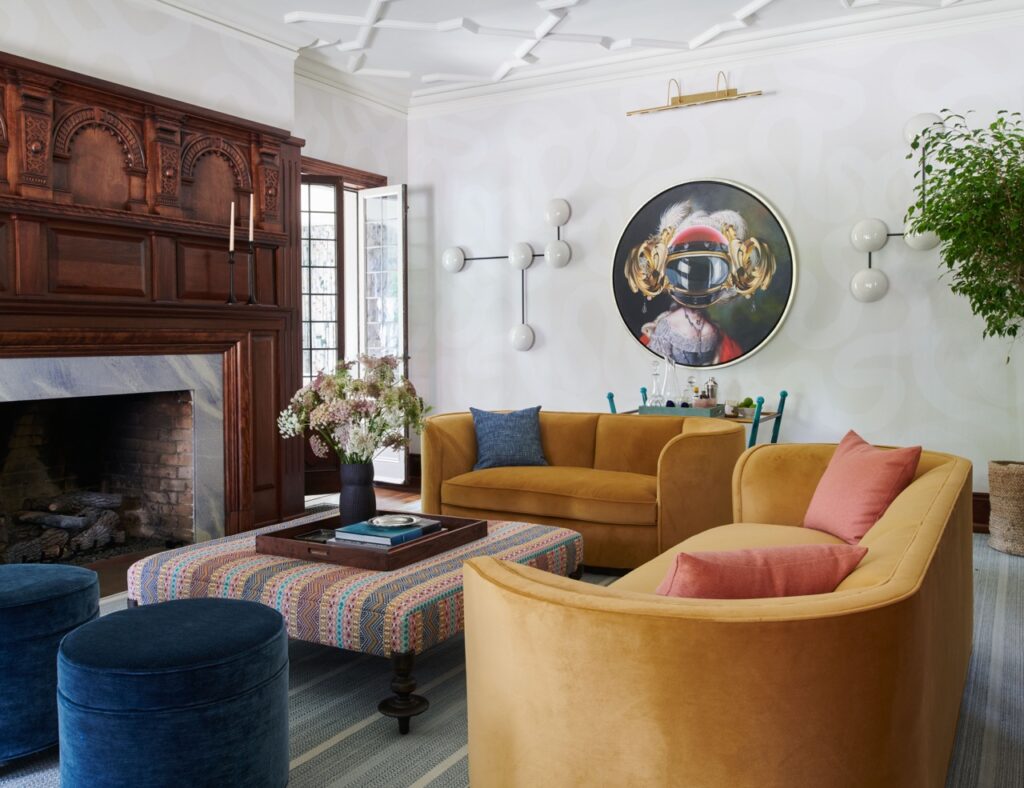
Painting: Never alone (2022) by Lucio Carvalho.
A large sofa and loveseat in gold Kravet fabric anchors the living room, creating a cozy seating area presided over by an incredible painting, Never alone, 2022, by Lucio Carvalho. A subtly striped Stark rug plays off the Schumacher drapery and wallpaper and a Century Furniture ottoman in a sort of modern patchwork pattern.
Combining Bold and Comforting Designs
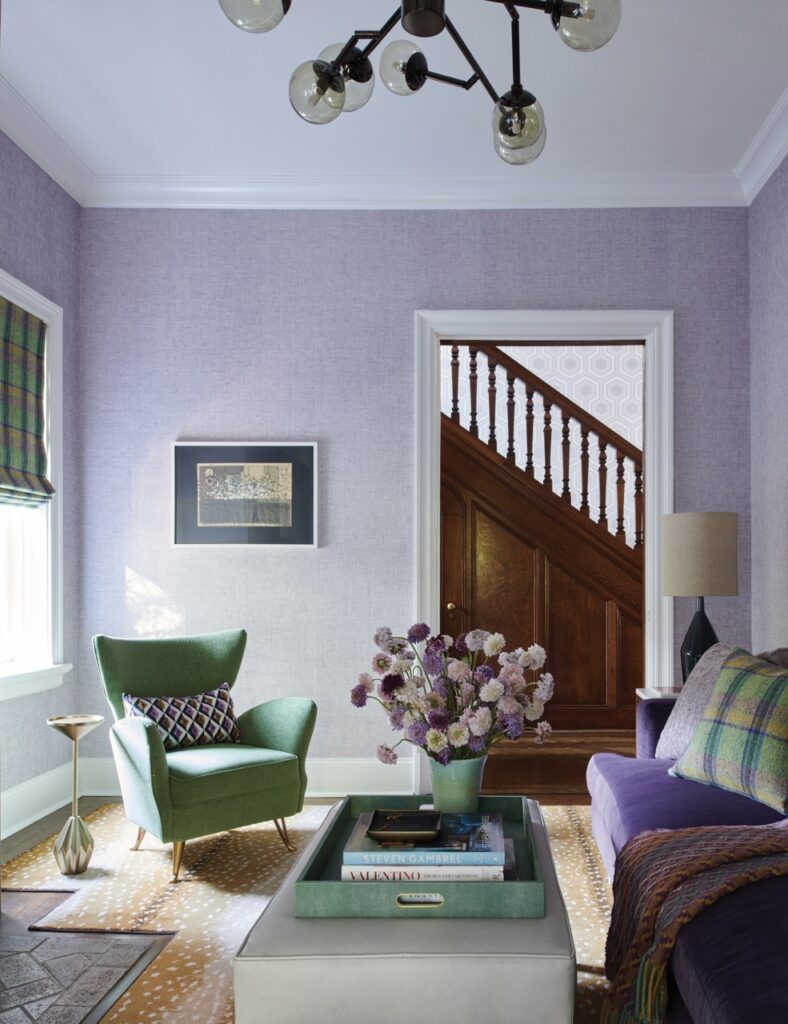
One of Wentz’s favorite spaces is an intimate sitting room, clad in lavender Phillip Jeffries grasscloth and a playful Stark rug, the latter strategically cut to work with the existing hearth. The mismatched chairs were the husband’s idea, and add to the casual vibe, even though they are quite tony in and of themselves. (The blue one sits in front of Untitled, 2022 (Lens) by Fabrizio Gerbino.)
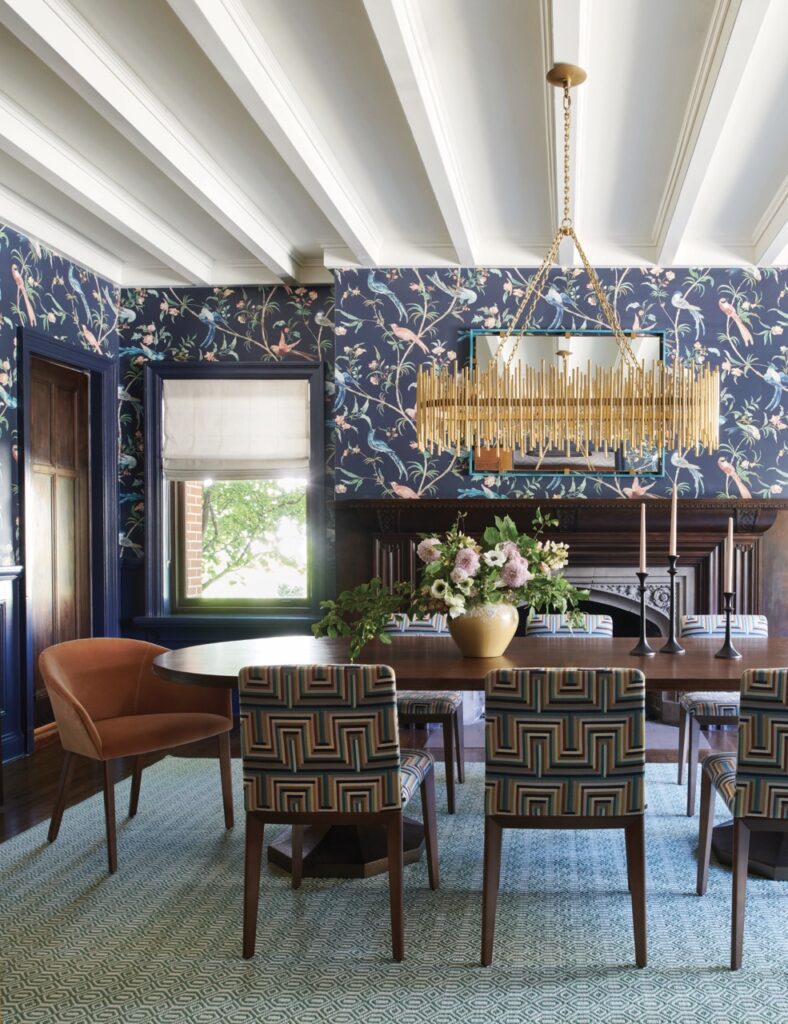
Wentz combined several strong patterns with plenty of color in the dining room, but it never goes too far. The Romo wallpaper is decidedly bold, but works beautifully with the Andreu World dining chairs and a From Jaipur with Love rug. She painted the molding but left the fireplace as it was, again striking that essential balance.
Keeping Things Functional
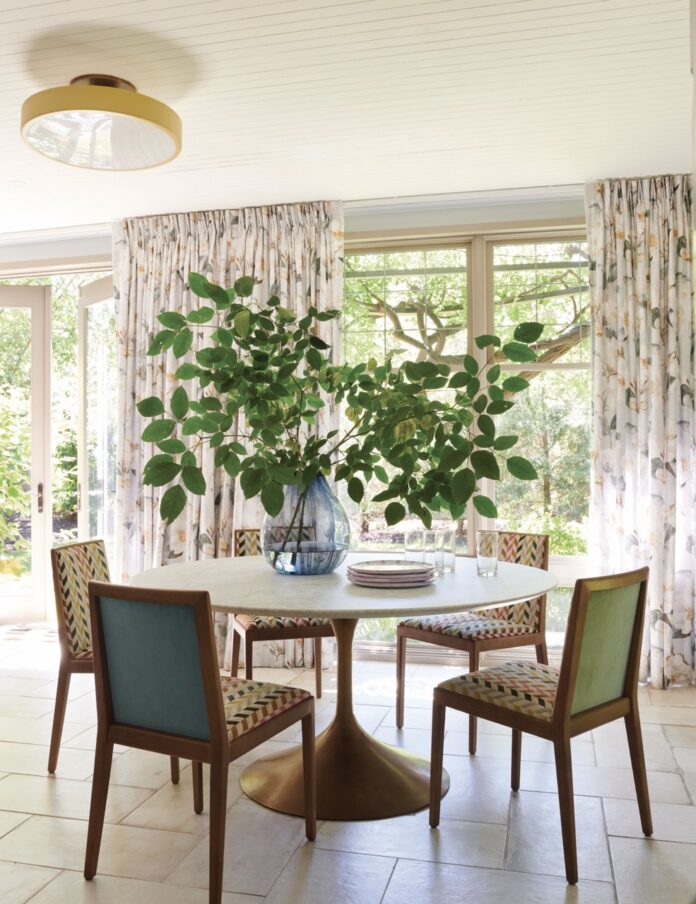
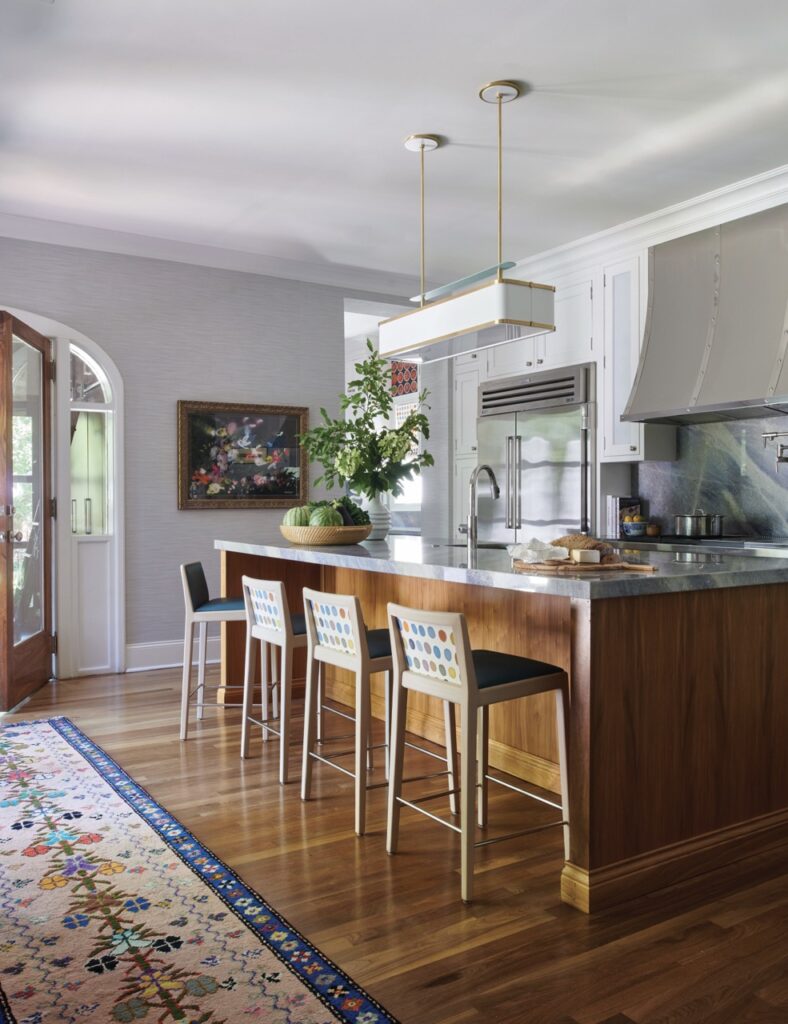
The kitchen had to be highly functional, with the three children running in and out, sometimes with wet feet or bathing suits. The Andreu World stools are upholstered in vinyl and can be wiped down. (For extra fun, she put polkadot fabric on the backs.) A vintage runner is both intriguing and practical. Off to the side is a walk-in pantry, its eye-catching Cole & Son wallpaper providing more circles, here cross-sections of bright citrus on a dark background. In the nearby sunroom, chair backs each have their own color in another less-serious element.
At the top of the stairs is another favorite of Wentz’s, a vintage rainbow glass chandelier hung over some heavily-carved woodwork and Juliette leaded glass windows. Another important piece of art, Our collective beauty, 2022, by Thandiwe Muriu, presides. The master suite is a serene space, but is nonetheless punctuated with rich accents, including a bench from Century covered in Missoni fabric and quietly textured Philip Jeffries grasscloth wallpaper. A moody, wood-clad dressing room is accented with striking lapis handles on the doors and a striped Stark rug.
Meeting Somewhere Between Fun and Sophistication
The children’s spaces are each clad in a different wallpaper, including a tiger and tree pattern from Rifle Paper Company in one daughter’s room, which also features a pin-up wall covered in green mica paper, forming a workspace area with desk and chair.
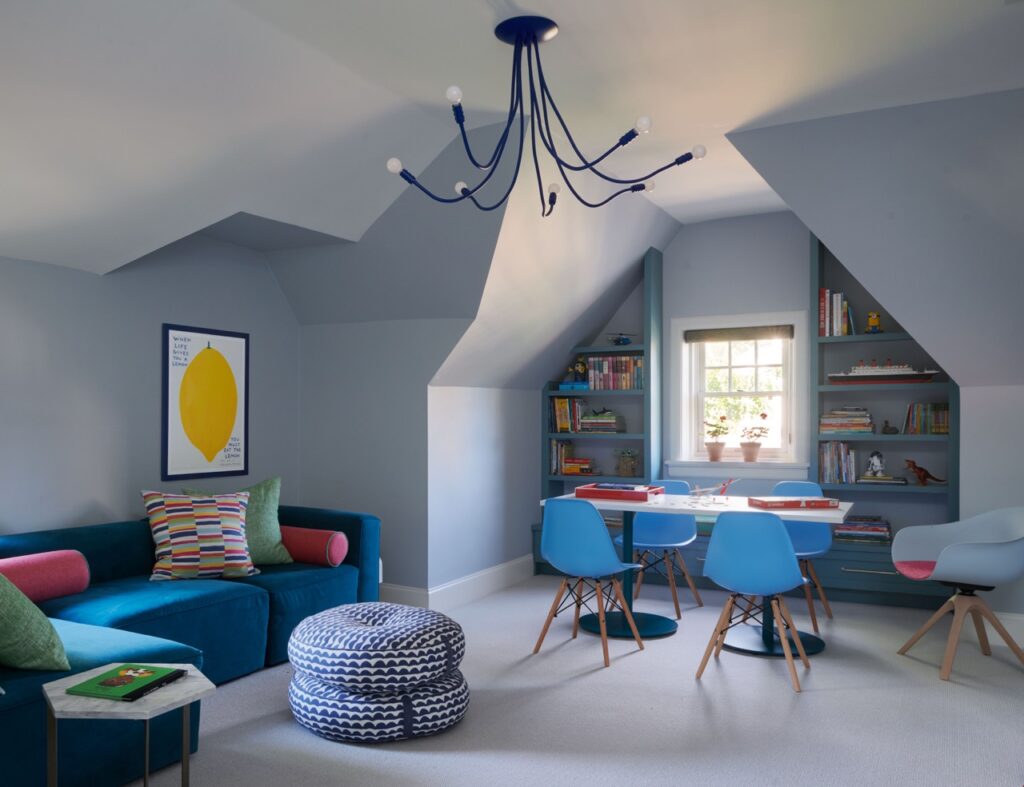
The playroom is subtly sophisticated, especially in its play of color, like the one established between the built-in and the wall. The Chairish chandelier, with its multiple purple arms, is pure fun. Ultimately, Wentz’s work was about coming up with a complex way to combine all the elements into a cohesive whole. “They are a very sophisticated couple—but they also have kids. So I think the point of the story was how to take an old home and make it more livable and approachable. It’s ultimately a family home.”
Story by Stephen Treffinger Styling by Tori Mellott Interior Design by Betsy Wentz Photography by Max Kimbee Flowers by Eleven Mile Farm Art Consultation by Melanie Werner, Galleria Werner
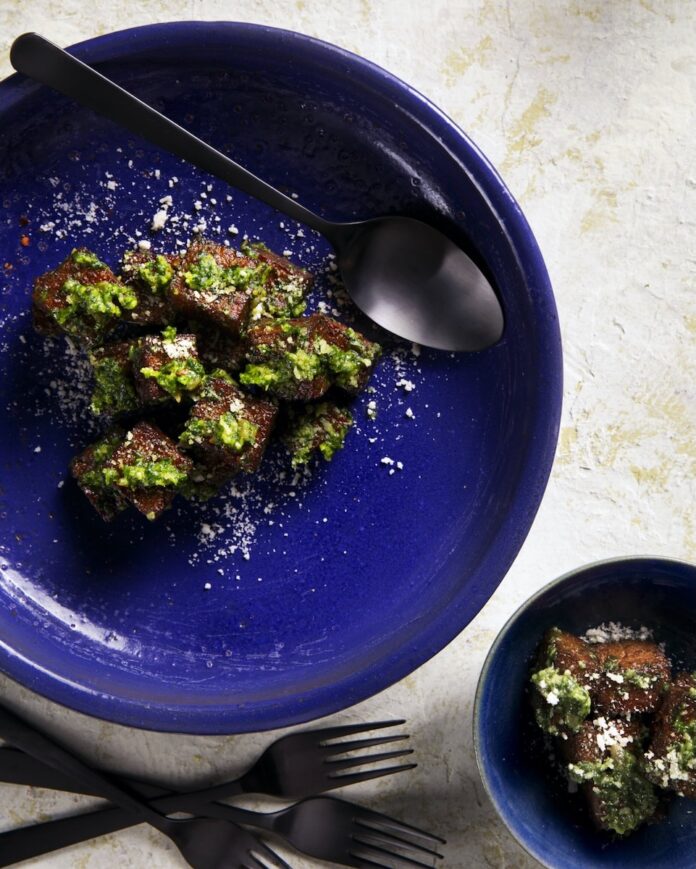
Chef Curtis Gamble invited TABLE Magazine to spend a day in his kitchen with simple recipes and springtime flavors. He had our full attention with this first delicate and delicious plate. “I look for ways to be reductive,” Curtis says, explaning his keep it simple ethos. “Limiting myself to a certain ingredient or idea leads to creativity with texture, salt, fat, and acid. Allowing space and room for flavor to breath is a skill.” In a dish like Gnocchi alla Romana with Pesto Genovese, it would be easy for the heaviness of pasta to overtake the dish. We will never forget these gnocchi, with their earthy crispiness playing off of the vivid, garlicky sauce, or any of Chef Gamble’s veggie-forward dishes.
What Makes This Gnocchi “alla Romana”?
There are many different kinds of gnocchi, depending on the grain. What makes this gnocchi Roman-style is that it uses semolina, milk, and cheese, giving it a uniquely filling texture and flavor. However, Curtis paired it with a Northern Italian condiment, the classic Pesto Genovese recipe from the city of Genoa. That results in the combination dish of Gnocchi alla Romana with Pesto Genovese.
Bring milk, salt, and pepper to a high simmer, almost to a boil. Using a hand-held sifter, sift in semolina and whisk while doing so.
This prevents clumping and promotes even cooking of the semolina. Once all is incorporated, continue to cook briefly until starch is cooked through (it will begin to pull away from the pot and won’t be starchy in the mouth).
Turn off heat, beat in 1 egg at a time, fold in cheese at the end. Pour into an 8 x 8 baking dish sprayed with nonstick spray and press into an even layer. Cool in the refrigerator. When cool, cut it into inch by inch squares.
For the pesto:
Combine all ingredients in a food processor.
Pulse to combine.
To finish:
Warm a pot of oil to 350 degrees and fry gnocchi until they are golden brown, and then lift with a slotted strainer onto some paper towels to dry, adding salt and pepper.
In a bowl, add 2 tablespoons pesto and toss gnocchi, salt, extra parm, and a touch of EVOO. Serve immediately.
Recipe by Chef Curtis Gamble Styling by Keith Recker Photography by Dave Bryce
Designer Colleen Simonds works with a like-minded client to update a traditional New Jersey farmhouse while retaining its inherent charms.
Colleen Simonds Updates a Charming New Jersey Farmhouse
Working on a home’s interior design during the pandemic should have, in theory, been a nightmare for interior design Colleen Simonds. But the client who reached out had a similar background, working as an executive for a women’s fashion brand, a position Simonds had once had early in her career. “We have very much a shared language around color and pattern. Both, of course, are very relevant to design. That’s what made this work so well — she and I were on the same page,” she says.
The work began with the living area, but it all went so well that it turned into a full house project. The two women worked in sync, coordinating complicated deliveries and installations over the phone with few hitches, getting everything done efficiently. (Simonds emphasizes that working remotely over COVID was by no means easy. “It would probably never have worked with anyone else, but it did work with her.”)
Diving Into a Whole House Project
The client, who shares the house with her husband and children, had moved from Manhattan for additional space, a yard for the kids to play in, etc. She appreciates color and pattern as well as unique finds —and wanted an exuberant feeling overall. Simonds envisioned a mix of vintage pieces and new designs, a balancing act she felt important for a house with old bones. Sometimes this took the form of reupholstering antique finds in more modern fabrics, layering in color and pattern while retaining more traditional silhouettes
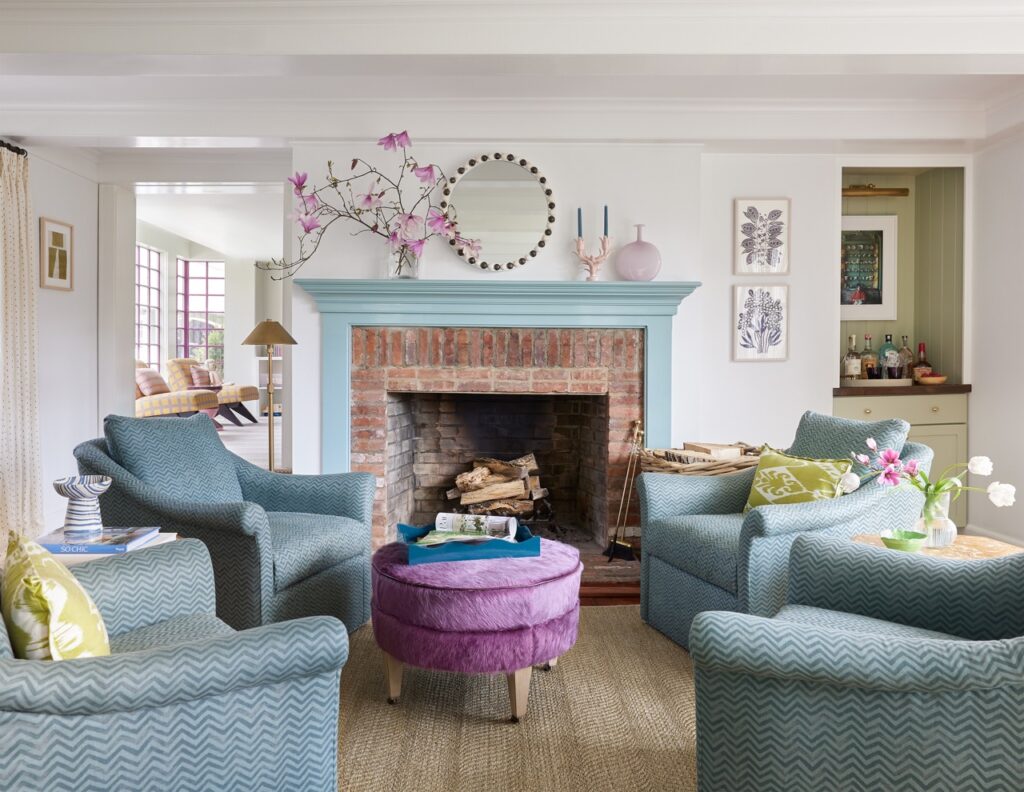
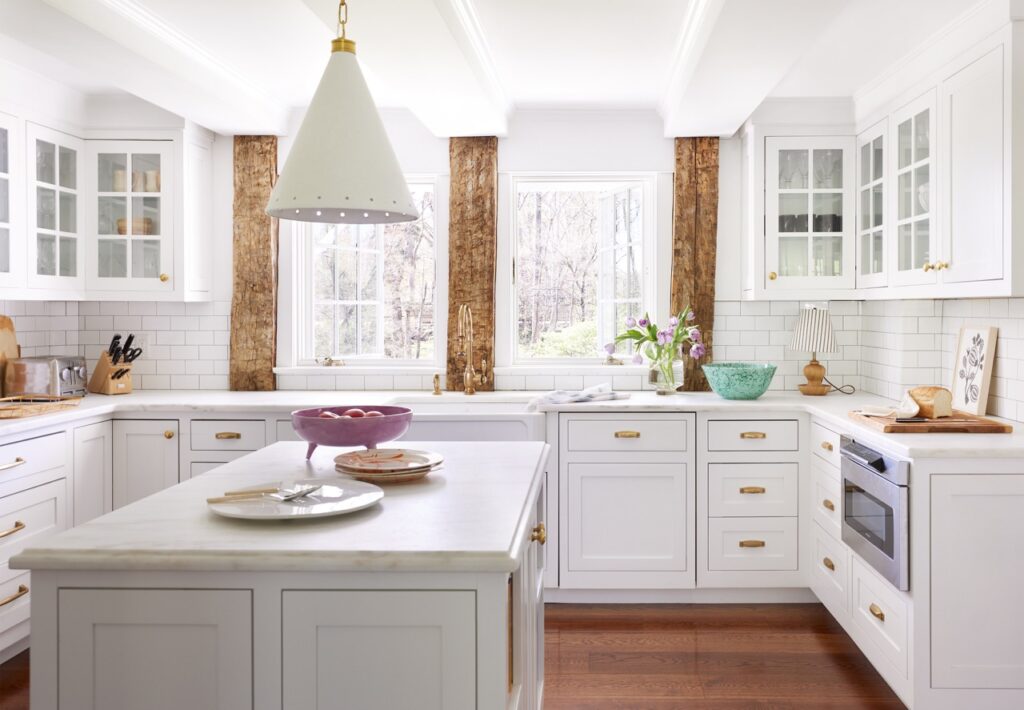
Comfortable seating was key for the living room, a long, rectangular space Simonds broke into two seating areas, one with four armchairs in Katie Leede fabric in front of the fireplace and the other anchored by a large Hickory Chair sofa in Isobel fabric. “It was about finding fabrics the client loved and patterns that resonated with her.” The house is intentionally not granny; rather, it’s a fresher take, pairing shapes and patterns that aren’t all matchy-matchy. “I wouldn’t call it modern, but it definitely has a bit of an edge.” Angular side and coffee tables in neutral solids balance the curvy florals and zigzags of the upholstery.
Adding a Splash of Color Everywhere
Graphic wallpaper from Peter Fasano wraps the dining area, which features a long sideboard from William Yeoward and Palacek dining chairs. The long, custom table from O&G Studio in Rhode Island is stained a very dark navy, which adds color and interest without competing. The last piece of the puzzle was the rug, which is the opposite of how things typically go. “It was a bit like finding a unicorn, but it’s perfect.” It’s a vintage Haroonian from the Rug Warehouse in Los Angeles.
Near the living room, the sunroom is an oasis of calm in blues and neutrals with a splash of yellow. “We went all in on the color, especially with the rug,” says Simonds. It’s a beautiful shade from Radici, and it makes an interesting ground for the Rogers & Goffigon upholstery on the sectional. Bright side tables from KRB in New York and a scattering of charming pillows makes the space cozy and relaxing but not in the least drab.
Still Crafting a Calming Atmosphere
For the children’s playroom, on the ground floor, it was important that it be something they could grow into. It is also directly off the living room, so it needed to live in harmony with the rest of the decor. One prominent feature is the very large fireplace, and Simonds decided to paint the mantle and the window trim a vivid purple, and to use a Stark chevron rug in pale shades to maintain visual interest but not to overwhelm.
A major challenge with the primary bedroom was an abundance of dormer windows and angles. Simonds chose a small, organic William Morris paper that lacks a pattern direction, allowing it to blur the hard edges. The client loved the way the custom lavender-hued bed with an Alice Sergeant fabric-covered boxspring, Christopher Spitzmiller-sourced table lamps, and vintage chairs upholstered in Imogen Heath fabric all work together with the yellow of the paper.
The project has been such a success that Simonds and her client are working on the next phase, an addition to the house. “When you find someone that compatible and that easy to work with, it’s incredible.
Story by Stephen Treffinger Photography by Emily Gilbert Interior Design by Colleen Simonds
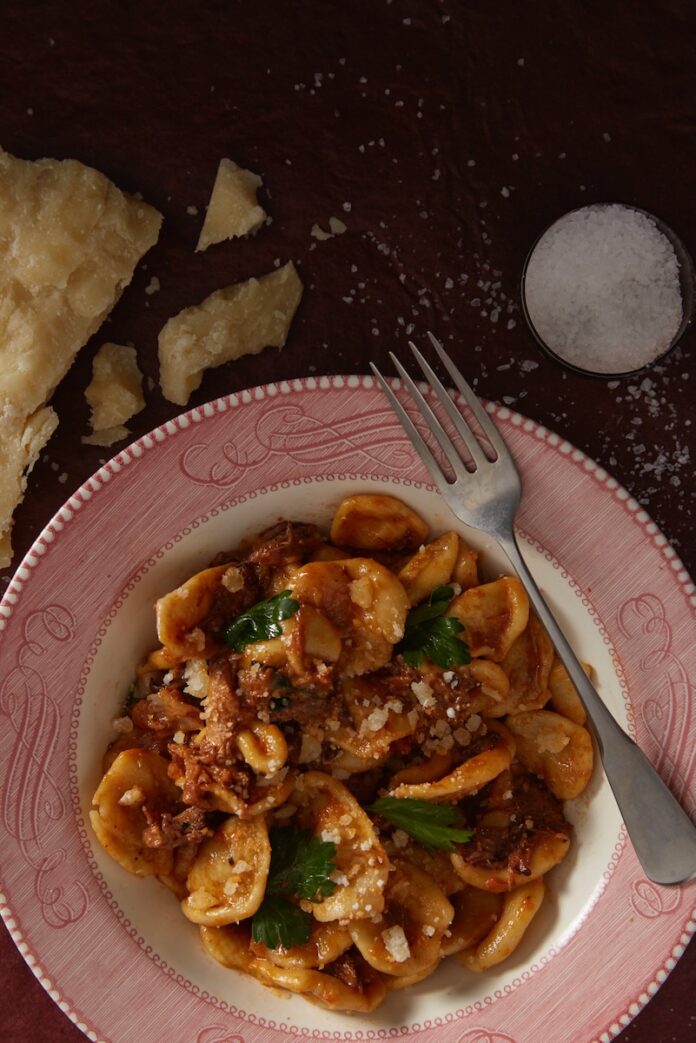
This orecchiette pasta recipe combines the rustic comforts of Italian cooking with an upscale plating and mouthwatering pork boscaiola sauce. The sauce (which gets its name from the Italian word for “woodcutter’s wife” combines fresh foraged mushrooms, pork, autumn vegetables, and cream, making a hearty companion for fresh, handmade orecchiette cooked al dente. Hear Chef Fiore Moletz share more about this recipe below:
What is Orecchiette Pasta?
Orecchiette hails from the southern Italian region of Puglia, where this pasta reigns supreme.
The simple recipe of flour, water and salt, makes this an important element of la cucina povera. The phrase means “poor cooking,” and refers to the frugal genius of Italians making the most of what they had at hand — and in the process, creating one of the world’s great cooking traditions .
The name translates to “little ears,” which describes its shape and its ability to hold onto a hearty sauce, which makes this pasta shape very versatile. Even the richest marinara will still combine well with orecchiette.
2 lbs. pork butt or shoulder cut into large chunks
25 grams dried porcini mushrooms
150 grams red cooking wine
285 grams diced white onions (1 large onion)
170 grams diced carrots (1 large carrot)
170 grams diced celery ( 2–3 stalks)
30 g minced garlic
930 grams of milled or ground san Marzano tomatoes
500 grams chicken stock
300 g heavy cream
1 orange halved
Instructions
For the pasta:
Start with equal parts flour, semolina and water. (1 cup of each will make 4 servings)
Combine both flours and create a bowl shape on a clean, smooth working surface. Slowly add the water and knead together until a dough forms.
Roll flat with a rolling pin, and cut into small pieces, and use a knife to pull them to shape. This particular step is easier to learn by watching than by reading, so please see above video for full instructions.
For the boscaiola sauce:
Wash the mushrooms well through a strainer, then soak in the red wine before beginning to cook.
Season pork liberally with salt and pepper. Heat butter and oil in large pot on medium high heat. Sear pork on both sides, then remove.
Turn heat to medium and add onions, saute for 2 minutes, then add carrots and celery and season with salt. Cook veg until browned, not burnt. Add garlic and brown, but DO NOT BURN. Once garlic is browned, add tomatoes and cook down until the liquid from the tomatoes is gone, and tomatoes are beginning to stick to pot.
Add wine/mushrooms, and cook down by half. Add stock & seared pork. Add orange halves. NO SEEDS. Bring to a boil, then cover and place in 350 F oven to braise for 2-3 hours.
After 2 hours, check doneness of pork, if not tender continue to braise in 30 minute intervals until tender. If there is a lot of liquid, remove lid and leave in oven for 15 minutes. Once tender, leave at room temp until cool enough to handle. Then break up meat with hands, removing undesired parts. Mix in heavy cream until incorporated.