Home Blog Page 179

Box Road Brings Unique Antiques to Albuquerque

0
A captivating blend of antique, vintage, and modern furnishings and accessories from Box Road, housed in the beautifully remodeled 1928-era Art Deco-style Arrow Grocery in Albuquerque's historic Barelas district.

What happens when two friends and business partners with a passion for antiques come across a derelict 1928-era, Art Deco-style grocery store? Alex Hanna headed to Albuquerque to find out more about Box Road.

Unique Antiques to Albuquerque

A Chance Meeting

When my husband and I moved into a new house years ago, we were faced with a very large cold floor, thanks to the previous owner’s DIY addition. Our feet were freezing, but, like a lot of new homeowners, our budget for remodeling was long gone. Luckily, we met Michael Ouellette who was working primarily in the rug business and was kind enough to loan us a luxurious, African-inspired, indigo carpet. That piece was worth far more than we could spend at the time, but it kept us cozy for months until we found something in our price range. That was years ago, but I still dream about that rug.

Popular antiques

Michael still deals in rugs but now so much more. He and his business partner Donnie Volkart have been fixtures in Round Top, Texas–home of one of the country’s most popular antiques fairs–for years. Now they’re a lot closer to home, thanks to their new space near downtown Albuquerque. It’s a classic story of people with a passion for what they do who literally live and work out of the back of their trucks to find the best antiques and vintage and modern furnishings and accessories.

Antiques vintage and modern furnishings

Connecting New Mexico to the Hispanic World

Michael and Donnie do lots of buying in Mexico City and have always had a strong connection to the aesthetics of the Hispanic world. When they came across the abandoned Arrow Grocery from the late 1920s in the Barelas district of Albuquerque–the oldest “barrio” in the city, established in the 17th century–they saw an opportunity to connect even more closely with the culture. Indeed, one of the very first things I saw when I arrived were the charming and mysterious faces sculpted onto a series of Oaxacan vessels. While the whimsy that animates these vessels seems to be a guiding force for their collections, it belies the amount of work behind the scenes: the massive remodel of the space, the countless hours traveling around the country and the world, and the efforts to connect objects with just the right owners.

Anything From Anywhere

Part of what makes the store’s style and creativity work is that they don’t limit themselves to Latin American objects or even to just old objects. You can find modernist gems and Scandinavia design sitting side by side quite happily. Distressed painted dressers proudly show their age, topped by French confit jars with crackled glaze. Tucked into weathered cabinets you’ll find folk-art pieces that beg the question: what is this for exactly? And there are what I’d call old-school antiques like 1800s English tableware and chests that look like they made the trip across the Atlantic covered with contemporary artisanal dinnerware and utensils.

The sum here is movingly greater than the parts, and It is this energetic juxtaposition that excites the imagination and feeds the soul. Cultural inspirations from around the world are beautifully curated in this transformed old grocery space in one of the oldest settlements in New Mexico. Both the space and its contents, now enjoying a new lease on life.

Old-school antiques

While much of their business is to the trade, don’t hesitate to visit, whether to shop or simply to get inspiration for your own interior design projects from these two passionate pros.

Story by Alex Hanna / Photography by Tira Howard

A footer photo with a black background and subscribe info and button

Subscribe to TABLE Magazine’s print edition.

6 Wines for the Holiday Table

0
Four people toast at a Holiday setting with holiday wine glasses over a table full of food and candles.
Photo courtesy of Kraken Images

The time for feasting is here! While most of us will enjoy our family’s traditional foods, perhaps the big meal could use a boost with a new wine or two for the holiday table to sip and savor.

Our wine expert, Adam Knoerzer, suggest wines for you to pour at the holiday dinner table, whatever your main course might be. His list includes turkey, ham or roast beef entrees, all of them available at Fine Wines, Good Spirits.  

6 Wines for the Holiday Table

Turkey Main Course

Hamilton Russell Vineyards Chardonnay 2021 (Hemel-en-Aarde, South Africa), $45.99

You’d be forgiven for thinking this absolute gem was grown somewhere in Burgundy. But, South African soils have given us this stunner with elegant pear and lemon notes that are bundled by bright, driving acidity and an epic finish. 

Tania & Vincent Carême “Terre Brûlée” Chenin Blanc 2021 (Swartland, South Africa), $9.99

Big, beautiful wines don’t always require a big price tag, and this offering proves it. Lush, unctuous textures of melon, honey, and citrus harmoniously mingle with notes of orange blossom and nuts to provide an all-around winner without breaking the bank. 

Ham Main Course

Pierre Sparr Crémant d’Alsace Brut Rosé NV, $19.99

Fresh red berries burst from the glass with primarily raspberry and strawberry leading the charge, and a hint of peach and crème work their way into the palate adorned by soft, delicate bubbles. The wine finishes dry and begs for another sip. 

Teliani Valley Guardians Rkatsiteli (Kahketi, Georgia), $11.99

Hard to pronounce (urr-cats-uhh-TELL-ee), sure, but absolutely perfect to accompany your holiday ham. This grape is rich in white peach, jasmine, and apricots with a honeyed lemon and lime element on the finish. Plus, the ample acid keeps things light and versatile enough for the side dishes, too.

Roast Beef Main Course

Domaine des Tourelles Vieilles Vignes Carignan (Bekaa Valley, Lebanon), $26.99

High-elevation old vine Carignan is a treat, and this example is full of ripe, dark cherries framed by a meaty, earthy undertone that makes it perfect for your roast. Notes of cranberry, licorice, and spices round things out on the finish, and you’ll be reaching back for more. 

Bodega Garzón Tannat Reserva 2020 (Uruguay), $12.99

This juicy red comes to us from Uruguay and offers a clean, modern example of Tannat that’s approachable and complex. Think dark plums, dark cherries, warm baking spices from oak, and a kiss of caramel and vanilla on the finish.

Story by Adam Knoerzer

Subscribe to TABLE Magazine‘s print edition.

Bacon Potato Roses

0
A round crackled looking plate with 6 bacon potato roses garnished with fresh rosemary, a glass or red wine and a stack of little plates and forks.

There are over 150 species of roses, but none more suitable or more appreciated at the holiday table than Bacon Potato Roses. Limited cultivation and rapid maturation, otherwise known as few ingredients and a short time in the oven, yield a “floral” centerpiece with an alluring aroma. Your guests will oooh and aaah. You will feel like a chef. Pair them with a crisp traditional French Chablis…and everyone around the table will be happy.

Bacon Potato Roses Recipe

INGREDIENTS

6 yellow potatoes
1/4 cup olive oil
½ tsp salt
½ tsp pepper
¼ tsp garlic powder
6 bacon slices

INSTRUCTIONS

  1. Peel potatoes and slice very thin on a mandolin or with a knife. 
  2. Add potato slices to a bowl, along with the olive oil, and seasonings, mixing well. 
  3. Take one piece of bacon and lay it on your cutting board. Shingle the potatoes together and roll up the bacon and potatoes so that it looks like a rose. 
  4. Bake in the oven for 30 minutes at 350 degrees.

Recipe by Chef Jackie Page / Styling by Anna Franklin / Photography by Dave Bryce

A footer photo with a grey and white marble background, three TABLE Magazines and subscribe info and button

Subscribe to TABLE Magazine‘s print edition.

The Best Gluten-Free Potato Latkes

0
A round blue platter with 5 potato latkes , two small bowls with sour cream and applesauce, 3 gold forks, and a smaller lighter blue plate with 3 smaller latkes, and a blue linen.

A little extra attention makes this recipe for The Best Gluten-Free Potato Latkes very special.

Traditionally consisting of foods fried in oil, perhaps the most iconic item on Hanukkah menus around the world are potato latkes. They, like the other Hanukkah foods that you fry in oil, are a symbol of a miracle. The Jewish people had reclaimed the Temple, and their freedom, from the ruler of Syria who had forbade their religious practices. After the rebuilding and rededication of the temple, there was only enough oil to light the candles of the menorah for one day, but the flame burned for 8 days.

About These Gluten-Free Potato Latkes

TABLE friend, Judah Cowen of Elegant Edge Catering, is sharing his recipe for this quintessential Hanukkah food with our readers. Judah’s told us, “We do not use a binder, and we keep them gluten-free. It’s a bit harder to fry, but it’s worth it, in my opinion.  The idea is to have them crispy and to be able to see, feel, as well as taste the shreds — not to be made into pancakes.”

We can certainly attest to the outcome being worth the extra attention, in what we are calling The Best Gluten-Free Potato Latkes recipe. It’s absolutely irresistible when served hot with sour cream and apple sauce.

Print
clock clock iconcutlery cutlery iconflag flag iconfolder folder iconinstagram instagram iconpinterest pinterest iconfacebook facebook iconprint print iconsquares squares iconheart heart iconheart solid heart solid icon
A round blue platter with 5 potato latkes , two small bowls with sour cream and applesauce, 3 gold forks, and a smaller lighter blue plate with 3 smaller latkes, and a blue linen.

The Best Gluten-Free Potato Latkes


  • Author: Judah Cowen

Description

Gluten-free so all can enjoy!


Ingredients

Scale
  • 1 1/2 lb (3-4) potatoes
  • 1 small shallot
  • 1 medium Spanish onion
  • 1 clove fresh garlic or 1/2 tsp granulated garlic
  • 1 large egg
  • 1 tsp kosher salt
  • 1/8 tsp black pepper
  • 1 cup schmaltz or oil (or a combination of both) for frying


Instructions

  1. Peel the potatoes and place them in water until ready to grate.
  2. Peel and then shred shallots, onions, and garlic.
  3. Shred the potatoes.
  4. Mix all ingredients, excluding the oil.
  5. Heat oil in a skillet.
  6. Add about 3-5 ounces of the mixture into the pan, depending on the desired size. Squeeze some of the liquid out for a crispier latke. Fry on medium heat for around 4-5 minutes on both sides until crispy and golden brown.
  7. Place the latkes on a wire cooling rack or paper towel and serve hot with applesauce and sour cream.

Recipe by Judah Cowan of Elegant Edge Catering Company 
Styling by Anna Franklin
Story and Photography by Star Laliberte

Subscribe to TABLE Magazine‘s print edition.

Gin Fizz with Rizz

0
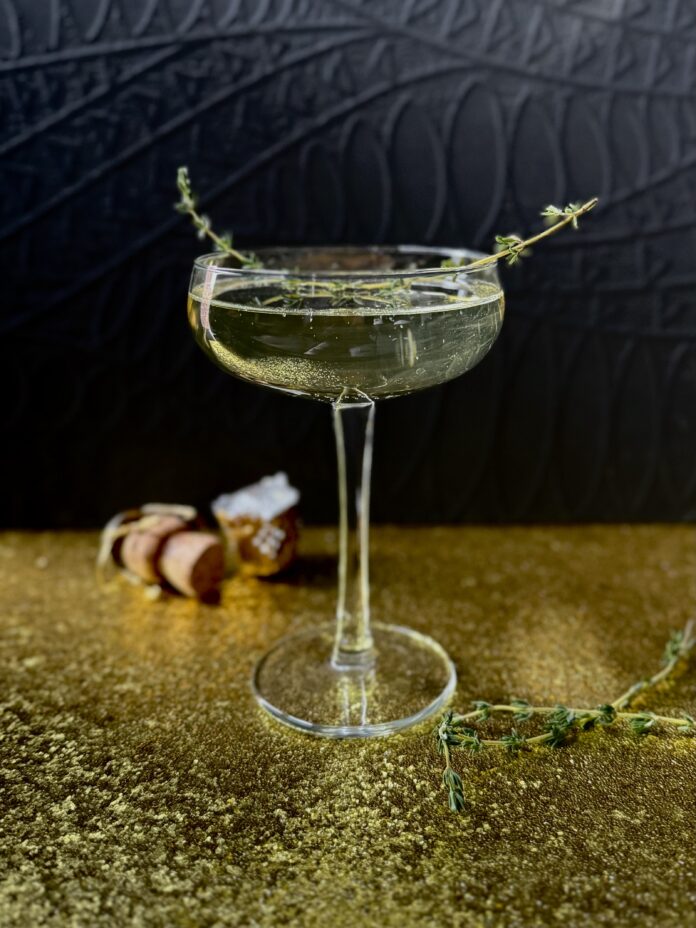
The Gin Fizz with Rizz: A tall, thin highball glass with a cocktail topped with champagne on a black background with a gold cocktail shaker, lemon, and the bottle cork as styling elements.

Oxford University Press, publisher of the Oxford English Dictionary, said that the 2023 word of the year is “rizz.” Do you have it? It is Charm, style, attractiveness…resulting in the ability to attract a romantic or sexual partner. So of course you have it!

What is Rizz?

Thank you, Gen Z, for popularizing the use of this slang term, said to be short for charisma. We credit you with the inspiration for a cocktail with more “rizz” than the basic Gin Fizz. Our Gin Fizz with Rizz embodies the trendy, suave, and seductive word. The charm of a feel-good cocktail, the style of a classic, and all the appeal of a fine Champagne.

Print

clock clock iconcutlery cutlery iconflag flag iconfolder folder iconinstagram instagram iconpinterest pinterest iconfacebook facebook iconprint print iconsquares squares iconheart heart iconheart solid heart solid icon
The Gin Fizz with Rizz: A tall, thin highball glass with a cocktail topped with champagne on a black background with a gold cocktail shaker, lemon, and the bottle cork as styling elements.

Gin Fizz with Rizz


  • Author: Zack Durkin

Description

A gin fizz that will give you an extra bit of rizz.


Ingredients

Scale
  • 2 oz Gin
  • .5 oz lemon juce
  • .5 oz simple syrup
  • 1 egg white
  • Champagne or sparkling white wine to top


Instructions

  1. Combine gin, lemon juice, simple syrup, egg white and ice into a cocktail shaker.
  2. Shake vigorously until the shaker is cold to the touch and the cocktail is frothy.
  3. Strain into your favorite glass.
  4. Top with champagne or sparkling wine.
  5. Enjoy!

Here are 6 Classic Cocktails that also have rizz.

Recipe by Zack Durkin
Styling by Anna Franklin
Story and Photography by Star Laliberte

Subscribe to TABLE Magazine‘s print edition.

On View at New Mexico Museum of Art

0
A painting titled El Santo in a blocky style by Marsden Harley on view at New Mexico Museum of Art
Marsden Hartley, El Santo, 1919

Marsden Hartley was part of the second generation of artists to come to Taos. This group, including Andrew Dasburg, John Marin, and Georgia O’Keeffe, introduced Modernism into the Southwest.  

Hartley often came into conflict with many of the academic painters who made up the Taos Society of Artists.  In 1918 Hartley wrote an essay in El Palacio Magazine critiquing the application of European academic techniques to what he saw as the uniquely American subject matter of the Southwest. Criticizing the Taos Society Artist, he wrote, “they tell themselves that the great art of America is to come from Taos. Well, there will have to be godlike changes for the better in this case.”

Hartley eventually moved to Santa Fe to distance himself from Taos’s artistically conservative climate. Like many American Modernist painters of the 20th Century, Marsden Hartley was looking for a distinctly American subject for his artwork, and a certain “aesthetic sincerity.” 

Hartley first visited New Mexico in 1918, the year after the New Mexico Museum of Art opened, and wrote of the experience, “I am an American discovering America.” During his early visits to New Mexico his style shifted from abstract to more realistic subject matter, and he found what he believed to be definitively American subject matter in the blending of Native, Hispanic, and Euro-American cultures. He produced a number of still lifes here, such as the Hispanic Catholic retablo in this painting, depicted along with Native pottery and textiles. 

Story by Christian Waguespack, Head of Curatorial Affairs, New Mexico Museum of Art

A footer photo with a black background and subscribe info and button

Subscribe to TABLE Magazine‘s print edition.

Mexican Masks

0
Helmet Mask Used in the Jaguar (Tecuanes) Dance of Zitlala, Guerrero, Mexico. From the collection of Rob Gaston. 

An exhibit at Oakland-based Latin American Cultural Center (LACC) explores ancient traditions and modern-day iterations of the mask. 

Sandra Budd, assistant director and curator, says the exhibit MEXICAN MASKS: Symbols, Celebrations, Satire, and Safety, represents incredible diversity and creativity, displaying 88 traditional and contemporary masks from 19 Mexican states. Visitors can find a video presentation highlighting five dance mask festivals, several contemporary photos, and miniature mask festival figurines, too. “Three sections showcase some of the best mask-making artists in Mexico,” she said. “Each is unique and beautifully sculpted in wood or leather by the artists.”

Sixty of the masks come from a collector friend of Budd’s—Rob Gaston of Gaston Design in Fruita, CO. Together they coordinated the mask transfer to Pittsburgh via rental van, and Budd also hand-carried masks on loan from local collections. “The coordination is a longer process than actually transporting the objects,” she explained, “There is packing, crating, shipping, loan agreements, condition reports, insurance coverage.” 

Billie (Bill) R. DeWalt, PhD, senior advisor at the Latin American Studies Association, said, “[Gaston] has assembled a spectacular collection of both older and more recent masks that will delight visitors.” DeWalt, who lived in a small central Mexico village while completing his PhD in cultural anthropology, contributes a few masks, too. He recalled, “On any day in some part of Mexico there is likely to be a fiesta happening; people in masks are a part of many of those celebrations.”

Traditions intersected with the COVID-19 pandemic

During the pandemic, DeWalt began reading about Mexican masks and COVID intersecting in interesting ways. “One connection was that freestyle wrestlers in Mexico who had been using masks as part of their personas in the ring were going out in public to encourage people to wear masks,” he said. “Some, who had made versions of their masks to sell to fans, began making COVID masks as a means of replacing lost income.” Two Mexican anthropologists, Carlos Davila and Blanca Cardenas, began encouraging traditional mask makers to portray how they thought about COVID in masks; this exhibit showcases several of those creations. 

The mask Budd most looks forward to viewing? A full-size jaguar body mask, carved in wood.

Through April 20, 2024: Oakland’s Latin American Cultural Center (LACC) welcomes MEXICAN MASKS: Symbols, Celebrations, Satire, and Safety.

Story by Corinne Whiting

A footer photo with a black background and subscribe info and button

Subscribe to TABLE Magazine’s print edition.

A Path Less Taken

0
NOSA Restaurant Recipes
TABLE Editor-at-Large Gabe Gomez explores NOSA and its talented chef and owner, Graham Dodds.

Graham Dodds, the chef and owner behind NOSA Restaurant & Inn, tucked away in the picturesque embrace of the Ojo Caliente River Valley, is a man straddling two worlds. His first spins on the axis of the insatiable wanderlust that courses through his veins, a wanderlust that became apparent when he couldn’t give two hoots about his fine art classes back in college. It set him on a culinary path, where he graced the finest kitchens of Dallas, trekked through culinary school in Portland, OR, and embarked on culinary escapades across Europe. The outcome is nothing short of a flurry of culinary creativity, Pollock on every meticulously plated dish.

But there’s another side to Graham, one that’s quieter, more contemplative, and deeply connected to the land. Like so many before him, he’s drawn to the magnetic pull of the Ojo Caliente River Valley. This is where dreamers and thinkers have sought refuge, a place that has nurtured restless souls and offered healing through its ancient spring waters for as long as time can remember. While notables like Georgia O’Keeffe and Thomas Merton might have staked their claims on Abiquiu, Ghost Ranch, and Christ in the Desert Monastery further west, it’s here, in this valley of spiritual resonance, that Graham Dodds has found his own slice of serenity.

During his visit to the Valley during the pandemic, he crossed paths with the new proprietor of what was once the renowned Rancho de San Juan, a place that had closed in 2012. The encounter ignited a spark in Dodds and, from that moment, he couldn’t help but let his imagination run wild with dreams of opening his very own restaurant.

“I obsessed about the place for about eight months. It was this perfect place with four guestrooms, a remarkable restaurant with an incredible history and an apartment in the back for me to live in.”

NOSA stands for North of Santa Fe. In the Galician language it means nuestra.

Eventually, the property changed hands and with the new owners, Dodds penned an agreement and began the work on what would become NOSA, which stands for North of Santa Fe or from the Galician language meaning nuestra.

Dodd’s NOSA Restaurant and Inn recently marked its first-year milestone, and in that brief span, has carved out quite a reputation. It’s an establishment that demands a well-thought-out pilgrimage, where you had better have your pre- and post-dinner plans locked in advance. This isn’t the place where you casually stroll up after catching a late-night show at the Lensic. Here, dinner is an event unto itself, a meticulously curated, seasonal, five-course pre-fixe affair. It’s a culinary conversation that manages the weight of high expectations from the very moment you walk through the door until the final bite disappears.

“It’s encouraging that people are loving it.”

For the ultimate NOSA adventure, consider booking one of their beautifully appointed suites to immerse yourself in the full sensory experience. But let’s be crystal clear here–the window to indulge in their culinary offerings is not wide. You’re looking at dinner, exclusively on Fridays and Saturdays, with a singular seating at the stroke of 6:30 p.m. If brunch is more your style, Sundays are your canvas, offering two sittings at 11:30 a.m. and 2:30 p.m. Breakfast is a well-orchestrated affair for the privileged guests of the Inn, but you’ll need to reserve your spot at the table for 9 a.m. sharp. So, if you aim to capture the essence of NOSA, get your plans in gear, choose your moment wisely, and prepare to savor every moment.

“The menu changes constantly. You get some ingredients that change, and the dishes come together in response to those changes. It’s great to have this environment where you have a small audience and people can come continually and have something different. Typically, it’s a wholly different menu every weekend,” says Dodds.

The recent NOSA menu is testament to the imagination of Chef Graham Dodds.

Among his offerings: a succulent Wagyu beef tartare with gribiche, and pickled vegetables served alongside a spelt baguette. The Corn Chowder is a comfort, infused with saffron and a hint of jalapeño, and crowned with a dollop of creme fraiche. For a hearty main course, the Bison Moussaka takes center stage, showcasing tender bison meat, chestnut mushrooms, and a velvety Parmesan bechamel, all enveloped in a San Marzano tomato sauce. To conclude, a Blackberry Semifreddo beckons, a sweet harmony of blackberries, lavender honey, and local peaches.

It’s often true that some of the most extraordinary dining experiences require a journey off the beaten path. However, it’s equally true that some of the most cherished culinary memories held in heart and mind are right within arm’s reach. In the case of Graham Dodds, he didn’t choose to open his restaurant in the middle of nowhere, but rather in the place where exceptional food should and could be savored – a place where diners can unplug from the distractions of the modern world, and share a meal across the table, immersed in the captivating connection of one another’s undivided attention.

Story by Gabe Gomez / Photography by Tira Howard

Subscribe to TABLE Magazine’s print edition.

Why Cook in Cast Iron?

0
A collection of well-crafted cast-iron cookware, symbolizing the revival of traditional culinary artistry.

It wasn’t so long ago that you couldn’t give cast-iron cookware away. Now it’s the darling of home and professional cooks alike. Regional Editor Julia Platt Leonard meets a new generation of cast-iron cookware makers to find out why.

September 15, 2013, was a bad day for Dennis Powell. That’s the day he dropped his grandmother’s cast-iron skillet and it fell down the stairs, destroyed. When Powell calls it a “bolt of lightning disaster,” he means it: it was one of only two things he had of hers (the other was her butcher’s knife). Holding her pan and using it was a daily connection to her.

Not only would a brand-new pan lack this connection, new pans just aren’t as good as ones made in the late-19th and early-20th centuries, he says. The difference? According to Powell, it’s all in the finish. “A lot of people describe it as being a velvety finish,” he says. “It’s not exactly smooth. It’s certainly not rough. It’s certainly not a pebbly finish that people associate with cast iron today.”

Powell set off on a quixotic quest to figure out how to make a cast-iron pan as good as his grandmother’s. And he’s not alone. There is a whole new generation of cookware makers who feel that progress hasn’t been kind to the cast-iron pan, including makers like Chris Muscarella who started Field Company with his brother Stephen. They were both at loose ends, considering their next career venture. “We’re hanging out and we’re cooking and we’re talking about things we might do,” he says. “We have some vintage cast iron that is really beautiful that had been family pieces handed down by mothers, grandmothers.”

They decided they wanted to add a large pan to their collection and bought a new one. “I was kind of shocked at the (inferior) quality of that one versus the vintage cast iron,” he says. They decided to create a pan like their grandmothers used. “I wouldn’t say we went into this with a lot of commercial intent. I think we fell into it organically and loved it.”

There are few things that improve with age … few things that will work better next year–or in two years or even 10–than they do today … few pieces of kitchen kit that you’d proudly pass on to your kids. The exception? Cast-iron cookware. With proper care (more on that later), cast iron will last lifetimes. With age and seasoning, cast iron is naturally non-stick. It’s a versatile workhorse (think frying, braising, baking) that earns its place in your kitchen.

Why did it fall out of fashion? The advent of Teflon-coated pans in the 1960s didn’t help. We started coveting shiny non-stick pans and ditched our grandmother’s cherished skillet at the charity shop. Modern manufacturing didn’t help either. “Cast iron kind of got cost-engineered to be as cheap as possible and that was its primary benefit,” Muscarella says.

Like Muscarella, Powell didn’t have ambitions to start a cast-iron company. “Initially I just wanted to make a couple of pans like a sculpture to give to my kids.” He hired a company to help him create his dream pan (“They thought I was ridiculous,” he says). When they told him there was no way they could get the cast iron as thin as he wanted and with the perfect surface he demanded, he wasn’t deterred. “What if I pay you to fail?” he asked.

After failing and failing again, he miraculously got the pan he was looking for. The good news is that we can share his success with a piece from his Butter Pat line of cast-iron cookware. They have lovely names like the 14-inch skillet called the Lili (named after his wife’s grandmother) or the 4.5-quart flat-bottomed Homer (named after his friend the chef “Homer” Sean Brock).

Cast-iron pans aren’t cheap but nor should they be. Powell compares a cast-iron pan the cost of a nice hotel room: one lasts for a night and the other for a lifetime. Actually longer. “We long for that touch, for our family and our ancestors and having something that someone else has used, I think, is meaningful,” he says. Cast iron has soul.

HOW TO CARE FOR CAST IRON

  1. Most cast-iron cookware comes pre-seasoned and ready to use. Remember that the more you use cast iron, the better it performs as it builds up a lovely, non-stick patina.
  2. Avoid acidic foods like tomatoes, wine, and vinegar, especially early in the life of your pan. Later on, a little acid isn’t a problem, but choose another pan for your signature tomato sauce.
  3. To soap or not to soap. That is the (hotly) debated question. Using dishwashing liquid every now and then won’t kill your pan but you probably don’t need it, so why bother? Instead, scrape off any cooked-on food, wash it in warm water and dry, dry, dry because …
  4. … Water is cast iron’s enemy. Don’t leave it to air-dry and don’t even think about putting it in the dishwasher. Dry it with a clean kitchen towel and then rub in a small amount–we’re talking a quarter of a teaspoon–of a neutral oil such as sunflower or grapeseed oil and it’s ready to go.
  5. Don’t ditch a seriously rusty pan. Remove the rust with a copper-wire scrubber, wash and dry it, and then rub it with a small amount of oil. Place the pan upside down in a 350-degree oven with a baking pan or piece of aluminum foil underneath to catch any drips. Bake for an hour, turn off the oven and let it cool, and voilà! Your pan is as good as new.

Story and Recipes by Julia Platt Leonard / Styling by Anna Calabrese / Photography by Laura Petrilla

A footer photo with a black background and subscribe info and button

Subscribe to TABLE Magazine‘s print edition.

Vermouth-Braised Radicchio & Fennel

0
Braised Fennel and Radicchio in a Butter Pat cast-iron skillet with vermouth, showcasing a perfect blend of caramelization and mellow richness. Fresh herbs garnish this delightful side dish.

We’re featuring the special and delicious technique of braising with our Vermouth-Braised Radicchio & Fennel. Browning vegetables like fennel and radicchio adds sweet notes from the caramelization, while the braising mellows some of the bitter notes in the vegetables. If you can find conical-shaped Rosso di Treviso radicchio, use it, but if not, the round variety called Rosso di Chioggia will work equally well.

What Kind of Vermouth Should You Use for This Braised Fennel Recipe? 

Not all vermouths are created equal. For braised fennel, a dry vermouth is usually a great choice. It adds a nice depth of flavor without overwhelming the dish. If you prefer a bit more sweetness, you can also use a bianco vermouth, which has a slightly sweeter profile. Either way, the herbal notes of vermouth complement the anise flavor of fennel beautifully once you braise it.

Print

clock clock iconcutlery cutlery iconflag flag iconfolder folder iconinstagram instagram iconpinterest pinterest iconfacebook facebook iconprint print iconsquares squares iconheart heart iconheart solid heart solid icon
Braised Fennel and Radicchio in a Butter Pat cast-iron skillet with vermouth, showcasing a perfect blend of caramelization and mellow richness. Fresh herbs garnish this delightful side dish.

Vermouth-Braised Radicchio & Fennel Recipe


  • Author: Julia Platt Leonard

Description

A unique way to enjoy fennel.


Ingredients

Scale
  • medium head fennel
  • 1 large head Treviso radicchio
  • 2 tbsp unsalted butter
  • 2 garlic cloves, skin-on
  • 1 cup vermouth
  • 1 cup chicken or vegetable stock
  • 2 sprigs thyme
  • 1 tbsp chopped parsley
  • 1 tbsp chopped chives


Instructions

  1. Slice the fennel into 4 or 6 wedges, depending on the size of the bulb, trim any fennel fronds and save them for a garnish. Slice the radicchio lengthwise into 4 wedges. Using a sharp knife, carefully remove most but not all of the woody core in both vegetables: the bit left behind will help keep the wedges intact during cooking.
  2. Over medium heat, melt the butter in a 12-inch cast-iron frying pan (we used Butter Pat’s Joan skillet), add the garlic cloves, thyme and vegetable wedges. Brown the vegetables on all sides.
  3. Once browned–about 10-15 minutes–add the vermouth and stock.
  4. Lower the heat and cover with a lid or another frying pan and cook until you can easily insert a knife into the thickest part of the vegetables without resistance, another 25-30 minutes. (The radicchio will cook faster so remove and keep warm while the fennel continues cooking.)
  5. Place the cooked vegetables on a plate. Discard the thyme sprigs. Remove the garlic skin and mash the garlic into the remaining cooking juices.
  6. Stir in the chopped herbs and add a splash more stock if needed. Add the braised vegetables back in and gently turn them to coat in the cooking liquid. Serve warm, garnished with the fennel fronds.

Recipe by Julia Platt Leonard
Photography by Laura Petrilla
Styling by Anna Franklin

Subscribe to TABLE Magazine‘s print edition.

Create a free account, or log in.

Gain access to read this content, plus limited free content.

Yes! I would like to receive new content and updates.

Table Magazine wants to know your location.

TABLE Magazine operates regional sites - Knowing your location helps us route you to the appropriate site for the best experience.