Home Blog Page 152

Savory Zucchini Muffins

0
a tray of zucchini muffins sit on a table with a stick of butter nearby.

An easy zucchini recipe for the peak of zucchini season. Plus a savory version of a muffin! Have it as a dessert with a drizzle of honey or as a savory add-on to a brunch. You can substitute the chicken stuffing mix and chicken soup for vegan stuffing and veggie soup and add plant-based butter if you’re cooking for a vegan audience. This is a great side dish for a group gathering, or make it just for yourself and munch away on the leftovers. 

What Makes the Best Zucchini?

Whether you’re at a farmer’s market or a big box grocery store, there are a few things you can look for to make sure you’re getting the best zucchini. Check for firmness, because if the zucchini is soft, the fruit is past its prime. (Yes, zucchini is a fruit, not a vegetable!) Some of the woody stem should still be intact on top and the fruit should be a bright, vibrant green with few blemishes. 

Print
clock clock iconcutlery cutlery iconflag flag iconfolder folder iconinstagram instagram iconpinterest pinterest iconfacebook facebook iconprint print iconsquares squares iconheart heart iconheart solid heart solid icon
a tray of zucchini muffins sit on a table with a stick of butter nearby.

Savory Zucchini Muffins


  • Author: Anna Franklin

Description

A staple for your morning work or school commute.


Ingredients

Scale
  • 2 lb diced zucchini
  • 1 medium onion, chopped
  • 1 tbsp olive oil
  • 1 can condensed cream of chicken soup
  • 1/2 cup sour cream
  • 1 cup grated carrots
  • 1 package chicken-flavored dry bread stuffing mix
  • 1 stick unsalted butter, melted


Instructions

  1. Preheat oven to 350 degrees.
  2. Sauté diced zucchini and onion in 1 tablespoon of olive oil until softened.
  3. Combine condensed soup, sour cream, and carrots in a large bowl. Stir in zucchini and onion until well combined. Set aside.
  4. Combine stuffing and melted butter in a medium bowl. Place a spoonful of stuffing into each muffin tin and top with some of the zucchini mixture, then top with remaining stuffing.
  5. This can also be made in a 9 x13 casserole dish if you do not want to make individual servings.
  6. Bake in the preheated oven until stuffing is golden brown, 25 to 30 minutes.

Recipe by Anna Franklin
Photography by Dave Bryce

Subscribe to TABLE Magazine‘s print edition.

Thai-Inspired Zucchini Noodles

0
A plate of Thai inspired zucchini noodle stir fry

Some people love zucchini noodles, some people hate them. Maybe you cringe when you hear “zoodles.” But whether you think they’re a fad or a genius health hack, they’re a great creative use for one of summer’s best seasonal produce. We have a Thai-inspired version for if you want to try a different take on Pad Thai. Zucchini noodles soak up the flavor of whatever they’re in, so they pair well with this savory sauce. To get the stir fry going, heat 1½ tablespoons of oil in a large saucepan or wok over medium-high heat, and then you’re ready to go. 

How to Cut Zucchini Noodles

Zucchini noodle recipes often use a “spiralizer,” which you can get from OXO. It’s a good thing to have if you’re interested in varying the way you eat lots of vegetables, not just zucchini noodles. But if you don’t want to spend the money or need to make them in a pinch, a mandoline, potato peeler, julienne peeler, or box grater will also do. Take a look at some of the no-spiralizer methods. 

Print

clock clock iconcutlery cutlery iconflag flag iconfolder folder iconinstagram instagram iconpinterest pinterest iconfacebook facebook iconprint print iconsquares squares iconheart heart iconheart solid heart solid icon
A plate of Thai inspired zucchini noodle stir fry

Thai-Inspired Zucchini Noodles


  • Author: Anna Franklin

Ingredients

Scale

Stir Fry Ingredients

  • 1 red bell pepper thinly sliced
  • 2 cloves garlic, minced
  • 2 large zucchinis, cut into “noodles”
  • 2 green onions, chopped
  • 2 eggs
  • 1/4 cup cilantro leaves, chopped
  • 1/4 cup crushed peanuts
  • Lime wedges for garnish

For the Pad Thai sauce:

  • 3 tbsp fish sauce
  • 1 tbsp low-sodium soy sauce
  • 5 tbsp light brown sugar
  • 2 tbsp rice vinegar
  • 1 tbsp Tamarind Paste
  • 1 tbsp Sriracha hot sauce , or more, to taste
  • 2 tbsp creamy peanut butter


Instructions

Stir Fry Instructions 

  1. Add garlic and bell pepper. Cook until the peppers are soft and the garlic is slightly browned.
  2. Push everything to the side of the pan. Add a little more oil and add the beaten eggs. Scramble the eggs, breaking them into small pieces with a spatula as they cook.
  3. Make sauce by combining ingredients in a bowl. Set aside before stir frying.
  4. Add the zucchini noodles, sauce, peanuts to the pan (reserving some peanuts for topping at the end). Toss everything to combine.
  5. Garnish the top with green onions, extra peanuts, cilantro and lime wedges. Serve immediately!

Recipe and styling by Anna Franklin / Photography by Dave Bryce

Subscribe to TABLE Magazine‘s print edition.

Kale and Sweet Potato Soup with Pasta and Poached Eggs

0
A plate of kale and sweet potato soup with a poached egg

This kale sweet potato soup is ideal for gray and gloomy days—it’s the essence of relaxed cold weather cooking. Made with colorful vegetables, tiny pasta, and poached eggs, it’s comforting and will brighten your spirits in less than half an hour. The liquid egg yolk melts into the clear broth, making the soup almost creamy, while the pasta soaks up all the flavors, making it a little richer, more substantial.

Which Ingredients to Use for Your Kale Sweet Potato Soup 

I like to use fregula sarda, toasted pearl-shaped pasta from Sardinia, which is tender and silky, but orzo or pearl couscous work well, too. Kale and sweet potato are a beauti­ful duo for a winter soup, but feel free to use white potatoes, parsnip, squash, or canned beans. This recipe welcomes any vegetable that can add subtle sweetness with open arms. You can poach the eggs in the soup, but I prefer to cook them separately.

The vegetables need to cook for about twenty minutes, so check the cooking time of your pasta and add it to the soup early enough that the pasta and vegetables will be done at the same time.

Print

clock clock iconcutlery cutlery iconflag flag iconfolder folder iconinstagram instagram iconpinterest pinterest iconfacebook facebook iconprint print iconsquares squares iconheart heart iconheart solid heart solid icon
A plate of kale and sweet potato soup with a poached egg

Kale and Sweet Potato Soup with Pasta and Poached Eggs


  • Author: Meike Peters

Description

A hearty midday soup.


Ingredients

Scale
  • Olive oil, for sautéing and finishing
  • 1 small onion, cut in half
  • 1 large clove garlic, cut in half
  • 4 ounces (110 g) trimmed kale or cavolo nero leaves, cut into short strips
  • 9 ounces (250 g) peeled sweet potato, cut into small cubes
  • 2½ cups (600 ml) homemade or quality store-bought vegetable broth, hot
  • 6 medium sprigs fresh thyme
  • 2 small sprigs fresh rosemary
  • 2 small bay leaves
  • Fine sea salt
  • Finely ground pepper
  • 4 ounces (110 g) pearl-shaped pasta (fregula sarda, orzo pasta, or pearl couscous)
  • 2 to 3 large eggs


Instructions

For the soup:

  1. In a medium pot, heat a splash of olive oil over medium heat. Add the onion and garlic and sauté, stirring, for a few minutes or until golden and soft.
  2. Add the kale and sweet potato, stir, and cook for 1 minute, then add the hot broth, thyme, rosemary, and bay leaves.
  3. Season with salt and pepper and bring to a boil.
  4. Reduce the heat, cover, and simmer for 10 minutes.
  5. Remove and discard the thyme and rosemary and cook for 10 min­utes, adding and cooking the pasta, according to the package instructions, so that the pasta and vegetables will be done at the same time.
  6. When the pasta and vegetables are tender, remove and discard the onion, garlic, and bay leaves. Season to taste with salt and pepper, cover, and keep warm.

For the poached egg:

  1. Bring a small saucepan of salted water to a low simmer.
  2. Crack 1 egg into a small bowl.
  3. Hold a large spoon just over the surface of the water and gently pour the egg onto the spoon. Lower the spoon into the water and hold until the egg white starts to turn white, then use a tablespoon to gently scoop the egg off the large spoon.
  4. Poach the egg for 3 minutes. Using a slotted ladle or spoon, transfer the egg to a plate.
  5. Poach the remaining eggs the same way, adjusting the heat as needed to maintain a low simmer. You can poach 1 egg at a time or cook all of them together, watching the time for each individual egg.
  6. Divide the soup among bowls and place an egg in the middle of each bowl. Cut the tops of the eggs with a sharp knife and let the egg yolk run into the soup, then drizzle with a little olive oil and serve immediately.

From Noon: Simple Recipes for Scrumptious Midday Meals and More by Meike Peters, © 2023
Published by Chronicle Books
Photographs © Meike Peters

Subscribe to TABLE Magazine here

Ada’s Cold Beet Soup with Cucumber, Radishes, and Egg

0
A bowl of pink soup staged over a black background

Adrianna “Ada” Jackowska has the talent to make me smile even on my grumpiest days. So does her Polish cold beet soup. She is the first person who convinced me that cold soup can be great. The soup she grew up with is called chłodnik. It’s vibrantly pink, and so crisp, it tastes like biting into a vegetable garden—I find it more refreshing than a salad.

Traditionally in spring or early summer using baby beets and their tender greens, this soup combines grated raw cucumber and radishes and topped with fresh dill and chives. The vegetables are stirred into a chilled kefir-buttermilk-yogurt mixture and crowned by a soft-boiled egg. Perfect frugal simplicity. Some add crayfish, which I don’t think it needs.

Sticking to vegetables and making them shine without distraction is the pure beauty of this soup. And it’s quick to prepare: You cook the beets for five minutes and then mix it all together. Ada makes enough for six servings, as it stays fresh in the fridge for a few days, developing just the right depth and flavor on the third day, and is also perfect for inviting friends over.

Print
clock clock iconcutlery cutlery iconflag flag iconfolder folder iconinstagram instagram iconpinterest pinterest iconfacebook facebook iconprint print iconsquares squares iconheart heart iconheart solid heart solid icon
A bowl of pink soup staged over a black background

Ada’s Cold Beet Soup with Cucumber, Radishes, and Egg


  • Author: Meike Peters
  • Yield: Serves 6

Description

Try this new way of incorporating beets into your diet.


Ingredients

Scale

For the soup:

  • lb (680 g) baby beets with their greens (or regular beets plus 2 large chard leaves)
  • Fine sea salt
  • 1 tsp granulated sugar
  • ¾ cup plus 1 tbsp (200 ml) water
  • 11 oz (310 g) peeled kirby or Persian cucumbers, coarsely grated
  • 2 cups plus 1 tbsp (500 ml) buttermilk, cold
  • 12/3 cups (400 ml) kefir, cold
  • 1¼ cups (300 ml) full-fat plain yogurt, cold
  • 10 medium radishes, trimmed and coarsely grated
  • 2 tbsp freshly squeezed lemon juice, plus more to taste
  • 1 medium bunch fresh chives, chopped
  • 1 small bunch fresh dill, chopped, reserving a few fronds for the topping
  • Finely ground pepper

For the topping:

  • 3 to 6 large eggs
  • 18 thin cucumber slices
  • 6 radishes, thinly sliced
  • Freshly grated lemon zest (optional)


Instructions

  1. For the soup, peel the beets and cut into small cubes, then finely chop the beet stems and slice the leaves. Transfer the beets, stems, and leaves to a medium pot and stir in 1 teaspoon of salt, the sugar, and the water. Cover the pot and bring to a boil, then reduce the heat and simmer for 4 to 5 minutes or until al dente. Transfer the beets and cooking liquid to a medium bowl, let cool at room temperature for 10 minutes, and then chill in the fridge until cold.
  2. In a medium bowl, mix the cucumbers with a generous amount of salt and let sit for 15 minutes, then drain and squeeze the cucumber.
  3. For the topping, place the eggs in a pot, cover with cold water, and bring to a boil. Once the water is boiling, cook for 4 minutes for soft-boiled eggs. Drain the eggs and rinse with cold water. Peel the eggs, set aside, and cut in half lengthwise just before serving.
  4. In a large bowl, whisk together the buttermilk, kefir, and yogurt, then stir in the beets and their cooking liquid, the drained cucumbers, grated radishes, lemon juice, chives, and dill. Season to taste with salt, pepper, and additional lemon juice.
  5. Divide the cold soup among bowls, arrange a few cucumber and radish slices on top, and place a half or a whole egg in the middle. Sprinkle with a little lemon zest and dill and serve immediately. You can keep the soup in the fridge for up to 3 days.

From Noon: Simple Recipes for Scrumptious Midday Meals and More by Meike Peters, © 2023.
Published by Chronicle Books.
Photographs by © Meike Peters.

Subscribe to TABLE Magazine‘s print edition.

Meike Peters’ Noon Celebrates Lunch

0
The cover of NOON by Meike Peters

Be honest. When was the last time you sat down to a proper lunch? And no, a gobbled sandwich at your desk doesn’t count. Research shows that one in two workers say they can’t afford to take time to eat lunch. So, it’s grab and go and work while you chew. If that has you dusting crumbs off your desk and longing for a proper meal, food writer and cookbook author Meike Peters has you covered.

Meike Peters is also the author of James Beard award-winning Eat in My Kitchen and 365: A Year of Everyday Cooking & Baking. This time around, she’s on a mission to revive the forgotten art of eating lunch.

Though the focus is afternoon dining, the recipes would be stars no matter what the meal. And a bowl of Cauliflower Soup with Tahini and Sourdough Crotons or Spaghetti with Mac and Fava Bean Carbonara could be just the ticket at dinner with leftovers for lunch the next day.

Peters divides the chapters into salads, vegetables, soups, sandwiches, pasta, seafood, meat and grains + bakes. They’re simple and straightforward with no tricksy techniques or obscure ingredients only found in a Michelin-starred kitchen.

On our site, you can check out Ada’s Cold Beet Soup with Cucumber, Radishes, and Egg and Kale and Sweet Potato Soup with Pasta and Poached Eggs

Invest in some reusable storage containers and maybe even a retro lunchbox and you’re ready for work, without sacrificing the quality of your meal. Meike Peters can’t do anything about looming deadlines or your draconian boss. But she can make sure you’re well-fed, even if the feeding still happens at your desk.

Story by Julia Platt Leonard

A footer photo with a black background and subscribe info and buttonSubscribe to TABLE Magazine‘s print edition.

It Starts with Fruit Helps You Start Your Summer Healthy

0
Blueberries, strawberries, and raspberries on a farm table.

It Starts with Fruit by Jordan Champagne has fruit recipes for even the most skeptical of shoppers. Champagne shares simple techniques and recipes for jams, marmalades and preserves. She starts with a get-to-know-you on the ‘stars of the show’ – everything from apricots and apples to peaches and persimmons.

I face late summer visits to the farmer’s market with equal parts joy and trepidation. Springtime produce feels pared down and almost zen-like with handfuls of purple-tipped lettuce leaves, a few perfectly formed spears of asparagus, and some just-unearthed potatoes, Summer, on the other hand, is like a sequin-filled cabaret show – all singing, all dancing. Corn, beans, tomatoes and mounds of fresh fruit all vie for our attention. No wonder glut and gluttony are such close friends. While Autumn brings its own joyous bounty to our table.

Champagne shares all the basics such as food safety (aka how not to kill your friends with gifts from the garden), options for jarring preserves, and the seemingly mundane decisions of choosing the right pot, and yes, it does make a difference.

What do I like about It Starts with Fruit? It sticks to the subject so in one book you’ve got all the basics for preserving fruit whether you’re after a killer Lemon Ginger Marmalade or her more-please Peach Rosemary Syrup. If you’d like to go farther afield, I’d suggest Pulp: A Practical Guide to Cooking with Fruit by Abra Berens. Check out the Watermelon Syrup Basil Lime Syrup recipe from It Starts with Fruit to make at home.

Story by Julia Leonard / Photography by Erin Scott

A footer photo with a black background and subscribe info and buttonSubscribe to TABLE Magazine‘s print edition.

Highlights from the ICFF at New York Design Week

0
A man sits back in a blue foam chair with his legs kicked up in a white sudio room.
Photo courtesy of Reggyyy

The annual convergence of design and commerce descended upon Manhattan and Brooklyn this month. Highlights of New York Design Week included the city-wide NYCxDesign, sprinkled around Soho, Madison Avenue, Tribeca, and a few other neighborhoods, coinciding with the more concentrated ICFF trade show at the Javitz Center.

I had the privilege of being a judge at the International Contemporary Furniture Fair (ICFF) as a part of New York Design Week, helping (with 17 other journalists, a record number) to come up with a set of Editor Awards. We combed the show in pairs and picked winners and runners-up in categories such as Furniture, Lighting, Booth Design, Flooring, Materials & Surfaces, and Emerging Design. You can see all of the various awards given out on their website.

I also moderated a panel on Norwegian Sustainable Design, chatting with representatives from the companies Lunnheim and Minus Furniture. The former runs an old-school blacksmith shop and makes high-quality, long-lasting pieces from sustainable materials. The latter also produces conscientiously made furniture, but plans to offer it on a subscription model, guaranteeing the “next steps” when people get tired of it (i.e., recycling it and keeping it out of landfill).

Highlights from the International Contemporary Furniture Fair at New York Design Week

A brown four piece wall stands tall and has wooden seats sitting against the walls in the ICFF New York Design Week space.
Photo courtesy of Studio Molo

Molo

Molo’s booth featured soaring, pleated paper room dividers and seating topped with wool felt. The new colors included a brownish-orange and pink.

A long, almost surfboard shape bench in white, wood, and teal colors sits on the floor of New York Design Week.

James Burleigh

The Eyot Bench from UK-based James Burleigh featured one of the show’s most talked-about items—fallen wood. (Some people call it found wood, and the definition varies a bit depending on who’s doing the finding.) The upholstery uses coconut husk, spun British wool, and natural latex instead of convention foam—and it’s supremely comfortable.

Two photos of sofas at New York Design Week sit side by side. On the left is a light grey colored leather sofa while on the right is a plush dark blue sofa.

Bernhardt Design

Bernhardt Design had some exceptional sofas, called Friends, in gorgeous fabrics. On the left is a gently shimmering leather in a sort of champagne color, while the one on the right is a dark gray wool with contrasting piping. The pieces are a collaborative effort between designers Noe Duchaufour Lawrance and Luca Nichetto (the eponymous friends).

A line of lights by stickbulb shine down from the ceiling in the ICFF at New York Design Week.

Stickbulb

Pillar collection from Stickbulb. Modular elements that can combine in any number of ways. Spotlights and rich wood grain come together for their newest system. Components come in a variety of lengths and can join with others to create a nearly limitless number of configurationssconces, pendants, ceiling-mounted lights, and chandeliers. Everything is hand made in their studio in Long Island City.

Two people sit in two tubular chairs, one red and one green while other colors of tubular chairs sit amongst the white background.
Photo courtesy of Heller, Inc.

Heller x Jumbo Design

The Fortune chair fun collaboration between Heller and Jumbo Design, available through DWR. Sophisticated, food-oriented colors in rotational molded, recycled (and recyclable) plastic in a shape that’s large and very cozy.

A small black chair sits in the corner of a room at New York Design Week.

Oš Estudio

Tloque furniture from Mexico-based Oš Estudio included one of the most comfortable wood chairs in which I’ve ever sat. It’s made from found wood and is finished in the traditional Japanese shou sugi ban (also known as yakisugi) burning technique.

A long lamp made from wooden slits sits against a white background at New York Design Week.

Katie Kilanowski

The Helena hanging light by Katie Kilanowski is curvy and sensual, appearing like a giant vase or a dress form, with slats of bent wood with a diffusion inside.

A geometric white lamp shade sits below a lightbulb against a black background.
Photo courtesy of Jason Wu Bergeron

Jason Wu Bergeron

The Lotus hanging light from Jason Wu Bergeron is an interactive pendant light that changes form to control the vibe of the room. It can morph from ambient to direct lighting at the pull of a chain.

A man sits back in a blue foam chair with his legs kicked up in a white sudio room.
Photo courtesy of Reggyyy

Reggyyy

Tom seat by Canadian designer Reggyyy mixes simple shapes to form a sculpture that is creature-like and exceptionally comfortable. Handmade in Montreal from a wooden frame covered in foam and upholstered in colorful wool.

Story by Stephen Treffinger

A footer photo with a black background and subscribe info and buttonSubscribe to TABLE Magazine‘s print edition.

1stDibs and Nate Berkus Drop Pride Collection

0
Nate Berkus leans against a white wall in a dark long sleeve shirt and white pants with his hands in his pockets.

Launching on June 1, 1stDibs and interior designer Nate Berkus team up to offer an exclusive Pride Collection. The curated collection features Berkus’ favorite pieces sourced from LGBTQIA+ sellers on the platform in celebration of Pride Month. 

“I’ve loved working with 1stDibs on this campaign,” says Berkus. “As an avid collector and longtime fan of 1stDibs, it’s been really special to curate a collection that celebrates LGBTQIA+ sellers along with their charity partner, Housing Works. In the spirit of Pride, the collection includes pieces that I would personally reach for, from home, to fashion, to jewelry.” 

For this campaign, 1stDibs partnered with the non-profit advocacy group Housing Works as their standalone charitable partner. 1stDibs is proud to support Housing Works with a donation towards their mission to provide funding and lifesaving services to those affected by HIV/AIDS and homelessness. 

An interior of a living room features orange cream colored couches and chairs with a silver table in the center.
An interior designed by Nate Berkus

About Housing Works

Housing Works is a healing community of people living with and affected by HIV/AIDS. Our mission is to end the dual crises of homelessness and AIDS through relentless advocacy, provision of lifesaving services, and entrepreneurial businesses that sustain our efforts. Born out of the Housing Committee of ACT UP New York in 1990, the organization currently serves over 12,000 clients annually in the five boroughs of New York City through a constellation of housing, primary and mental health care, case management, harm reduction services, job training and more, including services tailored for LGBTQIA+ youth, folks coming out of incarceration, and asylees. Housing Works is also nationally recognized for its fierce advocacy through organizing, policy, research, and litigation efforts. Housing Works fundraises through its beloved chain of social enterprise retail, including Housing Works Thrift Shops, Bookstore Cafe, and New York’s first adult-use cannabis dispensary, Housing Works Cannabis Co

Some of the Offerings on the 1stdibs/Nate Berkus Pride Collaboration

A rainbow kimono sits in a frame as a part of 1stDibs and Nate Berkus' Pride Collection.

Vintage Japanese Painting of Kimono in Giltwood Frame, Signed and Numbered, 1970

Signed and numbered (14/17) in upper left, faint signature is not legible, dated 1970. Sticker in Japanese on the reverse with all details, sold by Christie’s in recent years.

A small silver side table with a magazine rack sits against a white background.

Early Modernist Desk Side Table, Nickel Patina, Opaline Top, France, c. 1920

Excellent example of early tubular furniture. New Opaline Non Tempered Glass Top with Side Magazine Paper Storage.

A folding screen door from 1stDibs and Nate Berkus' Pride Collection has Japanese painted birds across the front.

Vintage Three-Panel Folding Screen Featuring DeGournay Birds Wallpaper

This folding screen features DeGournay hand-painted scenic wallpaper depicting various birds, including a central peacock, hens, swallows and hawks. The wood frame needs some restoration, the paper has small tears and imperfections as pictured.

Story by Stephen Treffinger / Photography courtesy of Heather Talbert

A footer photo with a black background and subscribe info and buttonSubscribe to TABLE Magazine‘s print edition.

Venue Highlights of NYCxDesign Week

0

Venue Highlights of NYCxDesign Week

The annual convergence of design and commerce descended upon Manhattan and Brooklyn this month. Goings-on included the city-wide NYCxDesign, sprinkled around Soho, Madison Avenue, Tribeca, and a few other neighborhoods, coinciding with the more concentrated trade show at the Javits Center.

For NYCxDesign, there was what felt like twice as much as usual to see. Grouped (more or less) by neighborhood, showrooms and designers presented the latest offerings, often accompanied by prosecco, passed hors d’oeuvres, and even a splendid risotto alla milanese. (I’m talking to you, Arclinea.) The shops on Atlantic Avenue in Brooklyn had an open house day, as did places in Soho and the Village in Manhattan. The showrooms on Madison Avenue were more exclusive and typically invite-only.

Both the Javits Show and NYCxDesign were particularly strong, and the energy felt higher than it has been in the past couple of years, where designers slowly emerged from the fog of the pandemic. For the first time since pre-COVID, it felt not only back on track, but really exciting.

You can hear more about it in my podcast for Business at Home, an interview with Dennis Scully about all things design. (Available on iTunes, Spotify, and other platforms.) Below are some highlights from events and new openings around town:

Quarters

383 Broadway, 2nd Floor

A new 8,000-square-foot environment store from Brooklyn-based lighting design studio In Common With is a gallery, wine bar, and boutique in a Tribeca loft. Virtually everything is for sale. / Photo courtesy of Quarters

Two cozy interiors at Nicky Kehoe in New York

Nickey Kehoe

49 E. 10th Street

A brand new NYC branch of the Los Angeles design studio and home boutique. It features two floors of furniture, lighting, and accessories in a beautiful 19th century Italianate brownstone.

Two scuptures, one white and one a multicolored structure with candles

Hostler Burrows

35 E. 10th Street

Sakari Kannosto – Air Maiden (diving suit sitter)

Sakari Kannosto (Finnish, b. 1973) is a multi-media artist working in Helsinki, Espoo and Vantaa, Finland with a primary focus on ceramics sculptures and large-scale installations.

Graham Marks – Candelabras

Graham Marks (United States, b. 1951) has taught ceramics at Kansas State University, Rochester Institute of Technology, and from 1986–1992 was Head of Ceramics at the Cranbrook Academy of Art.

A wide open space at Arclinea in New York

Arclinea

21 E 26th Street

A new showroom for the Italian brand is large and in charge, with myriad examples of the company’s streamlined, high-end kitchens. Particularly nice are the Convivium systems. The example shown has an island with a black Saint Laurent marble top and a work table in gray oak.  

Two exhibited pieces from New York's Kasthall

Kasthall

19 Howard Street

David Weeks – Scopo light

This new fixture from veteran designer Weeks felt like a return to his early days. This brass, entryway-filling hanging light has folded brass fins lit with flashlight-like elements. It was developed during a recharging, year-long stay in Rome. 

David Chipperfield – Tegel Collection

The Pritzker Prize-winning architect developed this family of hand-tufted, bouclé rugs that marry wool and linen, each hand made at the company’s factory in Kinna, Sweden, where it has operated since 1889.

A series of lamps by a New York window

Maison Gérard

29 and 43 East 10th Street

Sarah Coleman, whose hanging lamps are exhibiting at Maison Gérard, is a New York City based visual artist who is inspired by both high luxury and everyday items. Nostalgia and play drives much of her subversive approach to making art. Leveraging designer materials, playing off logos, and honoring legacy brand archives, Coleman gives repurposed objects a chance at another life.

Two lamps on display at Floas

Flos at Design Holdings

135 Madison Avenue

The new 25,000-square-foot showroom houses six brands—B&B Italia, Flos, Louis Poulsen, Maxalto, Arclinea, and Azucena—over two floors on Madison Avenue.

New fixtures from FLOS called Bilboquet by Philippe Malouin. “Bilboquet’s playful personality was central to the choice of a bold monochromatic aesthetic, featuring a three-color palette of sage, tomato, and linen. Crafted from sustainable polycarbonate, Bilboquet is designed to last and aligns with the Flos for Planet philosophy.”

Also from FLOS, Céramique by Ronan Bouroullec. “Each lamp is handcrafted and finished with a lead-free crystalline lacquer, showcasing functionality across three models that offer ambient, corner and task lighting.

Story by Stephen Treffinger / Photos courtesy of venues

A footer photo with a black background and subscribe info and buttonSubscribe to TABLE Magazine‘s print edition.

Mixed Berry Stuffed French Toast

0
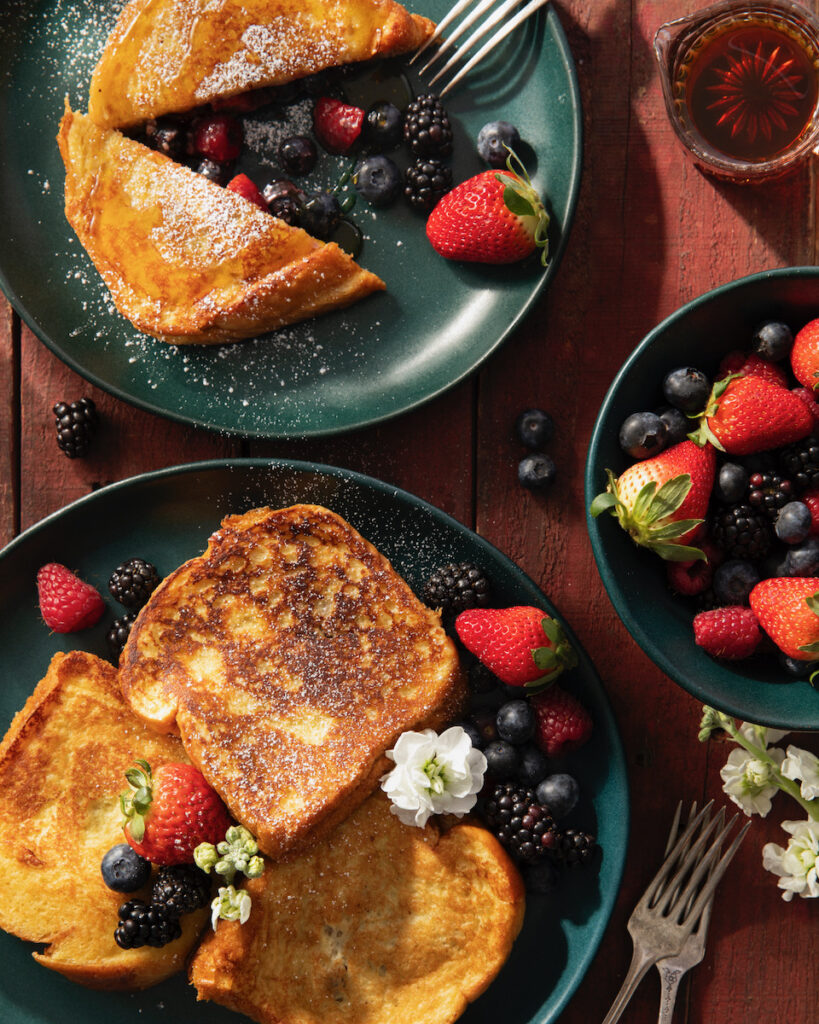
A plate of French toast with berries on a green plate.

Who doesn’t love French toast? This version is a serious morning wake-up call. If you’re familiar with British summer pudding, it may remind you of it, with bread soaking up deeply colored juices. For the best texture, use a somewhat soft bread like brioche or white, rather than a super-crusty country loaf.

Is French Toast Really French?

The short answer: no. “French Toast” actually originated in ancient Rome called “Pan Dulcis.” Some say that the man who popularized French toast was named Joseph French, and christened the dish after himself in 1724. It might as well be the breakfast food with a thousand names, though, given that it’s been called German toast, eggy bread, French-fried bread, gypsy toast, Poor Knights of Windsor, Spanish toast, nun’s toast, and pain perdu or “lost bread.” The “lost bread” moniker comes from the fact that the French used bread that would’ve otherwise been thrown out and gone stale to make French toast out of. Who cares what you call it, though, as long as it’s delicious.

Mixed Berry Stuffed French Toast Recipe

Mixed Berry Stuffed French Toast Ingredients

  • 1 cup mixed berries, any oversize strawberries halved or quartered
  • 2 tsp granulated sugar
  • Unsalted butter
  • Vegetable oil
  • Real maple syrup, warmed
  • Confectioners’ sugar, optional

For the Filling:

  • ¼ lb cream cheese, softened
  • 1 to 2 tbsp granulated sugar
  • 1 tsp vanilla bean paste
  • 1 cup strawberry, raspberry, blackberry, or blueberry preserves
  • 1 cup mixed berries, any oversize strawberries halved or quartered

For the Batter:

  • 1¼ cups whole milk
  • ¼ cup half-and-half or whipping cream, or additional whole milk
  • 3 large eggs
  • 1 tbsp granulated sugar
  • 2 tsp vanilla bean paste
  • Pinch of salt

Mixed Berry Stuffed French Toast Preparation Instructions

For the Filling:

  1. To prepare the filling, mash the cream cheese with 1 tablespoon sugar and the vanilla bean paste.
  2. Mix in the berry preserves well.
  3. Gently stir in the mixed fruit, and add more sugar if the mixture seems too tart. It should be thick and chunky.

For the French Toast:

  1. To prepare the batter, whisk together the milk, cream, eggs, sugar, vanilla bean paste, and salt in a small bowl.
  2. Preheat the oven to 300 degrees.
  3. Butter a baking sheet.
  4. Cut the bread into 8 equal slices, about 1 inch thick.
  5. With a serrated knife, cut a pocket into the side of each piece of bread, carefully slicing into but not through the bread.
  6. Spoon equal portions of the filling into each slice’s pocket.
  7. Dunk the stuffed bread slices into the batter and soak them for several minutes, turning as needed to coat evenly, until saturated but short of falling apart.
  8. While the bread is soaking, combine the berries with the sugar.
  9. Warm 1 tablespoon butter and 1 tablespoon oil together on a griddle or in a large heavy skillet over medium heat.
  10. Briefly cook the French toast in batches until golden brown and lightly crisp, turning once. Place the first slices on the baking sheet and keep them warm in the oven. Continue cooking the remaining slices, adding more butter and oil as needed.
  11. When all of the French toast is ready, top it with an equal spoonful of mixed fruit and juices, and if you wish, dust it with confectioners’ sugar, sprinkling it through a fine strainer. Serve immediately with maple syrup.

Story by Cheryl Alters Jamison / Styling by Anna Franklin / Photography by Dave Bryce

A footer photo with a black background and subscribe info and buttonSubscribe to TABLE Magazine‘s print edition.

Create a free account, or log in.

Gain access to read this content, plus limited free content.

Yes! I would like to receive new content and updates.

Table Magazine wants to know your location.

TABLE Magazine operates regional sites - Knowing your location helps us route you to the appropriate site for the best experience.