Few ingredients tell the story of Sephardic cooking quite like the eggplant. Jews from Spain, Portugal, Turkey, Morocco, and beyond have stewed, stuffed, roasted, and fried it for centuries. This simple recipe from historian Hélène Jawhara Piñer is a sweet one. Slices of eggplant are dredged in flour, fried in olive oil until golden and creamy, and finished with a drizzle of honey.
This recipe comes from Piñer’s 2021 cookbook, Sephardi: Cooking the History. The book traces dishes cooked by Jews across centuries of persecution, when food became a way to hold on to identity. Piñer still eats this version in Andalusia, Spain, where fried eggplant with honey, or berenjenas con miel, is a beloved tapa. At Hanukkah, it’s a fitting way to celebrate the miracle of oil.
Why Is Eggplant Important in Sephardic Cooking?
Eggplant arrived in Spain with Arab agriculture in the medieval period, and Jewish cooks in al-Andalus embraced it. It became so closely tied to Jewish households that, after the expulsion of 1492, eating eggplant could draw suspicion from the Inquisition.
Eggplant dishes are also traditionally eaten to break fasts. Piñer’s research turned up a moving example. In 1646, a prisoner of the Inquisition in Mexico named Juan de León, also known as Salomón Machorro, asked his jailers for two dishes sweetened with honey. He used them to break his fast with a fellow prisoner, Francisco Botello, three days a week. Read more about the history in Eat to Remember with Sephardic Cuisine.
Why Do You Salt Eggplant Before Frying?
Salting draws moisture out of the eggplant, which helps the slices brown instead of steam. It also collapses some of the spongy air pockets inside, so the eggplant soaks up less oil and turns silky rather than greasy. Modern eggplants are rarely bitter, but salting can soften any sharp edge, too. After 20 minutes, you’ll see beads of liquid on the surface. Pat them dry before you dredge the slices.
How Do You Make Sweet Fried Eggplants?
Wash the eggplants and cut them into slices about as thick as a finger. Sprinkle them with salt and let them drain in a colander for 20 minutes, then pat them dry.
Heat the olive oil in a large frying pan over medium-high heat. Coat the slices in flour, tapping off the excess against the edge of the plate rather than shaking them with your fingers. Lay them in the pan without overlapping, lower the heat to medium, and fry for five minutes without moving them. Turn them and fry for five minutes more. Transfer them to a large plate, add a pinch of salt if needed, and drizzle with honey.
Why Is My Fried Eggplant Soggy?
Cold oil is usually to blame. If the oil isn’t hot enough when the slices go in, the eggplant absorbs it like a sponge. Let the oil shimmer before you start, and fry in batches so the pan doesn’t cool down. Leave the slices alone for the full five minutes so they form a crust. Drain them briefly on a rack, and add the honey just before serving.
Can I Bake the Eggplant Instead?
You can, though you’ll lose some of the creamy, crisp contrast that frying gives. Toss the floured slices with a few tablespoons of olive oil and arrange them on a parchment-lined baking sheet. Roast them at 425 degrees for 20 to 25 minutes, flipping halfway, until golden and tender, then drizzle with honey.
How Do I Make Sweet Fried Eggplants Gluten-Free?
Gluten-free: Dredge the slices in rice flour or chickpea flour instead of all-purpose flour. Rice flour makes an especially crisp, delicate crust.
Tips for Success
Choose firm eggplants. Look for glossy skin and a green, fresh stem.
Cut them evenly. Slices of the same thickness cook at the same rate.
Add oil between batches. Eggplant drinks oil, so top up the pan as needed.
Try a darker honey. Buckwheat honey or Spanish miel de caña (cane molasses) adds a deeper, more traditional flavor.
Serve warm. The eggplant is best within an hour of frying.
What Can I Serve With Sweet Fried Eggplants?
Serve them as a meat-free main with rice and a green salad, or as a side with roast chicken or fish. They also make a lovely appetizer alongside olives, almonds, and a glass of sherry.
Also check out these other Sephardic recipes:
Ifseng
Also called sfenğ, this fried pastry is common among Jews and Muslims especially in Morocco and Israel. It is also called esponja (“sponge”) in Spanish, a word derived from the Arabic term sjenğ of the same meaning. The recipe dates back to the thirteenth century, when this and similar dishes were popular in al-Andalus.
Tortitas de Acelga
Piñer’s Tortitas de Acelga recipe combines some of the main ingredients of Sephardic cuisine from Spain: Swiss chard, eggs, garlic, and olive oil. This perfect Passover dish uses chickpea flour.
Makrūt and Neulas Encanonadas
Maqrūt is another type of fried honey pastry typical to Jews and Muslims from Morocco, and this recipe dates back to thirteenth-century al-Andalus. These tasty pastries flavored with honey and dates are now associated with the holidays: Muslims eat maqrūṭ when breaking the fast of Ramadan, and Sephardim of Morocco and France eat them for Rosh Hashana.
Toast with Justin Matase’s Hanukkah 75 Cocktail.
Browse every recipe in our Ultimate Guide to Hanukkah.
Print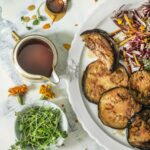
Sweet Fried Eggplants
- Total Time: 50 minutes
- Yield: 4 servings as a side, 2 as a main 1x
- Diet: Vegetarian
Description
Finger-thick eggplant slices dredged in flour, fried in olive oil, and drizzled with honey, a Sephardic dish from Andalusia.
Ingredients
- 2 medium eggplants
- 2 tsp salt, for draining
- ½ cup (100 g) olive oil, plus more as needed
- ½ cup all-purpose flour
- 1 tsp salt, for finishing (optional)
- 2 tbsp (about 40 g) honey
Instructions
- Wash the eggplants and cut into finger-thick slices. Sprinkle 2 teaspoons of salt and drain in a colander for 20 minutes. Pat dry.
- Heat the olive oil in a large frying pan over medium-high heat until it shimmers.
- Coat the slices in flour, tapping off the excess on the edge of a plate. Lay in the pan without overlapping and reduce the heat to medium.
- Fry for 5 minutes without moving. Turn and fry 5 minutes more, until golden. Repeat with the remaining slices, adding oil as needed.
- Transfer to a large plate. Add salt if needed and drizzle with honey.
Notes
Gluten-free: Use rice flour or chickpea flour.
Vegan: Use date syrup or miel de caña in place of honey.
- Prep Time: 10 minutes
- Cook Time: 20 minutes
- Category: Side Dish; Main Course
- Method: Pan-Frying
- Cuisine: Sephardic; Spanish
Nutrition
- Serving Size: ¼ of the recipe
- Calories: 290
About the Recipe Developer
Hélène Jawhara Piñer is a historian specializing in the food of medieval Spain and the Sephardic diaspora. She is the author of Sephardi: Cooking the History and Jews, Food, and Spain, and she recreates historical recipes to show how food helped Jews preserve their identity. Read more in Eat to Remember with Sephardic Cuisine.
About the Chef
Veda Sankaran is a Pittsburgh-area chef, recipe developer, and food stylist whose cooking blends her Indian heritage with the flavors of her Pennsylvania upbringing. She is the founder of Jalsa by Veda, which offers a signature spice blend, cooking classes, and pop-up dinners. See more of her recipes at TABLE.
About the Food Stylist
Keith Recker is editor in chief and co-owner of TABLE Magazine, directing coverage of food and drink, design, fashion, travel, and the arts across its Pittsburgh and New Mexico editions. A color and trend forecaster for clients including Pantone and WGSN, he is the author of three books on color and craft, most recently Deep Color: The Shades That Shape Our Souls. Read Keith’s articles.
About the Photographer
Scott Goldsmith | Photographer. Scott has photographed feature stories for National Geographic, Life, Time, Fortune, People, Politico, Sports Illustrated, Rolling Stone, and U.S. News & World Report. Meet TABLE’s contributors.
Subscribe to TABLE Magazine’s print edition.