Florence is a city that can wear out even its most ardent admirers. By late afternoon on a chilly day just after the New Year, my family of three was footsore and frazzled, having spent hours in long, disorganized lines and crowds that seemed to multiply around every revered masterpiece in nearly every church and museum.
Taking in a Florence Sunset Food and Wine Tour to Escape the Busy Tourists
We had started ambitiously. We stood in long lines for a glimpse of the luminous Fra Angelico works then on display at Palazzo Strozzi. Just after, we abandoned the endless queue at the Duomo to see, instead, Giotto’s frescos at Santa Croce, slipping next door to admire Brunelleschi’s perfectly conceived Cappella dei Pazzi and its Della Robbia sculptures. We were hardly alone at any point, but at least we could move.
Our afternoon plan—to glide gracefully into the totally overcrowded Uffizi with pre-booked tickets—collapsed in an unceremonious rejection at the entrance because we missed our time slot. We salvaged the day with a detour to San Lorenzo and the Medici Chapel, where Michelangelo’s sculptures brood magnificently over the tombs of two powerful princes. It was all glorious, but by late afternoon we were more than ready to leave the bottlenecked heart of Florence behind.
The relaxed, friendly Eating Europe Florence Sunset Food and Wine Tour was exactly what we needed.
Crossing the Arno, Exhaling
The tour focuses on the Oltrarno, the “other side” of the Arno—still central, but more “neighborhoody” in feel than the gridlocked streets around the monumental duomo and Uffizi. Just before the tour’s start time, we arrived at Piazza Santa Croce with a few minutes to spare. We took the chance to duck into the Chiesa di Santo Spirito.
Inside, the calm geometry of Brunelleschi’s architecture—those pietra serena columns, arches, and porticos—felt like a harmonious antidote to our day of crowd management. The proportions are so quietly perfect they lower your blood pressure on sight.
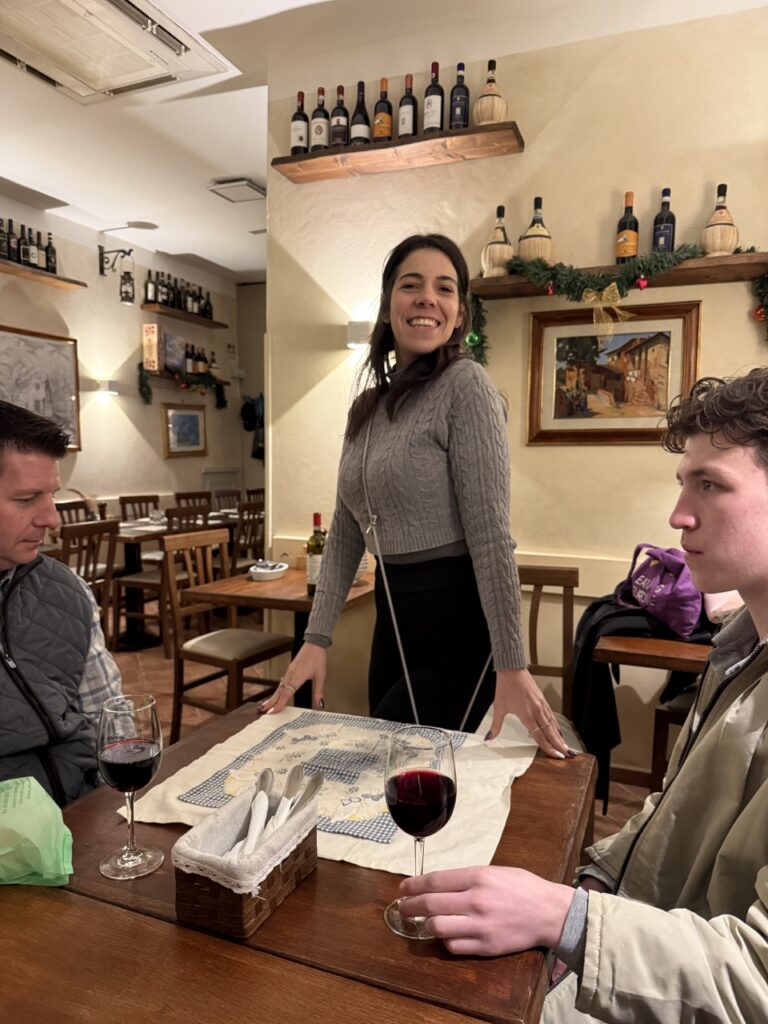
By the time we stepped back into the square, the sky was dimming. Our guide, Ellie, appeared. Warm, lively, and impeccably prepared, she radiated enthusiasm. Within minutes, our group of 10 Americans—strangers until that moment—felt like a small dinner party circulating through six stops in this lovely, mostly residential, part of Florence.
A Wine Window into History
DiVin Boccone, a family-run wine cellar and salumeria, sits behind a feature that’s typically Florentine: a tiny wine window, or buchetta del vino, set into the street-level facade. These stone-framed portals date back to the plague years, when wine merchants handed flasks and coins through the opening to minimize contact—an early form of social distancing. Even today, you can walk up to that same little window and order a glass of wine with almost zero human interaction.
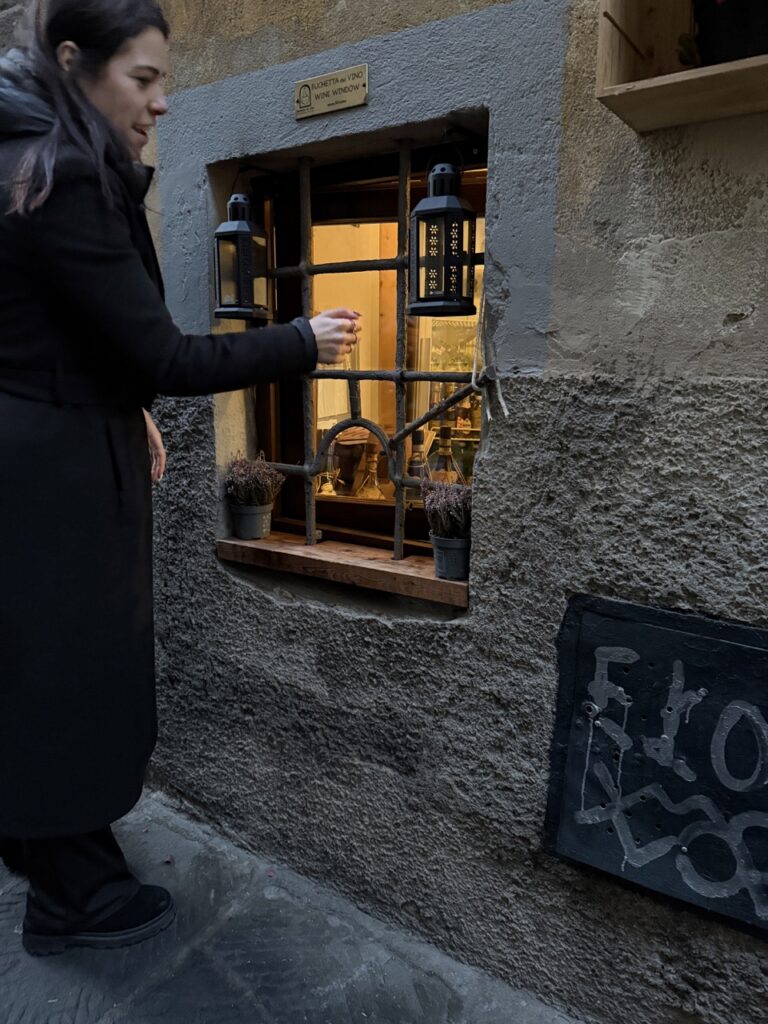
Inside, we descended into a cellar carved out of the earth by nuns in the 12th century. It felt timeless: cool air, stone walls, and rows of bottles resting in the half-light. Waiting for us: individual plates of charcuterie—silky prosciutto, housemade finocchiona (cured sausage scented with fennel), and a goat cheese and fig “tartare”—along with slices of schiacciata, the Florentine cousin of focaccia.
Our wine glasses filled up with Greco di Puglia, a bright and structured white wine that matched the food beautifully, lifting the richness of the meats and the sweetness of the figs. We no longer felt like tourists, but rather like guests at a neighborhood table.
We Met the “King of Cheese”
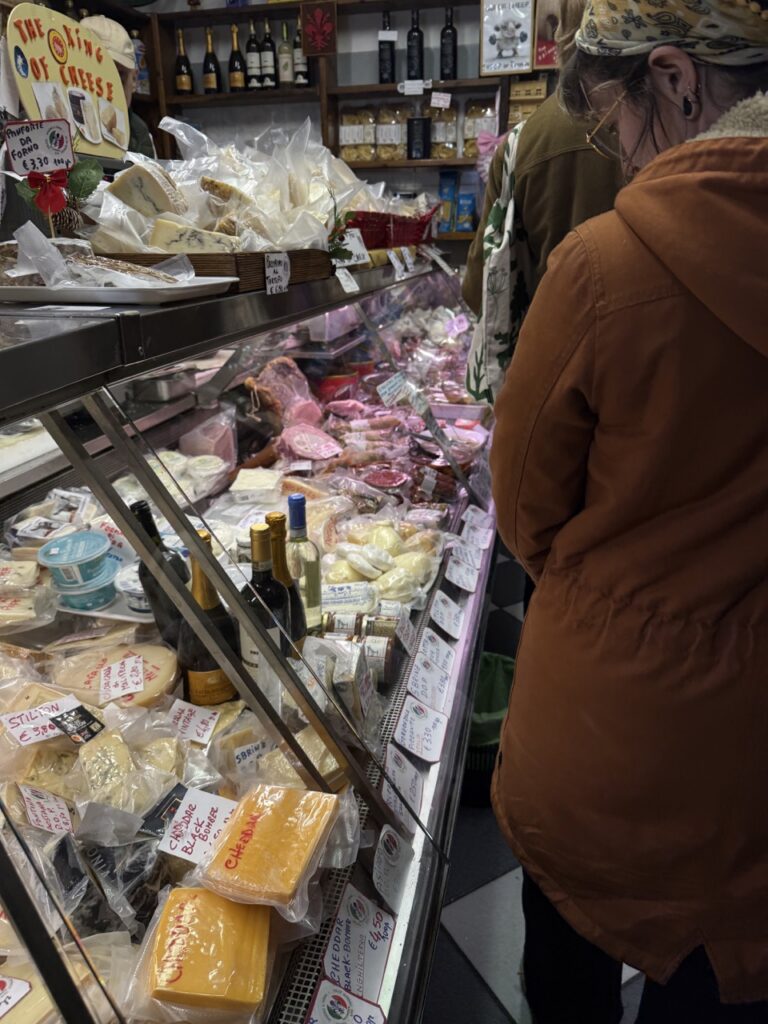
Our second stop was a few minutes’ walk away at Sandro and Ivana’s cheese shop, where cheese is not merely sold—it is presided over. Sandro introduced himself as the “King of Cheese,” and then proved it with a crown, donned with sincerity and considerable charm. He and Ivana greeted Ellie like an old friend, and by extension welcomed all of us as if we were regulars.
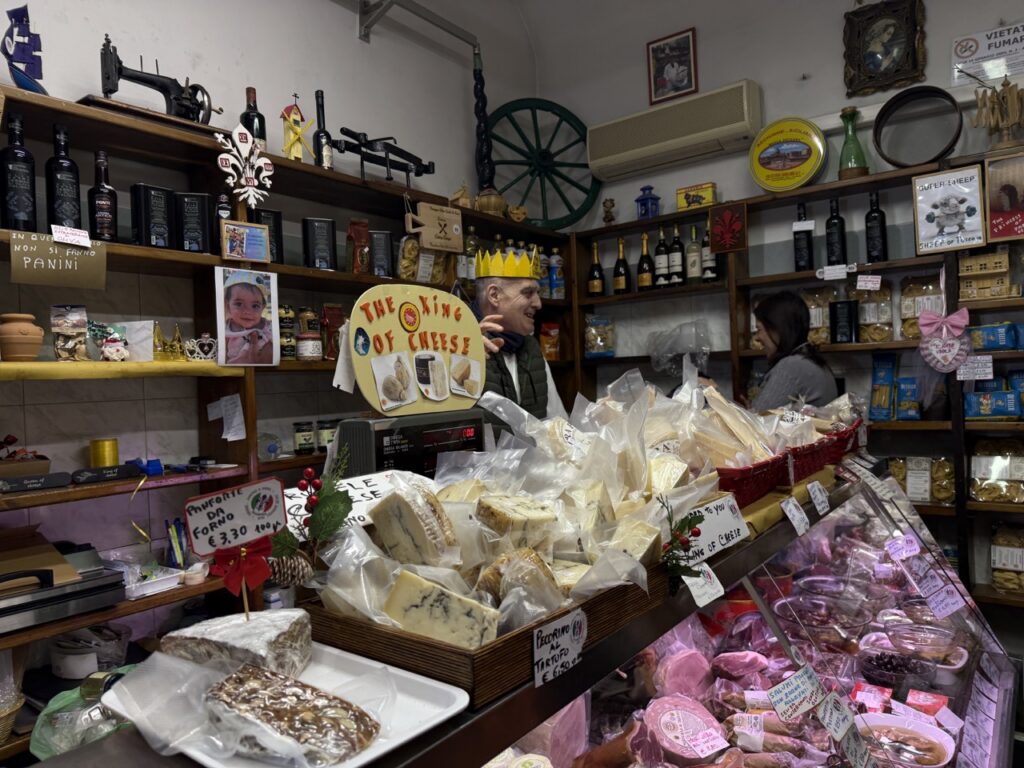
The tasting was simple but brilliantly instructive:
- A 36-month DOP Parmigiano Reggiano, whose crystals, salinity, and long, nutty finish reminded us why it’s truly Italy’s “king of cheeses.”
- A one-month-old Pecorino Maremmano, younger, softer, milder, and almost creamy in its delicacy.
Side by side, they told a story of time, salinity, aroma, and texture—with just two cheeses, you understand something essential about Italian dairy culture. Many in our group bought wedges to take home.
Ribollita and a Proper Negroni
Just a few doors away, at Fiaschetteria Fantappié, the evening took a decidedly Tuscan turn.
We started with a sip of Vermentino from Maremma, bright with green apple notes and a clean, saline edge. It cut straight through the chill in the air. Then came a Rosso di Montepulciano, made from Sangiovese Gentile—just a year old, and fresh, fruity, and open on the palate.
They paired both with ribollita, a deeply traditional Tuscan dish and ideal winter comfort food. Yes, it’s “just” a vegetable-and-bean stew, “reboiled” with stale bread folded into it. But you cannot deny its depth of flavor. It is the definition of restorative—thick, hearty, a bit rustic, infused with the long, slow cooking of a cold-weather kitchen. On a damp Florentine night, it warmed us all to the core.
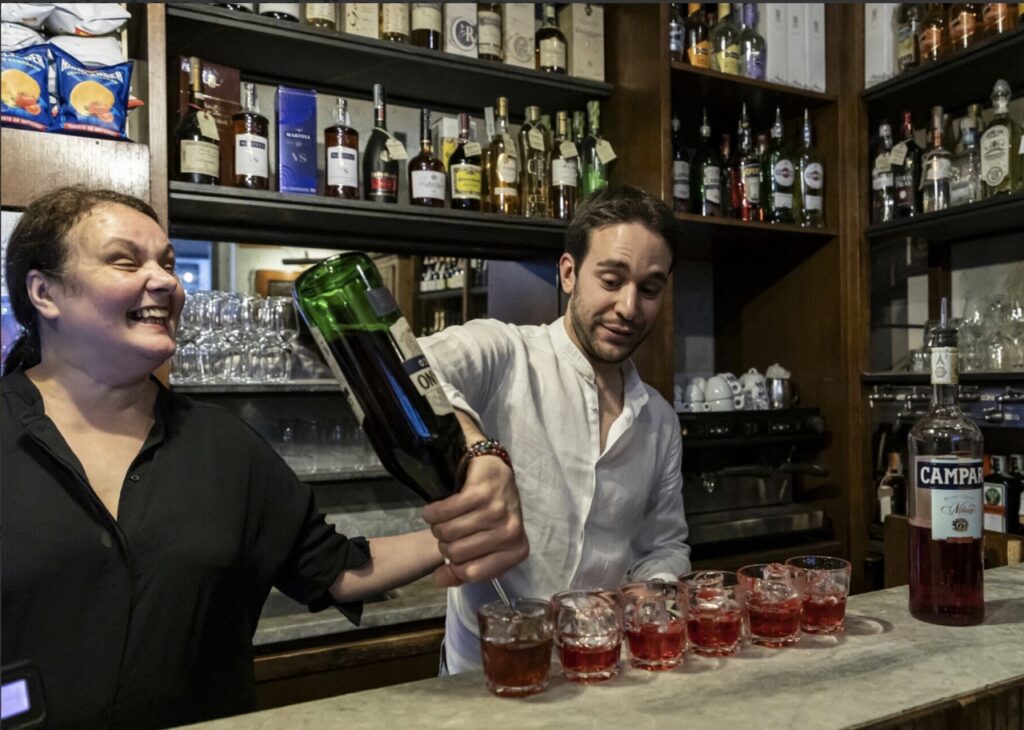
Then Comes a Bonus: Negronis.
The team at Fiaschetteria Fantappié mixed up a batch of their signature Negroni while Ellie told the origin story of Count Camillo Negroni and his namesake cocktail. He always insisted on the correct formula:
- Equal parts gin, Campari, and red vermouth
- Garnished with orange
- Finished with the fragrant oils from a freshly peeled strip of orange zest
For contrast, we also tried a Negroni Sbagliato, in which prosecco replaces gin. Its lighter, sparkling personality was charming, but the classic Negroni—with its precise balance of bitter, sweet, and botanical—is impossible to beat.
Light-as-Air Gnudi and Sun-Soaked Sangiovese
At Trattoria da Ginone, the atmosphere shifted from wine bar to old-school trattoria. Ellie warned us in hushed tones about the formidable grandmother in the kitchen—a real culinary matriarch. However, a very friendly chef named Marco emerged, pan in hand, to cook our dish tableside: spinach and ricotta gnudi. These are, essentially, the filling of ravioli without the pasta—delicate dumplings of ricotta and spinach, rolled swiftly and lightly in flour, then sautéed gently in butter and sage.
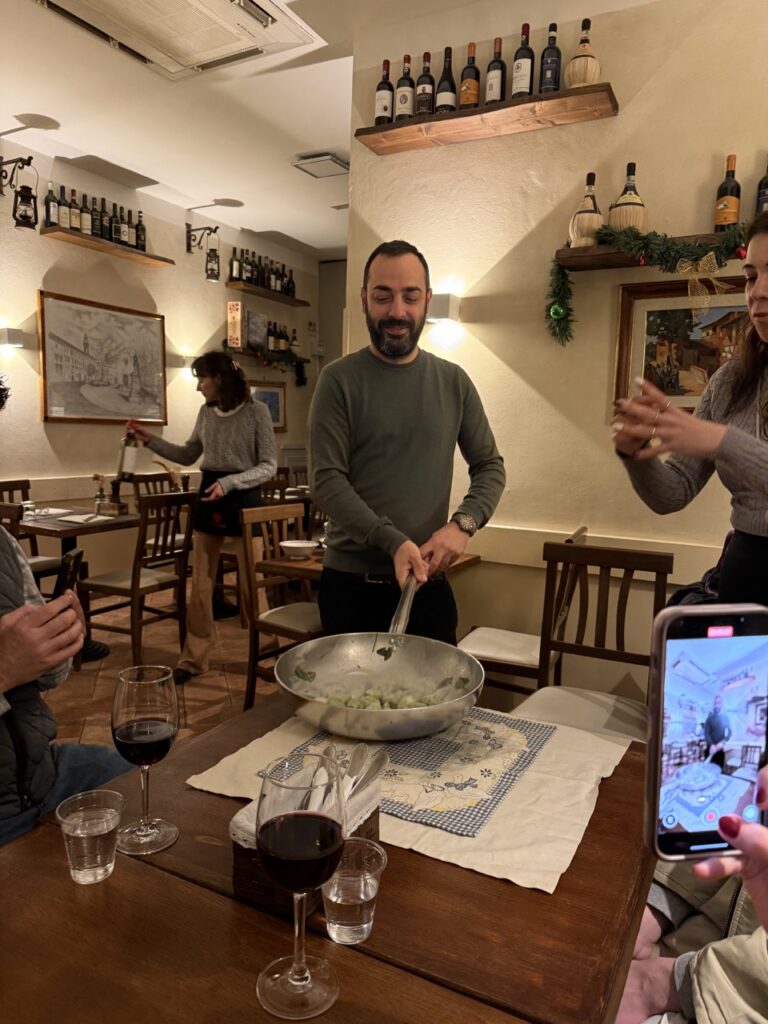
They arrived on our plates like little clouds: soft, tender, and barely held together, coated in sage-infused butter and finished with grated Parmigiano. Utterly delicious.
To drink, a Chianti DOCG made from Sangiovese grapes grown under the hot Tuscan sun without irrigation. The wine showed fig and raisin notes, with the warm, full body that makes Sangiovese so satisfying when served alongside rich, buttery dishes. It was another place we bookmarked for a long, unhurried return visit.
Peposo and a Big Tuscan Red
By this point, one might imagine we’d reached our limit. Assolutamente no.
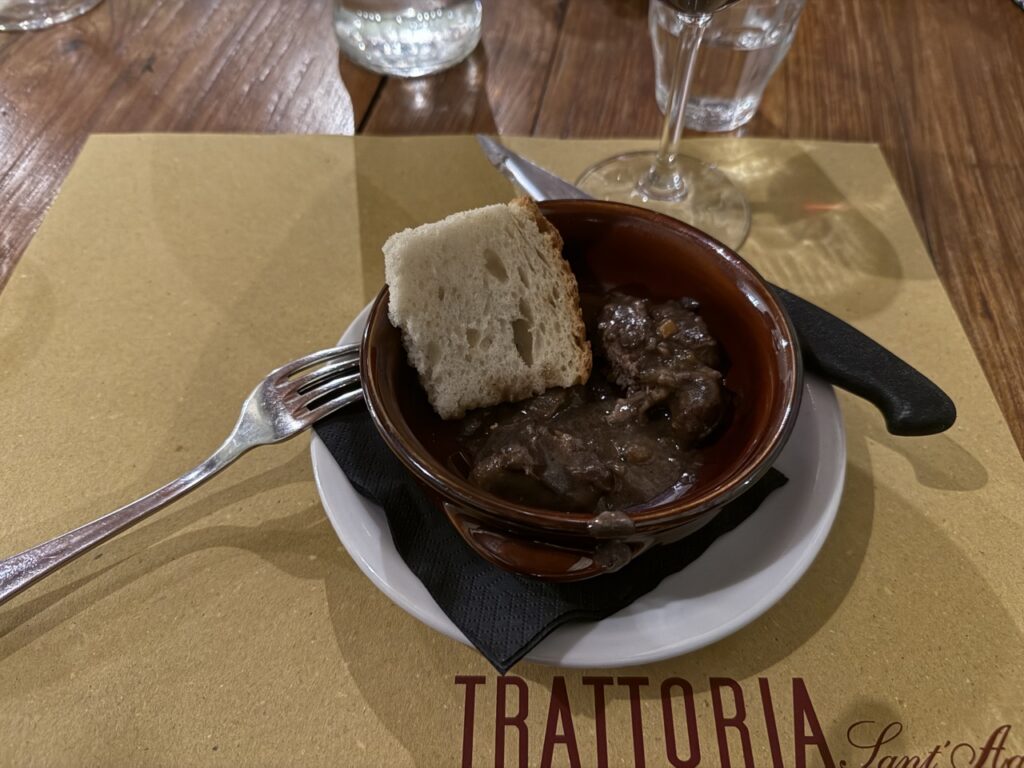
In the large back room of Trattoria Sant’Agostino, we gathered over bowls of peposo—a Tuscan classic said to have originated in nearby Impruneta, the town known for its terracotta. Traditionally, peposo is said to have fortified the brickmakers who fired tiles for the dome Brunelleschi designed for the Duomo.
The dish is spare in ingredients but generous in flavor: beef shank or chuck slowly braised all day in red wine with garlic and lots of cracked black pepper. What arrives at table is dark, silky, and aromatic, the meat yielding to the slightest nudge of a fork.
The wine pairing, a Ciliegiolo, was as memorable as the stew. Big-fruited and open, it hinted at cherries and red berries, with a subtle leather aroma that gave it complexity. Together, the peposo and the wine felt like a master class in wintery Tuscan robustness—hearty, bold, and memorable.
A Sweet (and Storied) Finale
After five stops, logic might suggest that dessert would be unnecessary. Ma no.
Ellie led us back toward the river, to Gelateria Buontalenti near the Ponte Vecchio, just off historic Via Guicciardini. There, among the gleaming pans of gelato, she told us the story of Catherine de’ Medici, who is often credited with bringing Florentine gelato to France when she married Henry II.
Gelato, as it turned out, did nothing to prevent Henry falling madly in love with Diane de Poitiers, but Catherine outlived him by three decades. It’s tempting, despite all medical evidence, to imagine that gelato may have contributed to her longevity. A spoonful of Buontalenti’s cool, creamy flavors certainly made a convincing argument.
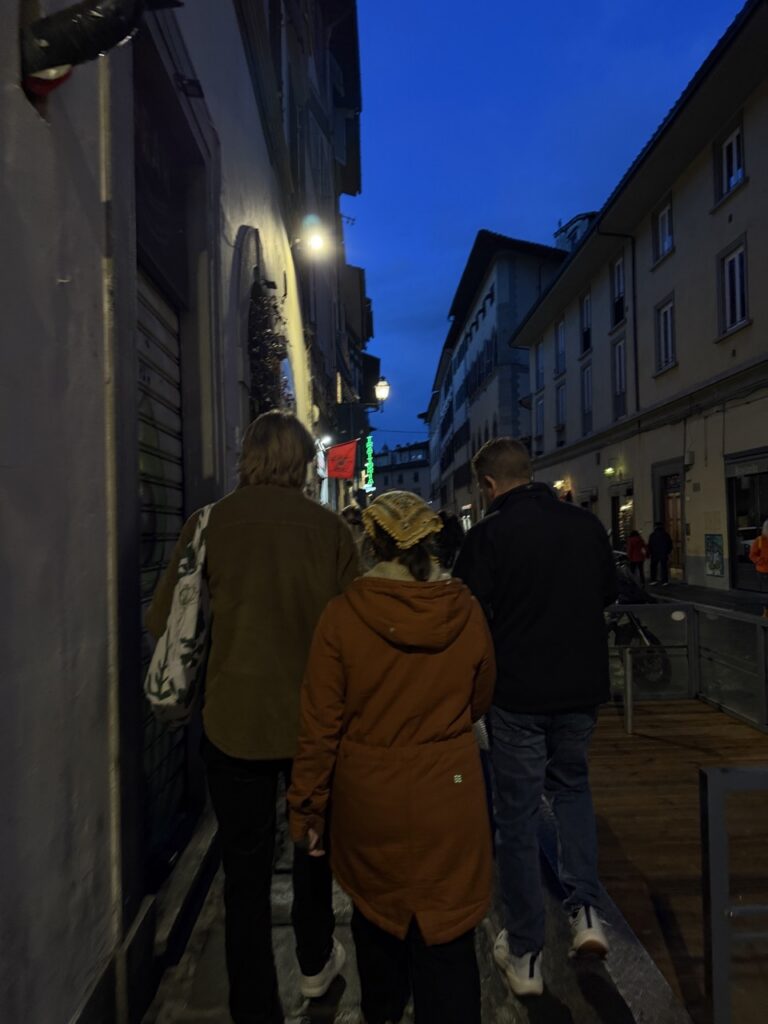
It was a simple ending and a perfect one: gelato in hand, the night settling over Florence, and the slightest hint of rain beginning to fall.
Why You Should Try an Eating Europe Florence Sunset Tour
We didn’t linger long in the drizzle to say our goodbyes, but we remember our guide and our small group with fondness. The Eating Europe Florence Sunset Food and Wine Tour did more than feed us well—though it did that, superbly. It reframed the city.
After a day defined by crowds and missed entry times, the tour gave us an entirely different Florence:
- A Florence of family-run wine cellars and centuries-old cellars carved by nuns.
- Of cheesemongers who wear crowns and treat DOP labels like living documents
- Of trattorie where gnudi are still sautéed in butter and sage at the table, and stews simmer all day in red wine.
- Of neighborhood bars where a Negroni is not a trend, but a tradition.
On our next trip to Italy, we plan to book with Eating Europe again—whether in Florence or another city. For travelers who crave not just the sights but the flavors and stories of a place, this kind of curated, neighborhood-focused, small-group tour is an invaluable relief from museum lines and jam-packed must-see landmarks.
For us, Florence is still about Brunelleschi’s domes, Giotto’s frescos, and Michelangelo’s marbles. But now it is also about ribollita thickened with yesterday’s bread, Sangiovese ripened under a dry Tuscan sun, and gelato melting just a little too fast as the rain begins to fall on the stones of Oltrarno.
If your next journey to Florence leaves you hungry—for context, for connection, for something more than another crowded piazza—cross the Arno at sunset and let the city feed you. We wholeheartedly recommend that you let Eating Europe lead the way how.
Story by Keith Recker
Subscribe to TABLE Magazine’s print edition.