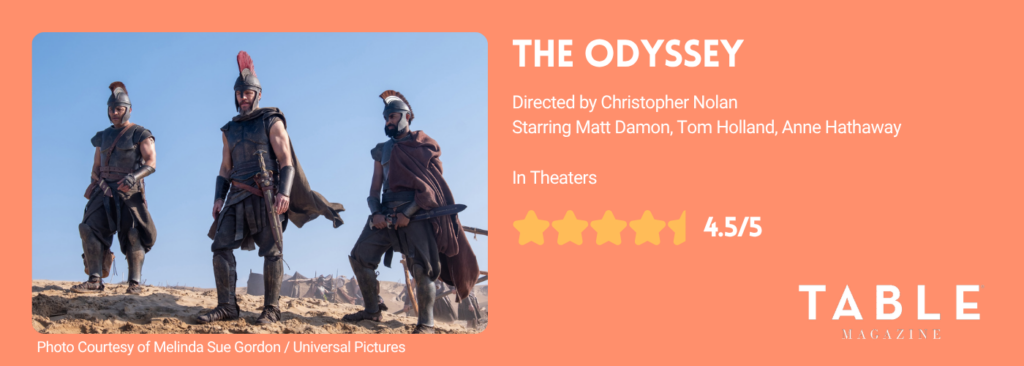
The wait for Christopher Nolan’s adaptation of The Odyssey has been lengthy. The film was announced nearly two years ago; tickets went on sale a full year in advance. And, if you’ve been waiting for any major film adaptation of Homer’s epic poem — Nolan’s or otherwise … well, you’ve been waiting since the dawn of cinema. While various Italian producers have taken a stab at The Odyssey, Nolan’s is the first Hollywood treatment of the tale.
The Odyssey by Christopher Nolan Conjures Memory and Myth
In keeping with the oral tradition that has preserved Homer’s tale for millennia, Nolan’s The Odyssey shares most of its story in flashbacks. Most are from Odysseus (Matt Damon) himself, stranded in a haze of confused remembrance on the island Ogygia; the nymph Calypso (Charlize Theron) has for years been feeding him lotus petals to make him forget his past.
As the memories he can’t quite grasp begin to weigh on him, though, she allows him to recall the tragic journey he’s been on for more than a decade. With these flashbacks comes guilt — first for the death of his compatriots; then for the unintentional abandonment of his wife, Penelope (Anne Hathaway), and son, Telemachus (Tom Holland); and ultimately for the toll of war.
That would be the Trojan War, and we witness it through another flashback, in the memory of Odysseus’ fellow soldier, Menelaus (Jon Bernthal). He recounts the tale of the Trojan Horse to Telemachus, who has gone on his own quest to find his errant father, lest an army of drunken suitors destroy his home in their dogged pursuit of Penelope’s hand.
Gods and Monsters in the Theater
The Greek gods are invoked constantly in this adaptation — Nolan also wrote the screenplay — but only one, Athena (Zendaya), makes her presence known. The rest are alternately cursed, blamed, praised and bemoaned. It seems deliberate that Nolan allows his characters to use the gods as justification for whatever deeds (or misdeeds) they have in mind; this version of the tale does not regard humans as playthings for fate, but rather as destructive, often animalistic forces ravaging the world around them.
While the gods may not be all that present, many other creatures certainly are. The first act of the film hangs on a brutal, often terrifying encounter with the fearsome Cyclops (Bill Irwin); we’ll later see men turned into beasts at the hands of Circe (Samantha Morton), narrowly avoid the call of the sirens and sail into the maw of the tentacled Scylla.
One could read into the reality of monsters and the relative absence of gods in Nolan’s adaptation (which is largely based on the recent literary adaptation by Emily Wilson). Perhaps he’s saying that cosmic forces have little to do with our fate, while tangible things we don’t understand do. The chief villain, certainly, is war itself; there are no battlefield heroes in The Odyssey, no matter what the songs say.
Christopher Nolan’s The Odyssey is a Captivating, Hypnotic Journey
As Odysseus is trapped by Calypso’s potions, the audience is ensnared by a haze of story and atmosphere. Nolan and his team — notably composer Ludwig Göransson, who crafts an uncanny and hypnotic score, and cinematographer Hoyte van Hoytema — have created an experience that feels like a journey of its own. Watching The Odyssey feels like more than a commitment of three hours’ time; somehow, the weight of Odysseus’ years in exile comes through the screen and settles in the mind of the viewer.
As was the case with Nolan’s Oscar-winning Oppenheimer, this is weighty, often troubling stuff. Many of the typical hallmarks of blockbuster cinema are deliberately absent here; wonder has been sacrificed to Athena, replaced with pervasive dread. It’s an odd and deeply affecting experience — yet one made with remarkable skill and, perhaps, a bit of magic. Or at least prophecy.
Story by Sean Collier
Photos Courtesy of Melinda Sue Gordon / Universal Pictures
Subscribe to TABLE Magazine‘s print edition.